


The allies decide
In February 1945, at Yalta – during the second conference of the so-called “Big Three” (Churchill, Roosevelt, and Stalin) – many key decisions were made regarding the future course of World War II, but above all concerning the post-war order in Europe and the world. One of these was the Soviet leader’s pledge to take action against Japan approximately three months after the conclusion of the war against Germany. The opportunity to carry out these plans arose quickly: Berlin surrendered in May 1945, followed immediately by the entire Reich. For the victors in Europe, the time had come to turn their attention to Asia.
The land… of the setting sun
Since December 1941, The Pacific became a fighting arena between Japan and USA, supported by the British, alongside with the dominions and colonies as well as other Allied nations. Every following battle brought immense loses for both sides. For the American Army and its allies, an additional challenge was the tropical diseases that repeatedly claimed an even heavier toll than the fighting itself.
The bloodiest battle took place on Okinawa and lasted from 1 April to 25 June 1945. As a result of the fighting and disease, approximately 12,000 Americans died, while around 40,000 were wounded. Japanese losses reached approximately 130,000. After conquering Okinawa, the US Army planned amphibious landings on further Japanese islands, leading up to the anticipated capture of Tokyo in the spring of 1946. However, these plans were never achieved as the Americans decided to use a weapon the world had never seen before. On 6th and 9th of August 1945, they dropped two atomic bombs on Hiroshima and Nagasaki, which forced the Japanese to capitulate. The signing of the surrender took place not earlier than 2nd of September. During the three weeks separating these events, another strategic player entered the game in the Far East: the Soviet Union.
Past Years
Conflicts and struggles between Tokyo and St. Petersburg – or Moscow – were nothing new. Following Japan’s “opening” to the world in 1854, Tokyo emerged from its long-standing international isolation. This led to an intensification of both diplomatic and military activity. The Russo-Japanese War broke out in 1904; it was expected to be an easy victory for Russia that would strengthen its position in the Far East. However, achieving victory proved to be a formidable challenge, and it was Japan that ultimately prevailed. As a result, Japan secured territories such as the Kwantung Leased Territory (including Port Arthur) and the southern part of Sakhalin. The blow dealt by Tokyo was not forgotten in either Tsarist Russia or the Soviet Union.
From 1932 onwards, the Japanese began to show increasing interest in the Soviet Far East. This was driven by Tokyo’s establishment of the puppet state of Manchukuo in Manchuria, which shared a border with the USSR stretching over 4,000 kilometres. From that point on, frequent border skirmishes occurred between the forces of both sides. Hostilities escalated in the summer of 1938, when the Battle of Lake Khasan led the Japanese to believe the Red Army was weak. Yet, a year later, it was the Japanese – not the Soviets – who suffered a crushing defeat at the Battle of Khalkhin Gol. The outcome of this clash determined the future course of Japanese conquest plans. An armistice was signed on September 15, 1939, and took effect the following day. Discouraged from expanding in the direction of the Soviet Union, the Japanese soon shifted their focus to Southeast Asia.
INTERESTING FACT
The course of military operations in the Far East during August and September 1939 was one of the factors that delayed the Soviet Union’s aggression against Poland. In addition to assessing the likely reactions of Great Britain and France to a German attack on Poland, Stalin sought to avoid a war on two fronts. Consequently, the signing of a ceasefire with Japan was a pivotal moment. Once the situation in Asia had been stabilized, Stalin immediately ordered preparations to begin for the invasion of the Polish Republic. The Red Army launched its attack on the night of September 17, 1939.
The next step was the signing of a non-aggression pact between Tokyo and Moscow on April 13, 1941; it was intended to remain in effect for five years. However, on June 22, the Soviet Union was attacked by Germany. As an ally of Berlin, Japan began considering renouncing the pact and attacking Siberia. Ultimately, Tokyo abandoned this plan and chose the USA as its primary adversary. This decision determined the subsequent course of the war. The Soviets gained the opportunity to redeploy some of their divisions from Siberia to the Moscow front, while the United States officially entered World War II in December, following the Japanese attack on Pearl Harbor. As for the Soviet–Japanese peace, it remained unbroken until 1945.
The Soviet Union is reclaiming former territories
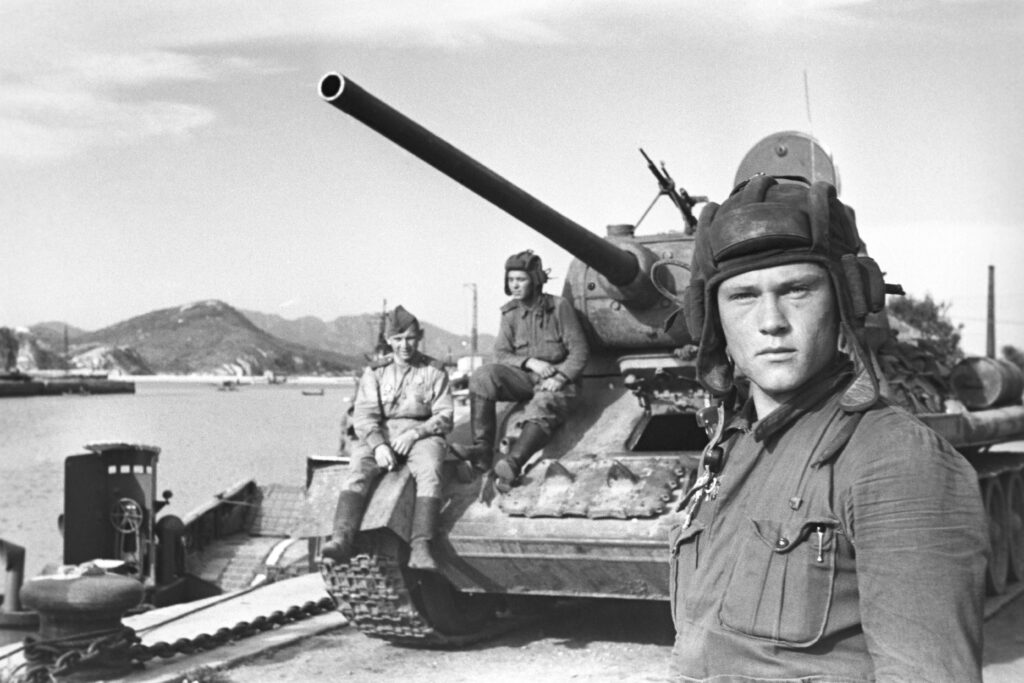
On April 5, 1945, the Soviets renounced the pact signed four years earlier, and on August 8, Vyacheslav Molotov informed the Japanese ambassador of the declaration of war, which was to begin the following day. Just after midnight (Vladivostok time) on August 9, the Red Army launched its final offensive of World War II. Its objective was to capture Manchuria, Korea (the northern part up to the 38th parallel), Sakhalin, and the Kuril Islands. All these objectives were achieved by the end of the month; the capture of the Kuril Islands was announced on August 31, thereby concluding military operations.
On September 2, 1945, the Japanese signed the instrument of surrender. World War II came to an end. These three weeks of fighting had resulted in the deaths of 12,000 Soviet soldiers, with another 24,000 wounded. Figures regarding Japanese casualties vary; Japanese estimates place the death toll at 21,000 soldiers, whereas Soviet estimates cite over 80,000, with an additional 600,000 taken prisoner. For the Soviets, however, territorial gains were paramount. The Kuril Islands and Sakhalin were incorporated into the Soviet Union. Furthermore, the northern part of Korea came under Soviet administration.
Despite the 81 years that have passed since those events, no peace treaty has yet been signed between Moscow and Tokyo. The Kuril Islands – referred to by the Japanese as the Northern Territories – remain a disputed area. Japan considers them an integral part of its territory and has no intention of renouncing its claim to them.
Piotr Bosko
Translation from Polish by Katarzyna Remża