

Aliaksandr Smalanchuk
The study of the idea of krajowość* and the activities of its proponents – the krajowcy – is, in essence, a discussion of the confrontation between tolerance and xenophobia, and between openness and ethnocentrism. In the early 20th century, krajowość represented a search for dialogue and coexistence among nations – a story of idealists striving to hold back the tide of time that would soon bring the catastrophic violence and wars of the 20th century. One such figure was the politician, scholar, lawyer, and journalist Michał Römer.
Krajowość as an Idea of the Lithuanian Poles
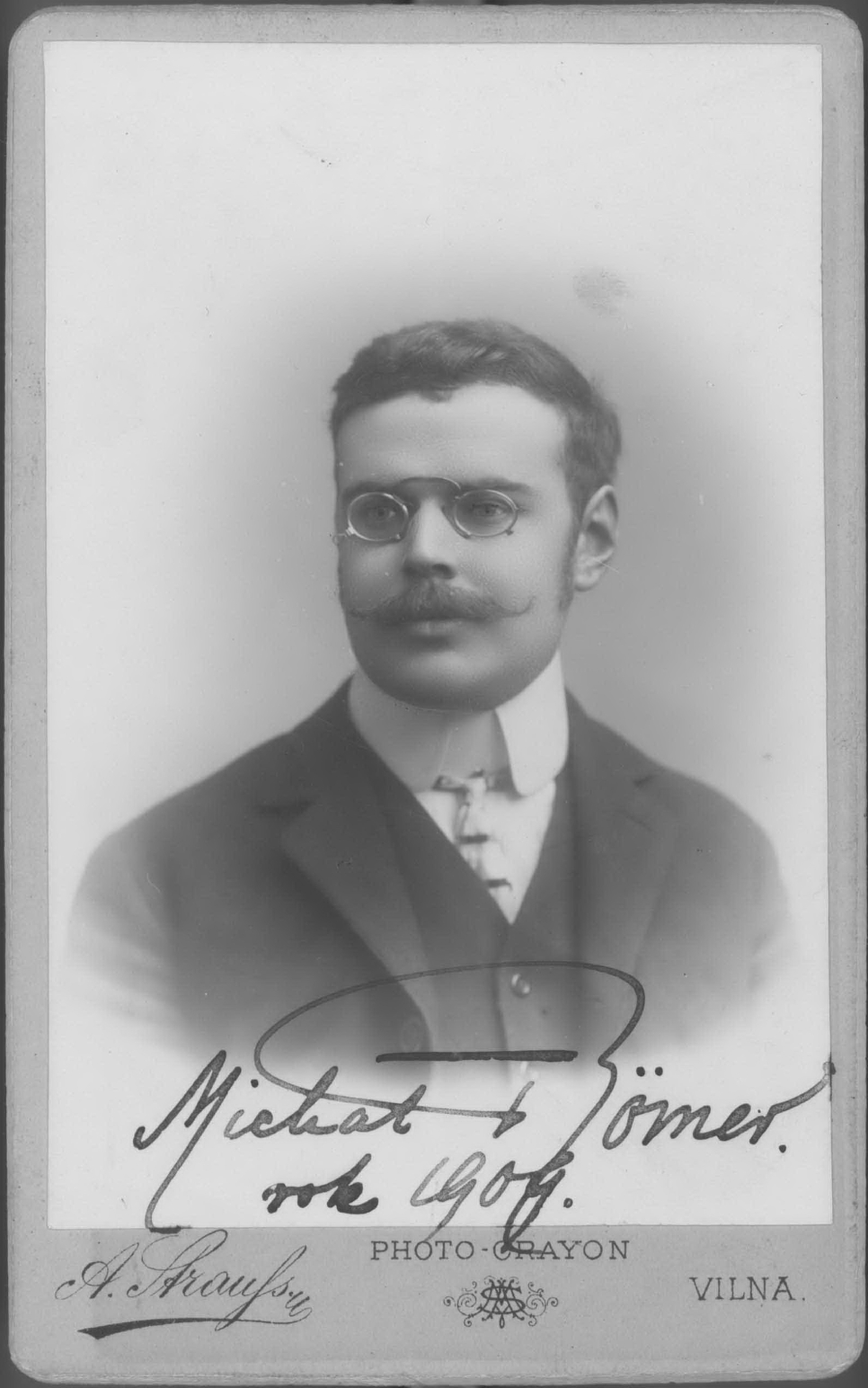
The krajowa idea – commonly interpreted as a form of political (civic) nationhood – was articulated in Belarus and Lithuania at the beginning of the 20th century. The krajowcy maintained that all indigenous inhabitants of historic Lithuania – regardless of their ethno-cultural orientation or social background – belonged to a single nation. Some referred to it as the ‘nation of Lithuanians’, while others described it as a ‘krajowy (territorial) nation’. Lithuanians, Belarusians, Poles, and at times Jews were all considered part of the indigenous population. The principal criterion of national belonging was loyalty to historic Lithuania, understood as a distinct and original region, separate from both Russia and Poland. Any patriot of historic Lithuania could thus become a ‘citizen of the Kraj’. The aim of the krajowcy was to democratise the concept of ‘citizenship’, which in the period of the Grand Duchy of Lithuania had been reserved exclusively for members of the social elite.
Krajowość emerged among the nobility of historic Lithuania, who combined an attachment to Polish culture with a sense of Lithuania as their homeland. In documents from the second half of the 19th century, the term ‘Polish-Lithuanian’ (Polak-Litwin) was fairly widespread in the Catholic regions of the former Grand Duchy of Lithuania. By the early 20th century, however, the term ‘Lithuanian Poles’ (Polacy litewscy) more accurately reflected the identity of broader circles within the local Polish community, denoting a particular type of Pole. This term was employed in his scholarly work by one of the principal ideologues of krajowość, Michał Römer. In his unfinished autobiography, recalling his childhood, he wrote:
‘At that time, I did not yet understand that my skin was different – neither purely Polish nor purely Lithuanian, but uniquely composite, bearing the marks of both Polishness and Lithuanianess – the old skin of Adam Mickiewicz, a singular creation of the history of our homeland; a skin in which the soul, too, is distinct – neither Lithuanian nor Polish. I did not yet realise that I would be untruthful in calling myself solely a Lithuanian, just as I would be untruthful in calling myself solely a Pole. I had not yet become aware that the truth of my identity lay in what I felt as a child and as a young person aged fourteen to eighteen, when I did not distinguish within myself between Pole and Lithuanian. I cherished and valued both names, yet felt particular sympathy for the Lithuanian land and its people; and when I dreamt and wrote poetry, like Adam Mickiewicz, I invoked not Poland but Lithuania as my homeland […]. At that time, I did not yet understand that our – those of us known as Lithuanian Poles – drama, or at least one of the elements of that drama, lay in the fact that we have no proper name; that our soul is a synthesis of two distinct national souls; that when these two souls come into conflict, it is far more difficult for us than for others to remain truthful and not to falsify ourselves. We use a name (“Poles”) which does not correspond to our particular essence and does not define the deepest foundations of our psyche and character, which derive from the character and psychology of the people of Lithuania, from the deepest roots of the local ethnic formation (Lithuanians and Belarusians). We are neither Lithuanians nor Belarusians, yet we are not Poles either.’
The distinction between Lithuanian Poles and the inhabitants of the Crown rested on an awareness of separate political interests, as well as on a different historical memory, centred on the past of the Grand Duchy of Lithuania. The former Duchy was regarded by the krajowcy as a historical entity (subject/agent) which they sought to transform into an actor of contemporary politics. Affirming the unity of the historical fate of all the peoples of this former state, they considered it essential to preserve the territorial integrity of the lands of the former Grand Duchy of Lithuania.
The Beginnings of the Biography
Michał Römer was born on 17 May 1880 at the Bohdaniszki estate (Bagdoniškis), on the Lithuanian–Latvian border, into a family of Lithuanian Poles. His father, Michał Kazimierz Römer, considered himself Polish and did not feel a strong attachment to either historic or ethnographic Lithuania. The Polish identity of his mother and her family was of a markedly different character, which had a profound influence on their son. Research by the Polish historian Zbigniew Solak has shown that, for his mother Konstancja of the Tukałł family, the traditions of historic Lithuania were of great importance. As mentioned earlier, in his unfinished autobiography Römer recalled his grandmother, Zuzanna Tukałłowa (from the Wilejka district), and her conviction that, by virtue of blood ties and nationality, her family belonged to a ‘distinct Ruthenian community’. Römer wrote that a similar sense of identity was fairly widespread among the landed gentry of the region, who saw themselves not as an alien element but as leaders of the local community, in whose name their ancestors – and they themselves – had shaped the history of the Belarusian-Lithuanian lands as its citizens. Polishness manifested itself primarily in language and in a sense of political unity with Poland.
Michał Römer left his family home at a relatively early age. He first attended the First Boys’ Gymnasium in Vilnius, and subsequently continued his education for ten years in St Petersburg. In 1901, he obtained a First-Class Diploma from the Imperial School of Jurisprudence, which offered promising prospects for an administrative career in St Petersburg. Römer, however, chose to continue his studies. In 1902, he enrolled in the Faculty of Philosophy at the Jagiellonian University, but soon left to pursue further studies in Paris.
In the French capital, Römer combined his academic work with social and political activity. Initially, this involved participation in the Polish youth organisation ‘Spójnia’ and the Union of Progressive Polish Youth, both of which were influenced by the Polish Socialist Party. At the same time, he maintained contacts with representatives of the older generation of the Polish-Lithuanian diaspora in Paris. Römer was a frequent guest at the home of Dr Henryk Gierszyński, where discussions centred on Polish independence, alongside recognition of the right to emancipation of all the nations of the former Polish–Lithuanian Commonwealth. An important figure in shaping the views of the future krajowiec was the Lithuanian student Juozas Petrulis. In his later autobiography, Römer emphasised Petrulis’s significant influence on his understanding of the processes of Lithuanian national revival and on his own development as an advocate of krajowość. Petrulis appealed to civic sentiment, calling for agreement and cooperation among all citizens of Lithuania, regardless of culture, language, or nationality. It was he who proposed the use of the concept of citizenship in place of that of nationhood.
This position had a strong influence on Römer, who collaborated with Juozas Petrulis and assisted him in establishing the student association ‘Lithuania’. In May 1905, at a meeting of the association, he delivered a paper entitled ‘Ethnographic and Cultural Relations in Lithuania’. In 1906, a revised version was published in the Kraków journal ‘Krytyka’. This was Römer’s first major publication, marking the emergence of a perceptive analyst of both the Lithuanian national movement and Polish–Lithuanian relations. In July 1905, he returned for the summer to his family estate in Bohdaniszki and never went back to Paris. Römer was deeply engaged by the transformations taking place in Russia, which, under the impact of the Russian Revolution of 1905, embarked on the path towards constitutional monarchy. In Lithuania, the Polish-language press revived, and social and political life intensified. The former Paris student began, for the first time, to consider the possibility of translating the concept of krajowa citizenship into political practice. As a result, the daily newspaper ‘Gazeta Wileńska’ began to appear, becoming a centre for the dissemination and promotion of the national idea in its democratic form.
The Emergence of the Krajowiec
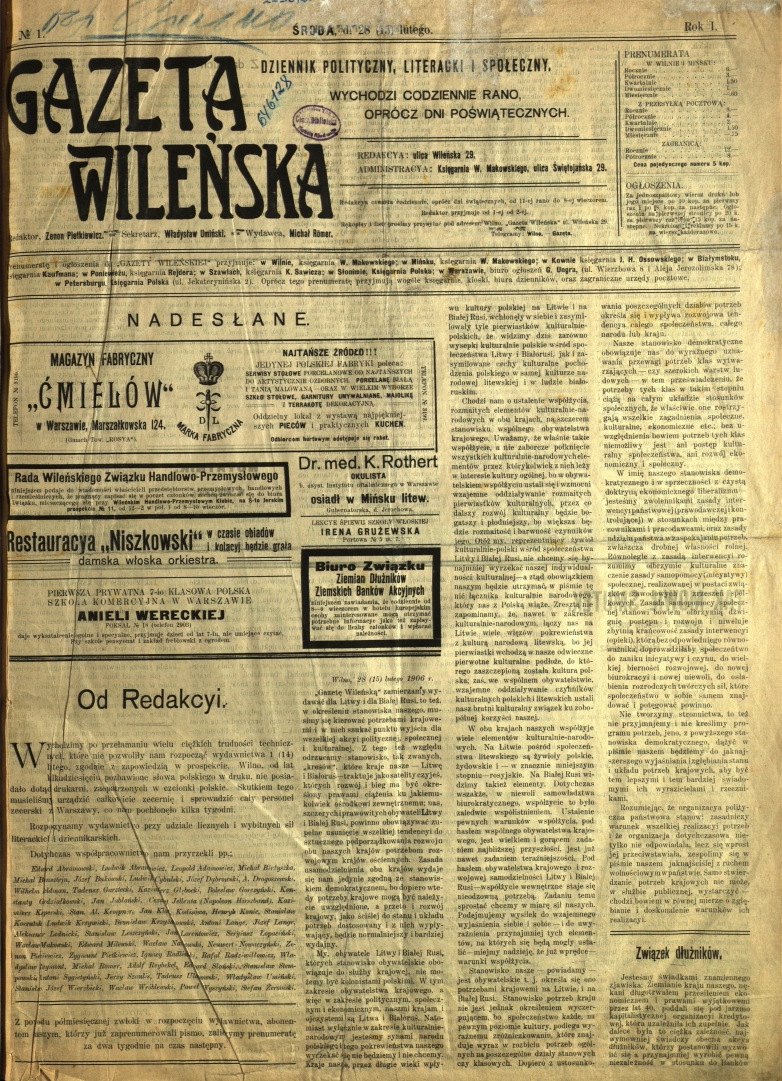
The first issue of ‘Gazeta Wileńska’ appeared in February 1906. In the opening editorial, Michał Römer wrote that: ‘In defining our position, we must be guided by the needs of the Kraj and seek in them the point of departure for all political, social, and cultural activity. For this reason, we reject the standpoint of the so-called “borderlands”, which treats our lands – Lithuania and Belarus – as satellites of others.’ […] We, the citizens of Lithuania and Belarus, whose civic position binds us to service to the Kraj, cannot be Polish colonists. Within the sphere of krajowa citizenship – that is, in political, social, and economic terms – our homelands are Lithuania and Belarus. Yet in the cultural and national sphere, we are sons of the Polish nation, and we shall neither renounce nor wish to renounce this kinship. […] Our aim is to establish coexistence among the various cultural and national elements in both countries (Lithuania and Belarus – A.S.) on the sincere basis of a shared krajowa citizenship.’
‘Gazeta Wileńska’ became a centre for the promotion of krajowość in its democratic form. The newspaper of the Krajowcy democrats rejected the dominance of the interests of any single nation over the broader interests of the country or other nations. It promoted dialogue between the Polish democratic group and activists of the Lithuanian movement. The editorial board critically assessed the concept of an ethnographic autonomy of Lithuania with Vilnius and the Vilnius region, as advocated by the leaders of the Lithuanian movement. It should be noted that, for M. Römer, historical Lithuania consisted of two parts – Lithuania proper and Belarus. M. Römer recognised its distinctiveness and its great importance in the realisation of the Krajowcy project. Perhaps this was facilitated by the aforementioned contacts with activists of the Belarusian movement associated with the centre of the Belarusian periodical ‘Nasza Niwa’.
The significance of ‘Gazeta Wileńska’ was aptly described by Ludwik Abramowicz, a colleague and friend of M. Römer, and editor of ‘Przegląd Wileński’. In his publication, he observed that the historical achievement of ‘Gazeta Wileńska’ lay in formulating and publicly proclaiming the Krajowcy programme, as well as in consolidating and giving concrete form to the sense of krajowość (regional civic identity). At that time, this sense was still deeply rooted in the consciousness of Polish society in the Lithuanian–Belarusian lands, yet had not yet assumed an ideological form.
A Proponent of a New Version of the Jagiellonian Idea
Over time, Michał Römer became a recognised leader of the democratic current of the Krajowcy movement, which, under the most challenging conditions, defended the idea of the unity of the lands and peoples of historical Lithuania, based on democratic principles. Belarus occupied an important place in his variant of the Krajowcy idea, as he regarded it as an integral part of historical Lithuania. For this reason, he was the first perceptive analyst of the Belarusian national movement. Römer’s journalism consistently included critical observations, primarily related to the fact that a significant portion of the Belarusian peasantry did not accept or support the national idea as articulated by ‘Nasza Niwa’. At the same time, he always expressed hope for the ‘awakening’ of the Belarusians and did not spare kind words for the Belarusian intelligentsia that led this process. In a letter to Anton Łuckiewicz (April 1917), the Krajowcy thinker confessed a deep sympathy for the Belarusians and expressed respect for the Belarusian elite. Römer closely followed the Belarusian national revival and, whenever possible, supported its development. He actively cooperated with political figures and sought to strengthen elements of the Krajowcy idea within the Belarusian movement. Römer was among those Polish and Krajowcy politicians who understood the importance of the Belarusian question for the future of the Belarus–Lithuania–Ukraine–Poland region.
During the First World War, which he spent largely in the Polish Legions of Józef Piłsudski, he sought to promote among Polish politicians the idea of a Commonwealth of free and equal nations. He associated the prospects for historical Lithuania in the new geopolitical situation with a renewed version of the Jagiellonian idea. The Krajowcy thinker encouraged leaders of the Polish movement to establish contacts with Lithuanian and Belarusian politicians within the framework of a revived and democratised Jagiellonian concept. In his reflections on post-war relations between Russia and Europe, he emphasised the crucial role of Belarus (as well as Ukraine) as a ‘key’ for Russia in its expansion towards the West. In his view, to deprive Russia of this ‘key’, Europe – and Poland above all – should have recognised the distinctiveness of the Belarusians and Ukrainians and supported their national development. As a result, the Belarusians could have become allies of Poland. However, his proposals did not gain support either among Polish elites or Lithuanian politicians. The latter were building their state on an ethnic basis, and this issue increasingly drew Römer’s attention over time.
A Krajowcy Thinker or a Patriot of the Lithuanian State?
In 1920, following General Żeligowski’s ‘mutiny’, during which his forces seized Vilnius, he moved to Kaunas. As a representative of a well-known noble family, he decided to devote the rest of his life to independent Lithuania, with its peasant roots. As a specialist in constitutional law and Rector of Vytautas Magnus University in Kaunas, he made a significant contribution to strengthening the independence of interwar Lithuania. In 1937, Römer wrote that, in reality, the emergence of a different Lithuanian state had not been possible, since it was only the Lithuanian national movement that had fought for it. The participation of other nations in this process would have resulted in a different kind of political entity. At the same time, this patriot of Lithuanian statehood never renounced his Polish identity and, until the last days of his life, continued to keep his famous 1911–1945 Diaries in Polish.
Römer returned to Vilnius after the city was transferred to Lithuania by the Soviet Union under the Soviet–Lithuanian Treaty of 10 October 1939. The professor took part in the closure of Stephen Báthory University, considered unnecessary for Lithuania, but at the same time criticised the Lithuanian authorities for an excessively harsh policy of Lithuanisation in the public and cultural life of the Vilnius region. In an effort to improve interethnic relations, he founded a Discussion Club as a platform for Lithuanian–Polish understanding. The meetings proved unsuccessful, as the Lithuanian authorities did not aspire to such an agreement, while Römer himself saw in the attitude of Polish Krajowcy activists in 1939–1940 only disapproval of the existing Lithuanian statehood.
In March 1940, he expressed his views in the Vilnius-based ‘Gazeta Codzienna’ (ed. Józef Mackiewicz). The editorial board marked the anniversary of Ludwik Abramowicz’s death with a public discussion on the significance of the Krajowcy idea in the new political situation. In the article ‘Ludwik Abramowicz Is No More’, Römer recalled: ‘The essence of the “Krajowcy” current lies in opposing the “borderlands” conception of Lithuania with a centripetal vision of Lithuania as a country possessing its own distinct political identity within the community of the world.’ He also critically addressed the attempt by Zygmunt Jundziłł, Józef Mackiewicz, and Bronisław Krzyżanowski to use the incorporation of the Vilnius region into Lithuania as a means of transforming the concept of Lithuanian statehood towards that of the historical Lithuania. Römer saw no grounds for such a transformation. He regarded the proclamation of Lithuanian independence on 16 February 1918 as the most significant act in preserving Lithuania’s political independence and categorically declared that there was no Lithuania other than Lithuania. His concept of krajowość, if it can still be described as such at that time, became confined to the borders of the contemporary Lithuanian state.
In June 1940, Professor Römer expressed loyalty to the Soviet government, considering it a lesser evil in comparison with the Third Reich. He soon realised, however, that the rule of the so-called first Soviet regime was based solely on repression and propaganda, which itself constituted an element of state terror. He was spared arrest and deportation by the German invasion of the Soviet Union in June 1941. During the period of German occupation, he maintained contacts with the Polish underground. On 22 February 1945, a long-standing heart condition, exacerbated by continual attacks on his person during the period of the ‘second Soviet’ rule, led to the professor’s death. He was buried at the Rasos Cemetery in Vilnius.
It appears that the entire external framework of the Krajowcy thinker’s life was built around an attempt to reconcile, within his own identity, Polishness and Lithuanianness. In 1919, in the pages of his Diaries, Römer admitted that he was a Pole, a citizen of Lithuania, and a Krajowcy thinker. He regarded Lithuania, with Vilnius as its capital, as the common homeland of Lithuanians and Lithuanian Poles. A year later, also in his Diaries, he wrote that he was ‘an epigone of Mickiewicz’s Lithuania — that which called Lithuania its homeland, even if it itself was of Polish culture. I am the last Mohican of that Lithuania.’ In 1930, in a letter to Professor Władysław Semkowicz, addressing the issue of the Polish–Lithuanian conflict, Römer wrote that, being equally Lithuanian and Polish, he experienced it particularly painfully: ‘for not only am I unable to hate Poland while loving Lithuania deeply, but I also love Poland deeply. I – and there are more of us – are epigones of a psychological type that is now dying out, and whose ideal model was Adam Mickiewicz: a type that succeeded in fusing within itself two national souls, being as much Polish as Lithuanian, yet neither solely Polish nor solely Lithuanian.’ One may agree with the opinion of the Lithuanian historian Rimantas Miknys that Michał Römer considered himself Lithuanian in terms of citizenship, while remaining a Lithuanian Pole in cultural terms.
* Krajowość – a concept of supra-ethnic civic identity rooted in the historic lands of the former Grand Duchy of Lithuania.
Prof. Aleksander Smalianczuk, PhD – a Belarusian historian living in Poland, a researcher at the Institute of Slavic Studies of the Polish Academy of Sciences.