


Sergei Lebedev
Born as a mass phenomenon in the 19th century, when the Russian Empire was rapidly conquering the Caucasus and Central Asia, Russian literature bears the hallmarks of this conquest, serving as a chronicler and instrument of colonisation. Although it is firmly set in a colonial context, readers are unaware of this as it has never been revealed by relevant scholarship or subsequent public discussions. This means that Russian classical literature is the only imperial literary tradition that has not been critically re-read.
The privileged status of the Russian language made it complicit in linguistic expansion and the erasure of the cultural identities of other nations. The ‘Golden Age’ of Russian literature in the nineteenth century was, in a sense, a façade or an associated result of the imperial attempt to incorporate, control, and Russify the vast territories stretching from Poland and Finland to Asia and the Northern Caucasus. Petersburg’s position among the great European empires was partly established through literature and classical music.
Later included in the Soviet project, the Russian classics became central to Soviet cultural imperialism, while the Russian language played a dual role in Sovietisation/Russification. How should Russian literature be rethought today, when Russia is waging a criminal war of aggression against Ukraine in the name of defending the Russian language and culture?
The Tram to The Pushkinallee
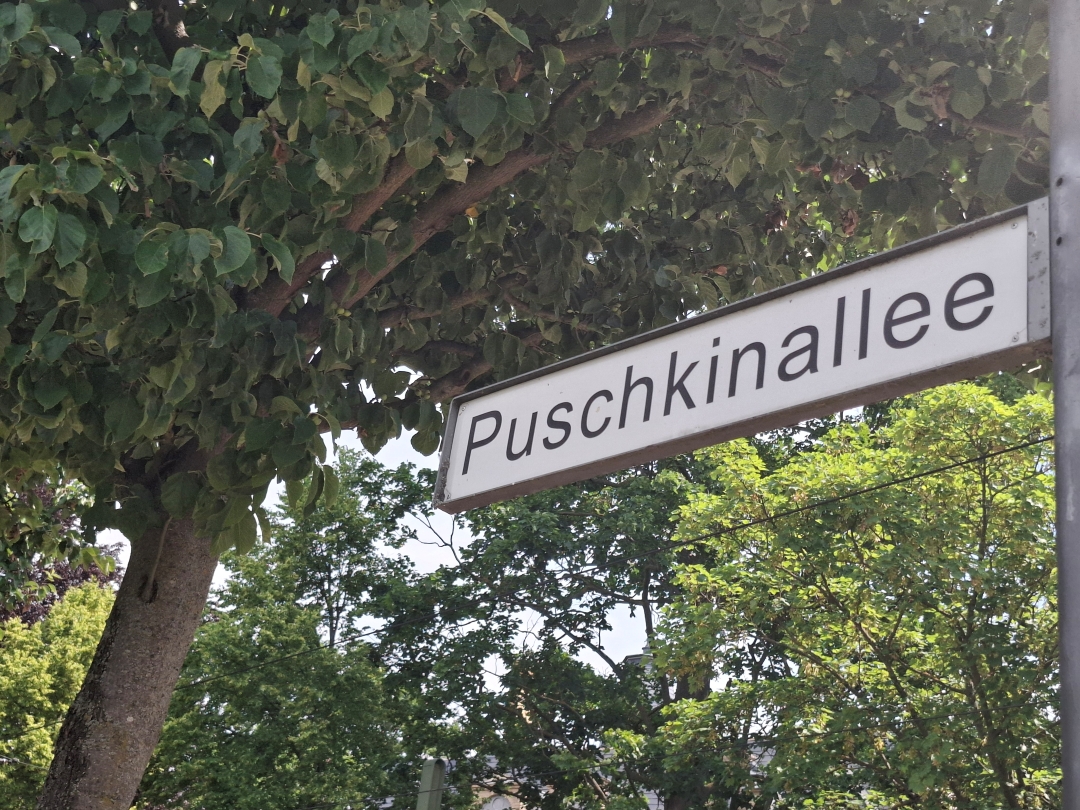
Every time I take a tram to the Central railroad station in Potsdam, where I live, I inevitably meet with my compatriot and colleague. No matter what season of the year or what time of the day, he is always there, as a stubborn indestructible spectre, represented by his name coming out of a loudspeaker in German: the next stop is Pushkinallee.
Pushkinallee – a street named after Alexander Pushkin, the most famous Russian poet of XIX century, Russian Goethe or Schiller, a rebel, a womaniser, a founder of the modern Russian literary language.
Dozens of his verses (willingly) learnt by heart in school, dozens of his lines engraved in conscience, becoming formulas of love and fate, of higher aspirations… Once he had been for me the very spirit of my native language.
Yet, I am not happy to encounter him in Potsdam, in the former GDR, Deutsche Demokratische Republik. In fact, I feel chilly and anxious at this stop, named after him, like am standing in a shadow invisible to others, on the edge of the otherworld.
And I am not misinterpreting things.
Here, in Potsdam, his name means something else.
Until 1949 the street was named Kapellenbergstraße. So what happened, why had it lost and never regained its name?
After 1945, this part of the city was cut off and handed over to Soviet control. The Soviet state security headquarters were installed there, responsible for the entire Soviet occupation zone in Germany. There was also a detention centre where both Germans and Soviets suspected of political misbehaviour against the communist authorities were held, interrogated and tortured. This centre was a hidden window to Russia, or, better to say, the gates to the hell – some of its inmates were later transported to serve their sentences to the GULAG camps on a Soviet territory.
Among the local population this Soviet state security colony was nicknamed „kleine Sowjetunion“,“the small Soviet Union”, or “die Verbotene Stadt”, the Forbidden City, because no ordinary Germans were allowed in, except if they were arrested.
So, it was the Soviet officers who сhanged the map of Potsdam and put Pushkin’s name on it. Geographically Pushkinallee marked the border of the Forbidden city, the border between life and death for many of those who crossed it.
I would like to stress it, to make an accent – the Potsdam´s Forbidden City was in no way a regular place, military or administrative unit of the occupying forces. It was a residence of the notorious and merciless secret police, the place of pain, injustice and suffering, as bloody as a crime scene could be. But the secret police itself demarcated it with the Pushkin´s name, as if they wanted to introduce a sort of normality, to construct a friendly, cultured interface for the bloodthirsty beast hidden inside of the closed territory, even though no one could have been mistaken.
Now the secret police torturers are gone, the former Soviet quarter is free again, the KGB prison became a museum.
But the Pushkinallee stays. Its name is weathered out, turned into a curious artefact, a harmless relic.
But I don´t feel this way.
Сontext matters. If you know it
Potsdam is not the only place where I meet him.
When I go to Anhalt-Zerbst, where my German ancestors lived, the city of the ghost churches, bombed to the ground in April 1945, I am inevitably forced to pass Pushkinpromenade.
When I walk through Wittenberg, Luther´s city, another ancestral place of mine, I cross the Pushkinstrasse.
In Halle, on my way from the main station to the Rote Ochse, the former Soviet camp and residence of the military tribunal punishing civilians of Sachen-Anhalt, later to become a Stasi headquarters and a place of memory after 1996, I am walking along another Pushkinstrasse.
I also meet Pushkinstrasse in Erfurt, where I visit another Stasi memorial.
In Werder an der Havel, a small city near Potsdam, I am cycling through another Pushkinstrasse, not far from the local cathedral. There is a modest monument dedicated to the local residents who objected to the communist regime and were arrested and sent to Moscow’s Lubyanka prison for interrogation and execution.
Sometimes these streets make really crazy and laughable conjunctions, in Erfurt, for example, intersecting with Lutherstrasse and Yuri Gagarin-ring at the Carl-Marx Platz.
I am not making up things here. I just try to live in my new home country and go on with my research. But it seems sometimes like Pushkin is stalking me.
The very fact that the Soviets are thirty years gone, with all their tanks and soldiers, artillery and aircraft, but the Pushkin name, absolutely foreign and evidently superimposed, stays, because it is somehow protected by his supposedly neutral artistic status, is a good point to start an inquiry about an intimate, unobservable, not easy to discern connection between Russian state power and Russian big literature.
Many Russian liberal-minded intellectuals (and not only Russian) will say that Pushkin cannot be blamed here. That he is, in fact, a victim. He was abused or misused by the distasteful and dumb Soviet officials, parasitising on his talent and glory. In 2022, a public letter from the German PEN Center stated that: “The enemy is Putin, not Pushkin”, generously freeing Russian culture from responsibility.
I would agree to disagree.
In the same 2022, when Bucha massacre was reported to the world, Belarussian poet Valzhina Mort wrote, referring to the factual account of the crime, underscoring its colonial context:
In the Pushkin street
and in the Lermontov street,
Russians shot women and girls,
and then drove over them
with tanks.
Сontext matters.
If you know it.
A sanctuary preserved in formaldehyde
When you are a child, you are born into a world full of books.
At least that was the case in my family during the last decade of the Soviet Union.
Our small, two-room apartment, which was shared by me, my grandma, and my parents, was filled with books. Assorted bookshelves that didn’t quite fit together covered all the walls. In this bookworm’s cave, there was no distance between books and people.
You could smell their bookish scent everywhere. You were surrounded, compressed and embraced by hundreds of titles, names, different fonts and cover colours. It was like a second womb (after my mother’s), where a reader’s existence begins.
At the time, it didn’t seem strange to me. But now I understand that the books were objects of a cult for the Russian Soviet intelligentsia. Russian and world classics represented a non-party, non-communist culture and values, and a reader’s biography substituted their real biography, which was unfree and full of compromises — inevitable in an authoritarian society.
Literature was a safe, neutral space, a sort of shelter. It was also a tool to reinstate one’s shattered dignity. The idea that a good man is raised by good books was a point of convergence between the official narrative and unofficial intelligentsia culture, and the recommended reading lists were not so different after all. This neutral space should not have been disturbed or challenged by any criticism, like a sanctuary.
The sanctuary is preserved in formaldehyde.
The official discourse spoke of the ‘Great Russian literature’, which was always great, indiscriminately great, like the ‘Great Patriotic War’, the ‘Great October Revolution’ and ‘great comrade Lenin’.
The adjective ‘great’ was not widely used in Soviet language, which was full of pathos and self-appointed compliments. It was reserved for a limited number of the most important people and events, like the highest noble title or military rank.
Nobody said ‘great Soviet architecture’ or ‘great Russian cinema’. Of course they were great — everything in the USSR was supposed to be great, despite the temporary difficulties. But Russian literature was great with a capital ‘G’. It was great, like other sacrosanct entities. One of a kind.
From my experience, this notion was shared by the intelligentsia. In a more emotional, less hierarchical way, but still shared. This supposed greatness, approached with semi-religious reverence, provided people with a potent means of self-preservation and self-affirmation, which was particularly significant for those who were powerless and coerced, and who had entered into a long-term moral compromise with the Soviet state by serving it.
Being a faithful reader of ‘Great Russian literature’ meant something beyond literary experience. It meant being part of something unquestionably good and therefore great and powerful, dominating peacefully through the power of persuasion and the power of words.
In her 1942 poem ‘Bravery’, Anna Akhmatova wrote about the ‘Great Russian Word’, or ‘великое русское слово’, the most important, and perhaps the only, common value to be saved from the advancing Wehrmacht. This is probably the best example of how the official discourse on greatness and the discourse of intellectuals naturally merged.
Russian literature was the only one to be given such a title on a regular basis.
There can only be one Generalissimus
There may be many generals and marshals, but there can only be one generalissimo.
‘It is shameful, sad and daunting to admit that my own thoughts were not critical views of the world, but artificially cultivated fruits of “Great Russian culture”,’ writes Ukrainian writer Olena Stiazhkina in her essay. ‘My brain worked like a piano: pressing a certain key was followed by the correct and expected sound.’ If a poet, it had to be Pushkin; if a writer, Tolstoy; if a composer, Tchaikovsky…’ The Soviet school was Russian. And imperial, because Pushkin was regarded as the summit, a yard-stick against which the skill of Byron and Burns was measured, and then those of all other, contemporary modern poets around the world”.
It may seem that I am focusing on something that is merely symbolic and practically insignificant. Perhaps it is distasteful, disproportionate, narcissistic or childish, but ultimately harmless. Or perhaps it can be justified to some extent on artistic merits.
However, I would argue that it is precisely this ‘greatness’, maintained by both the Soviet state and cultural elites, that has preserved Russian classical literature in a way that is unimaginable with respect to other world literatures. This condition outlived the Soviet Union.
No critical tradition was established that would have enabled us to discern, criticise and deconstruct its imperialist heritage, or to expose the colonial violence and gaze embedded in Russian culture. In this sense, Russian literature is frozen in time. It stands — and it is surprising how little this fact is acknowledged or reflected upon — as being mostly immune to critical analysis.
So, what is the blind spot, the most problematic flaw?
One of the first words that comes to mind when we speak about Russian literature is ‘suffering’. It has almost become a brand, a defining feature. Russians suffer more deeply than anyone else, and they can speak about suffering in a way that no one else can.
However, this fixation on suffering almost never includes the suffering inflicted by Russians on others. Even though the centuries-long process of imperial conquest was (and still is, given that Russia is currently at war with Ukraine) a series of wars and annexations resulting in the subjugation of numerous ethnic groups, this is rarely acknowledged.
The Other, whether swallowed by the Empire or resisting its onslaught, is almost entirely absent. The only notable exception known to a wide readership is Khadji-Murat, a novella by Leo Tolstoy which offers the perspective of the Chechens fighting against Russian occupation.
However, this is an exception that only serves to confirm the rule.
One cannot rewrite the classics. However, classics can be rethought and reinterpreted, and the voids and self-centred narratives could provide lessons and messages if they are evaluated.
Otherwise, they remain discreetly toxic.
Let’s return to Pushkin, with whom we started.
In 1833, he wrote a powerful poem called ‘The Bronze Horseman’. The poem tells the story of a terrible rider, Emperor Peter the Great, whose bronze statue comes to life on the night of the flood and haunts the poem’s hero until he goes mad.
One interpretation of the poem is that the Bronze Horseman is an embodiment of the authoritarian Russian state, which haunts independent individuals. In this interpretation, Pushkin is a bard of freedom, defending private liberties and individual dignity against the monstrous state.
Not exactly someone the Soviet secret police would want to name a street after, is he?
Hoever, the author’s direct speech at the beginning of the poem is an enthusiastic anthem to Russian statehood, its lines supercharged with imperial gaze, militarism and chauvinism.
He dismisses the “miserable” existence of the local people whose lands were taken from them to build the new capital, Saint Petersburg. He glorifies the capital itself, a symbol of imperial might and power, the ‘window to Europe’, even though thousands of its builders died trying to build structures in the swamps.
The story of the Bronze Horseman and the flood thus becomes a testimony to an earlier phase of imperial conquest when local natural and political elements had not yet been completely subjugated. This was a brutal and bloody phase, but from the poet’s perspective, it was historically unavoidable and therefore justified.
Its darkness and madness only emphasise, by contrast, the new order born from the chaos: the new regularity of military parades, the pompous facades and the trade ships in the harbour. This is a prosperous state, created through turbulence by the sheer will of its creator.
A modern, attractive, vibrant state that has left the painful birth phase behind and is now talking patronisingly to an old Europe.
This is precisely the figure and narrative with which the Soviet secret police can identify. A bard of the empire and an advocate of violence as a means of state building — a very Soviet worldview — such a poet should have been given a leading role in the Soviet pantheon.
In this sense, Pushkin is the best example of the ambivalent nature of Russian literature. It changes colours and images like a banknote with different watermarks. From one angle, one can see an aspiration for freedom and human rights; from another, a deeply embedded complex of imperial superiority, a colonial gaze, and an admiration for Great Russia.
It is precisely at this point that a bizarre yet intimate connection is formed between the Russian state and Russian literature.
This connection is not easy to spot, but under certain conditions it becomes more visible and tangible.
The infrastructure of cultural occupation
Some of you may have heard that monuments to Pushkin, erected during the Soviet regime, are being dismantled in Ukraine today. Some Russian and Western intellectuals are voicing cautious discontent, viewing this as a politicised attack on cultural values.
Of course, these are not monuments to the poet himself. They are markers of Russian-speaking cultural dominance and signs of cultural superiority. I would not be afraid to say that they are infrastructure of cultural occupation. To tell Ukraine what it can or cannot do on its own territory is to perpetuate this colonial mindset.
However, I would like to take this further. Consider briefly the genesis of the Russian idea that Ukraine is not a subject, but rather destined to be part of Russia or the Russian world. This idea represents the ideological fuel of today’s Russian aggression against independent Ukraine.
In 1828, he wrote the poem ‘Poltava’ in response to Byron’s poem ‘Mazepa’, written ten years earlier.
Both poems refer to events during the Great Northern War, which, in Russian historiography, culminated in the Battle of Poltava in 1709. There, Peter the Great’s Russian army defeated Charles XII of Sweden, and Russia finally entered the circle of European powers.
The battle took place in Ukraine, where Ukrainian forces switched sides, abandoning Peter and joining Charles.
Byron described it as a romantic struggle for emancipation from the Russian Empire, depicting the young nation’s doomed yet noble attempt to distance itself from its dominant neighbour. Pushkin wrote about the poisonous betrayal of the brotherly bond, the unreliability of Ukraine and its predetermined destiny to unite with Russia.
This long tradition of depicting Ukraine as part of Russia originates from his “Poltava”, portraying it as a region susceptible to external influences and temptations. Consequently, it is destined to be controlled and monitored; otherwise, it could be seduced by the West and switch allegiances, becoming a weapon against Russia.
In short, this is the crux of the current Russian propaganda narrative, aimed at justifying ongoing aggression.
Russian intellectuals should track and expose these toxic tropes. However, as I said, this work was never completed in its entirety. There are also no signs that it will be undertaken soon.
Should an instrument be blamed? Yes…
Let’s delve deeper into the relationship between literature and state power.
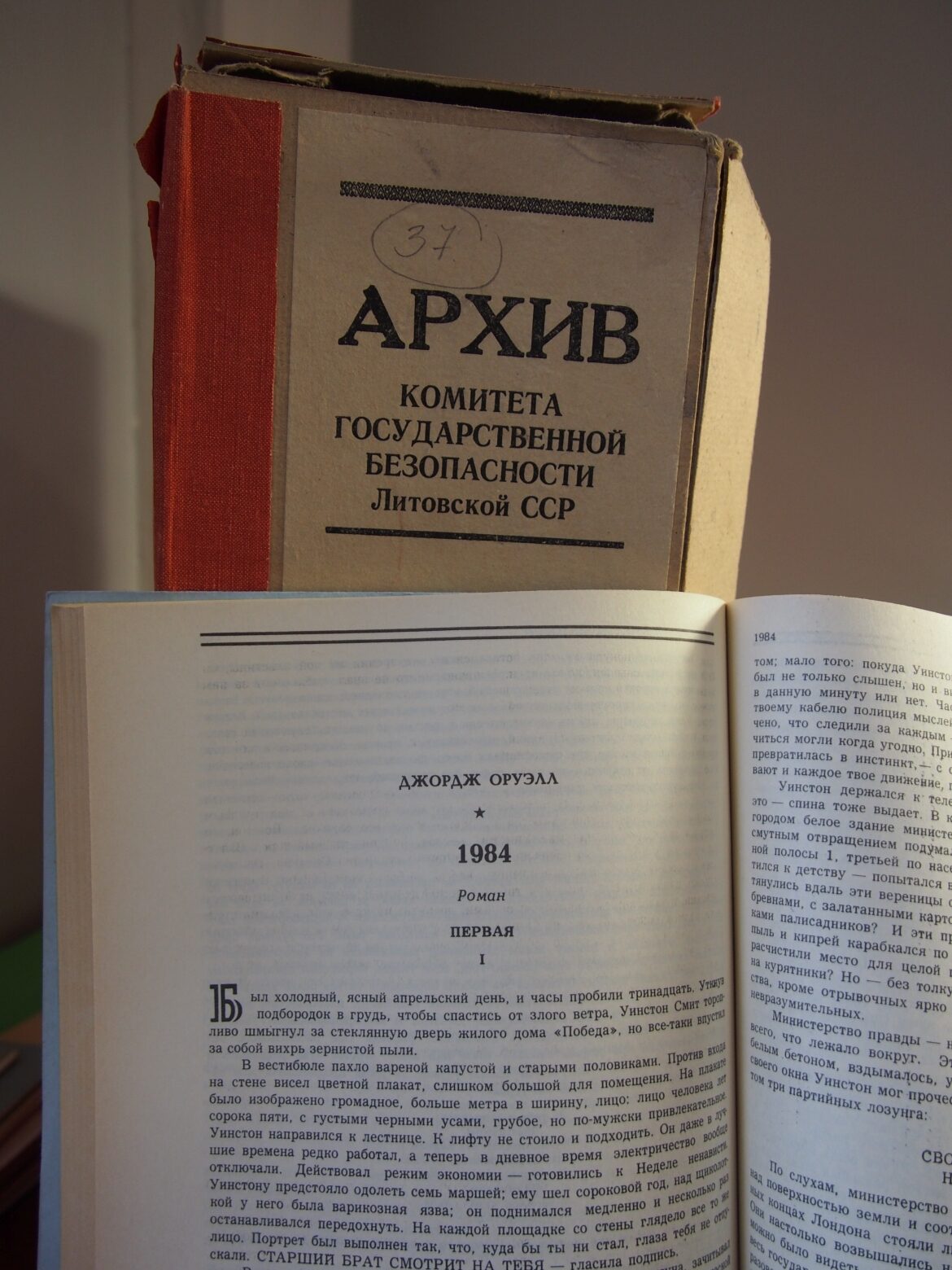
While working in the archives of the Lithuanian State Security Committee in the centre of Vilnius — located in the same building that once housed the KGB — I found a remarkable file. Dating from the late 1940s, it details the period when the Soviet occupying forces in Lithuania were destroying the remnants of armed resistance and Sovietising the country.
As part of this project, new textbooks were created for Lithuanian schools, particularly for subjects such as history and literature that were considered important from an ideological perspective. These were entrusted to Lithuanian scientists who were proven members of the Communist Party and had demonstrated their loyalty.
However, the Soviet secret police controlled their work, of course. At some point, state security officers began a secret investigation into the authors of a literature textbook.
Let me remind you: it was a literature textbook for Lithuanian schools. For Lithuanian students.
But the authors were accused of including — pay attention! – too many Lithuanian authors and texts. And not including enough Russian ones. This was labelled ‘ideological sabotage’.
Therefore, the degree to which Russian classics were represented in the textbooks could have been a matter of life or death.
The classics themselves were instruments of cultural intervention or aggression, forcefully reshaping national identity.
But should an instrument be blamed? Yes, because it is a suitable instrument for the job and embodies the idea of imperial dominance.
Unfortunately, history is repeating itself today.
In the occupied territories of Ukraine.
The Ukrainian history and literature programme is being replaced by the Russian one.
Russian textbooks and reading books are being imported and teachers are being forced to undergo retraining. Library collections are being filtered.
Ukrainian children who have been forcibly displaced to Russia are being “re-educated”, with Russian cultural institutions — for example, the Russian State Children’s Library — involved in this process. A recent European Parliament declaration refers to “forced Russification” as part of a ‘genocidal strategy’ against the Ukrainian nation.
‘Us’ first?
How can Russian culture and literature reassert themselves and take responsibility?
In 1988, Milan Šimečka, a prominent Czechoslovak dissident and philosopher, wrote an article called “The Conscience of the Russian Intelligentsia”. This article was widely republished across Europe, and even in the Soviet Union, where it was published in Russian.
Allow me to quote at length from this text.
“After three years of perestroika, however, I still feel deep disappointment that the conscience of the Russian intelligentsia has not yet transcended the confines of the nation. It has not yet shown sufficient sensitivity to the fate of other nations whose misfortunes and moral and economic decline have been derived from Russian destiny. It seems to me that there is a somewhat defective conscience, focused only on its own national suffering. In the writings of the Russian intelligentsia today, we read plenty about the countless moral dilemmas, but true moral indignation must not only recognise the wounds on its own body and turn its eyes away from the wounds inflicted on others. For three years, we have heard lamentations over the ruined destinies of millions of our own people, yet we rarely hear the same intensity of lamentation over the misfortunes of others”.
In the context of Czechoslovak history, the misfortune Šimečka referred to was, of course, the Prague Spring of 1968, which was crushed by a Soviet invasion. But it was also the whole long story of brutal Stalinist repression in Czechoslovakia after WWII that inflicted deep wounds.
The frustration and bewilderment in Šimečka’s voice is clear: ‘How can you, who consider yourselves victims and are knowledgeable about suffering, not see the damage inflicted by your country on other nations?’
Šimečka’s article did not provoke any heated or protracted discussions among Russian intellectuals at the time. It was routinely dismissed by Lazar Lazarev, a Soviet literary critic and Second World War veteran who built his career writing about Konstantin Simonov. Simonov was a superstar of Soviet military prose and a laureate of six Stalin Prizes. He participated in defamation campaigns against Alexander Solzhenitsyn.
Essentially, Lazarev argued that the Soviets are preoccupied with their own internal problems because they are the key to a better future for everyone. Despite his friendly rhetoric, he clearly did not accept the idea that the invasion of Czechoslovakia was also a Soviet internal problem.
He draws a very strict line between what comes first — ‘we’ — and it takes patience to explain pedagogically to the impatient Šimečka that the Czechoslovaks would be better off staying in the queue and waiting for their turn while the Soviets discuss their internal matters.
Needless to say, that moment never came.
The problem is that imperial and colonial policies form the core of the empire.
They are also the most problematic and dangerous internal issue for Russia.
The crimes committed by the USSR in Central and Eastern Europe — crimes of invasion and occupation ordered from Moscow — were never addressed legally in Russia and never entered wide public discourse. Crimes committed against nations and ethnic groups within the Soviet Union, including the extermination of cultural elites, starvation, mass deportations and Russification, were not recognised as colonial.
Russian public consciousness is blank in this regard. If these policies and cultural traditions continue, Russia will continue to pose a threat to the entire continent.
Therefore, I would argue that the main goal of literature in exile should be to shift its focus. We should take on the role of critically re-reading the classics and creating a new, self-critical narrative.
We should listen carefully to what Russia’s neighbours have to say. What the Ukrainians have to say.
Listen and learn.
Rather than defending ourselves automatically in response to criticism, we should stay open to the voices of those for whom Russian literature represents invasion, loss of statehood, cultural subjugation and Russification.
It continues to represent deafness.
We also need to listen to the voices of non-Russian citizens of the Russian Federation who are currently subject to Russian domination. These voices are barely heard by the outside world because the world generally views Russia almost exclusively through the lens of Russian culture, which denies or avoids colonial responsibility.
It could be a long journey.
But the first steps must be taken.
The subheadings have been added by the editors.
Sergey Lebedev was born in Moscow in 1981. His parents were geologists. Following in their footsteps, Lebedev spent eight seasons as a field worker on geological expeditions, starting at the age of 15. Since 2010, he has written five novels devoted to the theme of the hidden Soviet past and the impact of Stalinist repression, persecution and their consequences on the contemporary life of Russians. His latest novel, The White Lady, shows the dark forces driving Putin’s Russia today. Lebedev’s books have been translated into 22 languages, and he has been a finalist for major literary awards. He has lived in Germany since 2018. He speaks out unequivocally and openly against Russian aggression in Ukraine.