


Ērika Jaskólska
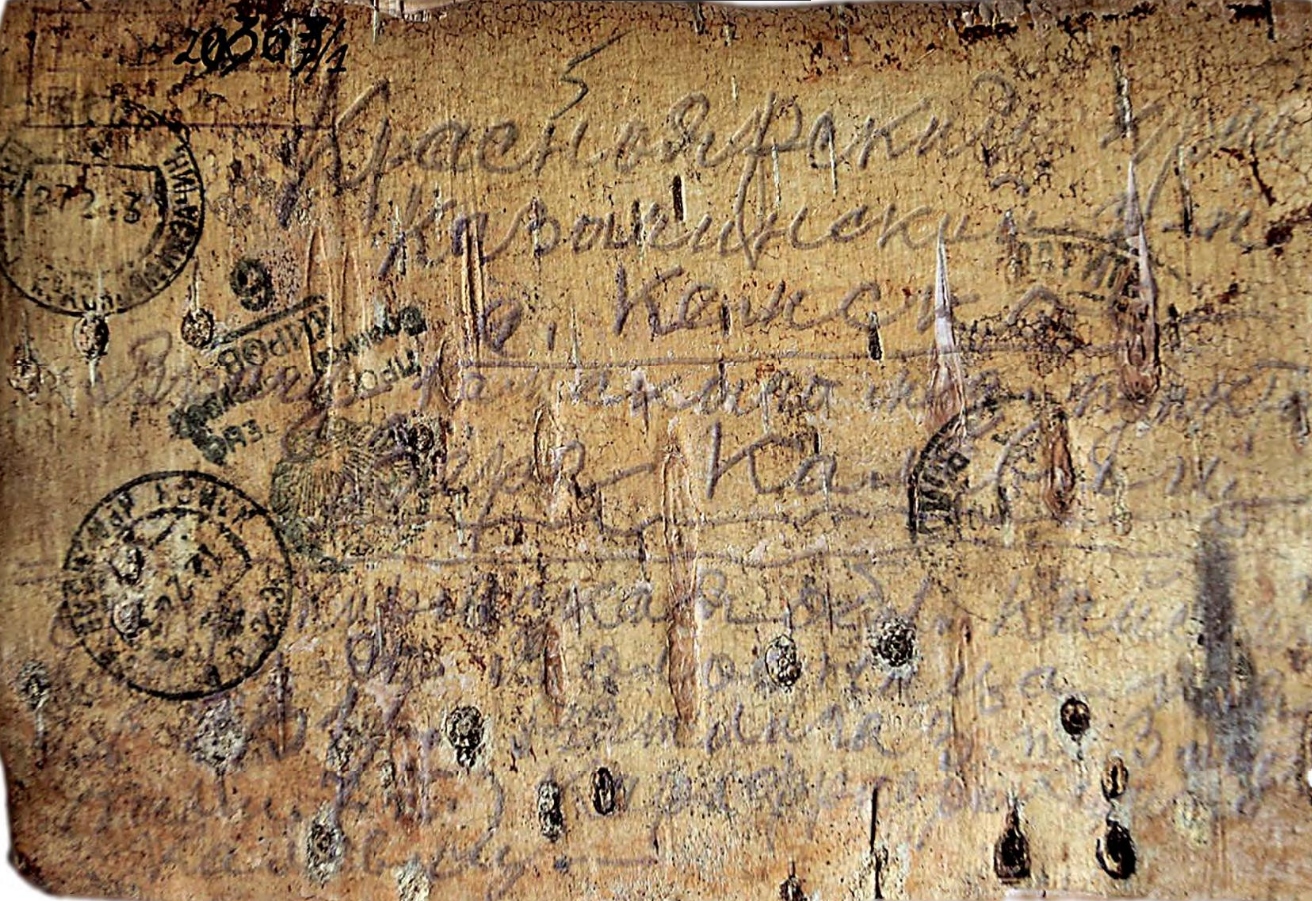
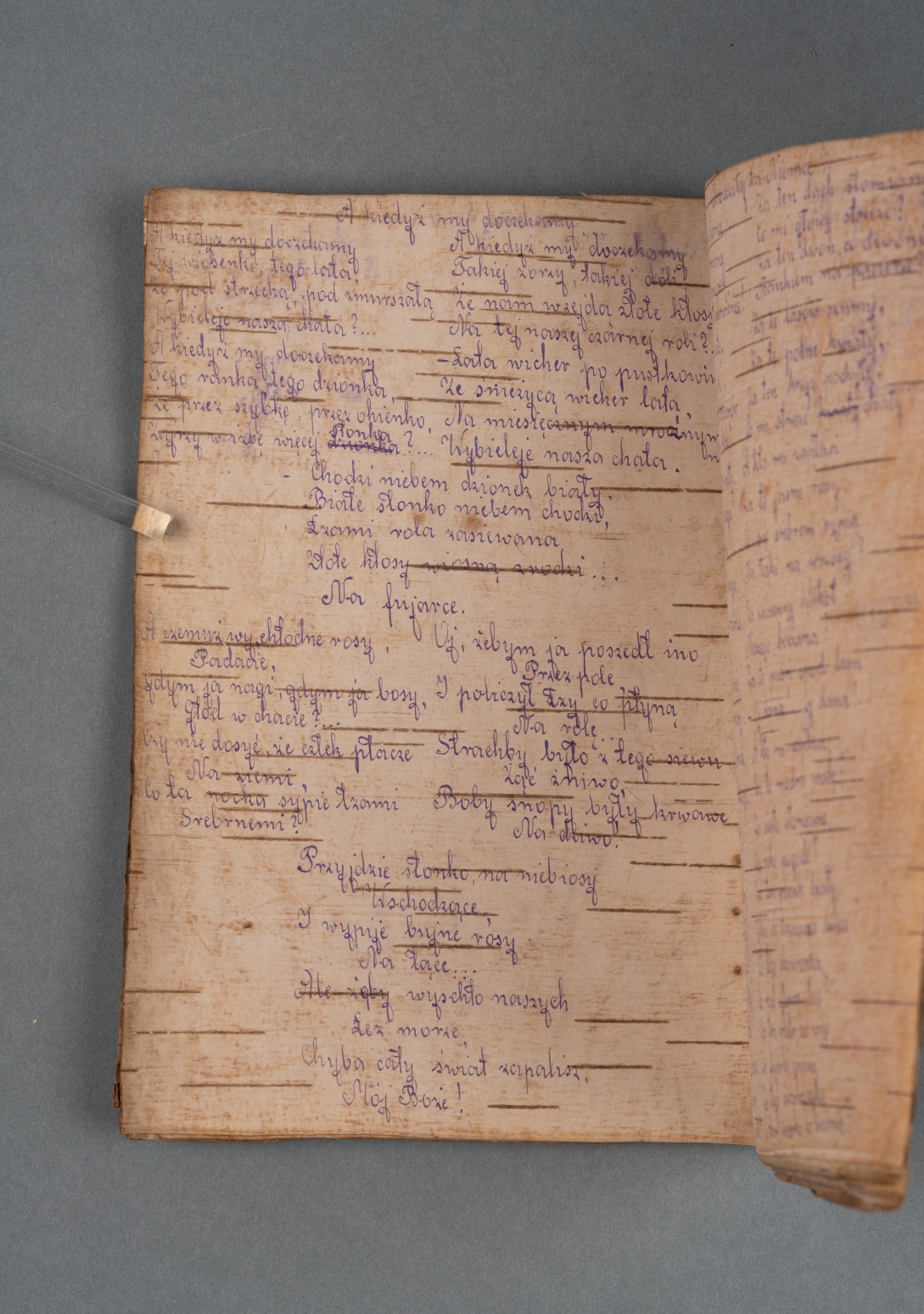
Residents of Latvia deported to Siberia by the Soviets sent letters to their loved ones written on birch bark. In 2009, these letters were inscribed in the Latvian register of UNESCO’s Memory of the World programme.
The collection of letters written by Latvians deported to Siberia, compiled by Agrita Ozola, a researcher and museum curator in Tukums, and the historian Ritvars Jansons, is aptly titled Letters from Siberia on Birch Bark. The letters recount some of the most tragic moments in the twentieth-century history of Latvia – the Soviet repressions against the Latvian people, which may be regarded as crimes against humanity. Today, these letters are preserved in the collections of seven museums: Tukums Museum, Museum of the Occupation of Latvia, Latvian National Museum of History, Aizkraukle Museum of History and Art, Talsi Regional Museum, and Daugava Museum.
Deportations from Latvia, 1941–1956
The letters recount the stories of individuals who were deported to Siberia by the Soviet regime between 1941 and 1956. Those subjected to repression were primarily the so-called kulaks – relatively prosperous peasants, labelled by Soviet propagandists as ‘class enemies’. A peasant designated a kulak by the local Party authorities – together with his family – was subjected to so-called dekulakisation, which involved the confiscation of all property, the transfer of the land to a collective farm (kolkhoz), and subsequent deportation to Siberia. The regime also sought to eliminate the armed resistance movement, which the communists regarded as a threat to the authorities. On 14 June 1941, the first mass deportation was carried out, directed primarily against the intelligentsia. Approximately 15,500 Latvians were deported during this operation. Those targeted included individuals active in politics, culture, and the pre-war state administration. The majority were residents of Riga and its surrounding areas. Women, children, and the elderly were sent to Krasnoyarsk Krai, Novosibirsk Oblast, and the northern regions of Kazakhstan, where they were assigned mainly to work in forestry, collective farms (kolkhozes), and state farms (sovkhozes). It is worth noting that more than 1,900 citizens of Latvia perished there. Those deported on 14 June 1941 were permitted to return to their homeland only in the mid-1950s, while many were not able to return until the 1960s or even the early 1970s. After their release, the property confiscated during deportation was never restored to them. The second deportation took place between 25 and 30 March 1949 and was directed primarily against the rural population. Approximately 44,300 people were deported.
Enemies of the Soviet Power
The collection of letters in question has been divided into chapters according to both the fates of the deported individuals and the places of their deportation. The thematic scope of the volume includes childhood in exile, the fate of a teacher labelled an ‘enemy of the Soviet power’, participation in the resistance movement, as well as the experiences of a poet, a mother, and friendships formed during deportation*. In terms of locations of deportation and forced settlement in labour camps, the collection includes references to camps such as Vyatlag, Shiroklag, and Vitegostroy, as well as sites in Krasnoyarsk Krai, Omsk Oblast, and Tomsk Oblast. The collection consists predominantly of private letters, forming correspondence between deportees and their family members and friends. They most often contain descriptions of everyday events, personal experiences, and impressions of a new place of residence, as well as information about key turning points in life (such as a change of camp, relocation to a new place of exile, or news of an unexpected return). The deportees also shared their longing for their homeland and sent holiday greetings. Poetry appears only rarely in the collection. This form was used only by Aleksandrs Pelēcis, Elza Trumekalne, and Gaida Eglīte. The poems were written in the vicinity of Tayshet, Omsk, and the Asinovsky District. […]
Aleksandrs Pelēcis was repressed on suspicion of involvement in the armed underground resistance. His letters belong to the group written by inmates of the Gulag labour camps. Acting in accordance with their convictions, these individuals dared to oppose the Soviet authorities. Among them was, for example, Ernests Ķirķis, a director of a butcher’s shop in Jūrmala, who opposed the nationalisation of property and was later accused of supporting the Nazis. Another was Voldemārs Mežaks, a member of the Latvian Central Council, who led its branch in Ventspils. All were arrested between November 1944 and January 1946. The birch-bark letters they sent home originated from camps in the Molotov Oblast, Vologda Oblast, and Irkutsk Oblast. All of them eventually returned to Latvia.
The Poet’s Fate
Pelēcis was born in 1920 in a town called Marupe. He studied Philosophy and Pedagogy. With the support of Latvian President Kārlis Ulmanis, he was admitted to the Faculty of Philology at the University of Latvia to study Baltic Philology, where he remained until his conscription into the Latvian Legion [a collaborationist formation and unit of the Waffen-SS – editor’s note] on 24 March 1943 (the faculty was closed later that year). The young poet’s first poem was published in the 16 December 1941 edition of the newspaper ‘Tēvija’. During his studies, Pelēcis was active in the student organisation Ramave. Together with 16 other conscripts, he was sent to Berlin, where he attended war correspondent training courses until October 1943, after which he became a war correspondent for the newspaper ‘Daugavas Vanagi’. That same year, under the editorship of Kārlis Rasiņš, the poet’s first collection of poems and ballads, Dream, was published in Riga. After returning to Latvia, he lived and worked as a schoolteacher in Talsi, undoubtedly serving as a source of inspiration to his students as a free-thinker who dreamt of Latvia’s independence. In September 1944, when the newspaper’s editorial office was relocated to Courland, Aleksandrs deserted and went into hiding in Riga.
In 1946, Pelēcis’s poems were published by the underground publishing house of the Latvian National Partisan organisation ‘Kurbads’, as a result, the poet was imprisoned in a labour camp, where he spent 23 years – the longest period of incarceration among all the individuals represented in this collection. After the teacher disappeared from the school in 1945, his pupils learned a year later, on 17 January 1946, that he had been imprisoned in Tayshet (Irkutsk Oblast), where he was employed in railway construction. Aleksandrs sent poems written on birch bark to his pupil Velta: ‘Do not think that we have no paper. I just want to send you a piece of the taiga.’ Velta, Aleksandrs’s pupil at the school in Valka in 1944–1945, was captivated by her teacher’s courage and creativity. During literature lessons, he inspired his pupils with patriotic poetry, including his own works. An example of the poet’s courage and independent spirit was his appearance in a radio broadcast in 1944, during which he recited a poem expressing the desire of Latvians to remain in their homeland. The poem also referred to the terror directed against the people of Latvia:
As the sea remains within its shores,
Despite the hundreds of passing winds,
Let us too remain upon our land,
Our whole lives in one place.
In 1963, Pelēcis completed his prison sentence, but he was not permitted to return to Latvia. He did not return to his homeland until 1969. He settled in Talsi, where he wrote his autobiography, The Siberian Book (published in 1993), as well as a poetry collection entitled Lapegle. In April 1994, Pelēcis was awarded the literary prize of the General Kārlis Goppers Foundation for The Siberian Book. The poet’s works have been collected in the library of the town of Talsi. In 2000, the Latvian Writers’ Union, together with the town council and the main library of Talsi, established the Aleksandrs Pelēcis Prize for prose, poetry, journalistic, and literary-critical works dedicated to the town of Talsi, as well as for contributions to the study and promotion of Pelēcis oeuvre. On 31 January 2000, in Dižstende (Liepāja District, Talsi Municipality), a public organisation called the ‘Aleksandrs Pelēcis Reading Room’ was founded. Its aim was to promote spiritual culture and the creative ideas of society, as well as to document and build a collection of Talsi’s cultural and historical heritage.
It should be emphasised that during his time in the labour camps, the poet wrote not only to Velta but also to other pupils of his. It is also worth noting that many of them, including Velta, were not afraid to write back to their sentenced teacher. Aleksandrs’s 1955 letter to Velta consisted of two parts. In the first, the author informed her that he had been released from the camp, while the second part was presented in poetic form. Aleksandrs did not state openly that he had been released – it is possible that in such a case the letter would not have passed censorship. However, within the poet’s close circle, a code phrase was used: ‘morning ray’. Aleksandrs wrote that he was writing this letter from a café called Morning Ray. The author of the letter, written in Latvian, also asked the addressee to reply in Latvian or Spanish, but not in Russian. Together with the letter, Aleksandrs enclosed a sonnet written on 2 June 1955:
Prayer for Happiness
You, more fragile than a reed from sorrow,
Orchid in a beautiful flowerpot!
Come to me in a warm embrace!
[…], so that no more sadness rests upon the heart!
I know that misery follows in its footsteps.
But if just a single moment of life –
In life, as in the song of a saint,
The forgotten chant of resolve!
God’s gracious and gentle breath,
Touch, even if only for a moment!
I call to you in terrible suffering,
Knowing only one eye!
One cannot pass indifferently by death,
Celebrating happiness without shedding tears!
The poet always wrote poetry with patriotic themes. An example of this is the poem ‘Calling to the Sons’, written in June 1941, which is also included in the collection of letters on birch bark. It reflects the impossibility for exiles to return to their homeland and the concern of families for their loved ones in distant lands.
In one quatrain, the lyrical voice urges the mother not to call her sons, for they will not return; only migratory birds, carried by the wind, can deliver a message from a loving and longing heart. In the poet’s work from the second half of the 20th century, features of Latvian national Romanticism** frequently appear, along with motifs drawn from nature: the sea, the Daugava River, fields, trees, and so on. In the collection The Birch Book, which presents Pelēcis’s poetic output from his time in Siberia, echoes of national Romanticism are evident, such as references to trees, particularly the oak, which holds a significant place in Baltic mythology***. Examples of this can be found in the poems: ‘The Oak of the Sun Mountain’, ‘Thus Sing the Sacred Oaks’, ‘The Mamre Oaks’. In the latter poem, dedicated to Pelēcis’s exiled friend, the anthropologist Vilis Derums, he intertwines the biblical story of Abraham’s Oak, under which Abraham is said to have received three angels, with the forces of masculinity symbolised by the oak in Latvian mythology. ‘Three oaks grow in a foreign land’ – in this way, the lyrical voice speaks of the sons of Latvia who must endure life in Siberia.
For Pelēcis, another association with the homeland is the folk festival Līgo, connected with the Midsummer Night celebration. This is reflected in the poems ‘Distantly Celebrating Līgo’ and ‘The Fiery Flower of Ancestors’ (both from 1961). In the final quatrain of ‘The Fiery Flower of Ancestors’, a sense of longing for the homeland is contrasted with life in exile:
Walking for a long time along foreign paths,
Our eyes must not grow blind –
We search for the fiery flower of our ancestors,
So as not to lose our Fatherland!
In the poem ‘Distantly Celebrating Līgo’, the lyrical subject contrasts the coldness of foreign lands with the Līgo festival, associated with the element of fire, which the poet links to the warmth of the homeland:
When the sun sets in a foreign land,
When the stars shine coldly abroad,
I want to come to you to celebrate Līgo
And bring a little of the Fatherland!
The opposition between foreign land and homeland is a recurring motif in Pelēcis’s work, appearing in almost every piece in the collection The Siberian Book. Given the particular symbolic significance of trees in this collection, it is also worth highlighting the importance of the birch. In Pelēcis’s work, the birch frequently enters a network of associations with the concept of homeland, even though in Russian tradition it is usually a symbol of Russia. In his poems, the birch most often symbolises salvation and hope: in the 1958 poem ‘Birch’ – ‘the birch brings purity to my heart’; in the 1962 poem ‘To Pēteris Ērmanis’ – ‘the birch raises its green hands of hope’; in the 1963 poem ‘To Valdemārs Ancītis’ – ‘Birch of my memories! You still grow in the Fatherland!’; in the poem ‘Eternal Birch’ – ‘One birch with silver leaves still grows near the Daugava!’. In the poem dedicated to a friend of the poet, ‘To Maija Vinter’, written in May 1962, the lyrical subject is suffused with the power of the glow of the ‘festive birch’, ‘Latvian birch’, ‘native birch’. At the end of the poem, the poet emphasises:
My uncut native birch,
Beside which I am filled with strength.
It is most likely that the associations above are evoked by the birch bark letters, as it is precisely birch bark that enables Pelēcis to maintain contact with his pupils, family, and like-minded people. In the poem ‘Birch’, the lyrical subject clearly conveys that the birch tree holds a special significance for him:
Many trees appear in my poetry,
One of them, it seems, has grown in my breast,
Through my heart it carries purity,
So that life abroad is not so hard!
[…]
The Fate of Women
In the collection of birch bark letters, there are also poems written by young women in poetic form, addressed to their families. Through poetry, they sought to give their letters an uplifting tone and to spare their addressees distress over their difficult circumstances. These women belonged to a group of people deported from Lithuania on 23 May 1948 and from Latvia on 24–25 March 1949, and sent to the regions of Krasnoyarsk, Omsk, and Tomsk. The letters were written between 1949 and 1951 by women who had been deported because their husbands or fathers had opposed the Soviet regime. They were often deported from different places and only met one another in the camps. For example, the teacher from Kaunas, Gražina Gaidienė, sent a beautiful drawing along with name-day greetings to her friend Sofija Milda Meldere, whom she had met while collecting resin in the Novostrojka camp in the Ingasz district of Krasnoyarsk Oblast in the spring of 1948. These two women from Lithuania and Latvia were deported together with their husbands due to their alleged threat to Soviet authority. Gražina Gaidienė’s drawing confirms that these letters were not limited to poetry, but also included visual art. Despite the harsh conditions in which they lived, the deportees were able to find time and space for artistic creation.
There are also examples of friendships formed in Latvia that continued throughout deportation. For instance, the poem ‘In Exile’ was written by Gaida Eglīte at her place of deportation and sent to her school friend Laura Rozensztrauch, who, together with her sister Rūta and their parents, had been sent to another location.
Initially, the Eglītis family lived in Vecpilati (Iduski district), while the Rozensztrauchs family lived in nearby Jaunpilati. The head of the Eglītis family, Krišs, together with his wife Milda and daughters Gaida and Lija, was deported on 25 March 1949 to the Asino district of Tomsk Oblast. From the Rozensztrauchs family, only the two sisters – Laura and Rūta – were deported. They were taken from the dormitory of the Agricultural Academy in Riga. Gaida Eglīte and Laura Rozensztrauch had been childhood friends and attended the same school. When Gaida, together with her parents, was deported to the Asino district, and Laura, with her sister Rūta, to the Ivanovo district, the girls began corresponding with each other. Gaida wrote her first birch bark letter to Laura on 24 May 1949. It was a poem dedicated to their shared suffering. In it, Gaida emphasises the common misfortune of their families, with the lyrical subject largely reflecting on their hardship:
In Exile
On foreign soil in the distant taiga
We are nothing more than slaves.
Beloved Homeland, you shine,
You are dear to our souls.
I weep hot and sacred tears,
My lips quietly pray to God:
Grant me strength and patience
To endure and survive.
I will endure cold and hunger,
I will endure pain and thirst.
I only ask, dear God,
Do not keep me far from my Homeland.
I want to see my loved ones,
To rest my head upon their chests,
To tell them of my suffering,
To feel warmth in my heart.
Dear God, I beg You,
Do not let me die in exile;
Let me fall into eternal sleep
In a grave in my Homeland.
The poem written by Gaida Eglīte, which she included in a letter to her school friend, contrasts the homeland with foreign soil. The word Homeland is capitalised. Gaida appeals to God, asking Him not to let her die in a foreign land.
Poetry was also a refuge in letters for 12-year-old Elza Trumekalne, who was deported in 1949 with her parents to Omsk. From there, she sent Easter greetings and her poem to her aunts, Emīlia and Anna, who lived in the Latvian town of Madona. Elza’s father, Pēteris, was a farmer who employed labourers on his farm and was deported together with his family as a kulak. […]
In the child’s poem, a sense of longing for home and the homeland also appears, associated with the river Daugava (Dźwina):
I keep thinking of you,
Sunlit land of my homeland.
I think of the old Daugava and my home,
Covered with flowers in May.
The world is a dense swamp.
I ask you not to sink into it!
The final two lines are particularly striking, as the lyrical subject expresses a desire to protect the homeland from a world described as a ‘dense swamp’. This reflects a sense of Latvia being set apart from the wider world, perceived as vast, and undoubtedly dangerous and threatening, from which it must be safeguarded.
In all the poems written by deported individuals, regardless of their age, occupation, or education, the main theme is a longing for home. The lyrical subjects in these poems reflect a sense of disorientation in time and space and often include the motif of being forced to journey to an ‘other world’ against their will.
* The teacher – an enemy of the Soviet regime – was Kārlis Vadziņš, who was arrested on 8 August 1945 and sentenced to five years in Pechora labour camp for delivering a speech at the cemetery in Libagi dedicated to those who had fallen at the hands of the Soviet regime. The collection also includes letters written by his wife, Lūcija, to her husband from the camp in Tomsk. A railway worker, Voldemārs Mežaks, was a member of the resistance movement and served as a representative of the Latvian Central Council in Ventspils. During the occupation, he organised a collective escape by boat to Sweden, to Gotland. He was captured on 5 November 1945, sentenced to 25 years in a labour camp, and imprisoned in Ozerlag. Mežaks was able to return to his homeland ten years earlier. The collection also contains his letters to his friend Tekla. The fate of a mother is illuminated by the story of Matilde Kaktiņa, a mother of three who spent her youth in Russia, in Saint Petersburg and Moscow, before returning to Latvia to Ievnieki. During the occupation, she lost two of her children – Vilma was shot during deportation to Siberia, and Ļevs was murdered by security officers as a member of a national partisan group on 28 October 1945. Matilde herself died in exile in 1956 The collection includes her letters to neighbours, which mainly contain holiday greetings. Friendship during deportation is illustrated by the correspondence between Gražina Gaidienė from Kaunas, Lithuania, and Sofija Milda Meldere from Latvia, who met in Novosibirsk while deported with their husbands. Their friendship continued even after they were sent to different locations.
** The term national romanticism in the works of Latvian writers, including Livonian writers of Latvian origin, refers to a literary movement that developed between 1905 and 1911. A defining feature of Latvian national Romantic poetry is its use of folkloric imagery, depictions of the deities of the Baltic pantheon, their glorification, and addressing them with pleas for deliverance from the rule of ‘foreign powers’ over the ancestral lands of the Latvian people (J. Kursīte, Dzejas vārdnīca, Riga 2002, pp. 197–198).
*** In Latvian mythology, trees played a role no less important than natural phenomena or the souls of ancestors. According to folk songs, trees were believed to have the ability to speak with a human voice. The principal trees in Latvian mythology are the oak and the linden, symbolising masculinity and femininity. Often, a positive trait of the male is compared to a ‘strong oak’, while a female quality is likened to a ‘full linden’. The oak represents not only strength but also a source of life, capable of protecting people with its branches from illness and death. The linden, on the other hand, is usually associated with cemeteries, where the soul of the deceased is believed to dwell (P. Šmits, Latviešu mitoloģija, Rīga 1926, pp. 126–128).
Ērika Jaskólska – MA in Literary Studies, University of Warsaw, Faculty of Applied Linguistics, Department of Russian Studies. Her academic interests include Latvian and Russian literary studies, as well as Russian–Latvian and Polish–Latvian literary and cultural contacts (in particular the image of Polish Livonia in literature).
Unless otherwise stated, all translations have been completed by the author.
Abstract of the article ‘Poetry of Latvians Deported to Siberia in the Collection Letters from Siberia on Birch Bark, in: Syberia i Polska, miejsca wspólne w literaturze i historii [Siberia and Poland: Shared Places in Literature and History], ed. M. Dąbrowska, P. Głuszkowski, M. Wyrwa et al., Białystok 2024, pp. 433–445.
Mid-titles from the editorial team.
Literature:
Geka D., 1949. gada 25 marta deportācija Latvijā, krājumā Sibīrijas bērni 1949, ed, D. Geka, A. Lubānietis, Rīga 2021;
Ieviņa M., Atmiņas par Aleksandru Pelēci, ‘Jaunā gaita’ 2005, No. 241;
Kļaviņa G., Aleksandram Pelēcim – 100,2020, www.talsumuzejs.lv (access: 14 VII 2023);
Ozola A., Jansons R., Sibīrijas vēstules uz bērza tāss. Cilvēks padomju represiju sistēmā 1941–1956, ed. L. Akmens, Tukums 2011;
Pelēcis A., Aizsapņošanās, Rīga 1943;
Pelēcis A., Bērzu grāmata. Cilvēks padomju represiju sistēmā 1941–1956, Talsi 2001;
Pelēcis A., Sibīrijas grāmata, Rīga 1995;
Riekstiņš J., 1941. gada 14. jūnija deportācija Latvijā, ‘Latvijas Vēstnesis’ 2001, No. 93;
Доброноженко Г.Ф., „Кулак” во второй половине XIX в. – 20-е гг. ХХ в.: общеупотребительное слово – научный термин – идеологема, „Вестник ТГУ” 2008, выпуск 12(68).