

Roman Skirmunt is an extremely interesting figure in the circle of krajowcy[1]. He was a representative of the conservative-liberal Krajowość movement, which found support among the landed gentry and some of the Lithuanian Polish intelligentsia. Skirmunt was a deputy to the State Duma (1906) and a member of the State Council (1910) of the Russian Empire; in 1918, he led the government of the Belarusian People’s Republic, and from 1930 to 1935 he served as a senator of the Second Polish Republic, representing the Non-Partisan Bloc for Cooperation with the Government.
The Belarusian episode in his political biography deserves particular attention. In 1906, in a conversation with a correspondent for the “Kyivskyi Daily”, he described himself as a “Belarusian of Polish culture”. His sympathies towards Belarusianness eventually made him one of the leaders of the Belarusian national movement. In 1917–1918, Roman Skirmunt was one of the political leaders of this movement and sought recognition of the independence of the Belarusian People’s Republic.
An Evangelist of the Krajowość Idea
Roman Skirmunt was born to Alexander Skirmunt and Teofila née Lubanski on April 25, 1868, in the village of Porzecze in the Pinsk district of the Minsk Governorate. His father ran a large industrial centre there, sometimes referred to in Belarusian historiography as “Liverpool on the Yaseldova River”. Roman attended a German gymnasium in Riga, but due to family circumstances he did not complete school. At a relatively young age, life forced him to become involved in managing the family estate, which for many years was his main occupation. He combined management with tutoring and self-education. Although this combination was quite uncommon at the end of the 19th century, he achieved a very good standard of education, including in the humanities.
Roman Skirmunt was born to Alexander Skirmunt and Teofila née Lubanski on April 25, 1868, in the village of Porzecze in the Pinsk district of the Minsk Governorate. His father ran a large industrial centre there, sometimes referred to in Belarusian historiography as “Liverpool on the Yaseldova River”. Roman attended a German gymnasium in Riga, but due to family circumstances he did not complete school. At a relatively young age, life forced him to become involved in managing the family estate, which for many years was his main occupation. He combined management with tutoring and self-education. Although this combination was quite uncommon at the end of the 19th century, he achieved a very good standard of education, including in the humanities.
His biography as a social activist and krajowiec began with the publication in Lviv, under the pseudonym Ro…munt, of two pamphlets devoted to the political and national situation in the Belarusian–Lithuanian Krai: New Slogans for the Rebirth of Lithuanian Nationality (1904) and The Voice of the Past and the Need of the Moment (1905). He was drawn to public affairs and politics by his father, Aleksander Skirmunt (1830–1909), and his cousin, the renowned journalist and historian Konstancja Skirmuntt (1851–1934). Perhaps Roman Skirmunt’s first publications arose from reflection on his sister’s books on the history of Lithuania and discussions among close relatives. Analysing the views of the Polesian Skirmunts, who owned estates in Pinsk, Porzecze and Mołodowo (Kobryn County, Grodno Governorate), one can come to the conclusion that the arrival of the era of nationalisms caused a serious internal family debate.
In the historical territory of Lithuania, the manifestations of this era included the development of the Lithuanian national movement, the beginnings of the Belarusian movement, the expansion of Polish nationalist ideology as exemplified by Roman Dmowski, the activities of the Polish Socialist Party (PPS), and the activation of Greater Russian chauvinist organisations. In this debate, the Skirmunts of Mołodowo defended the heritage of the Polish–Lithuanian Commonwealth, perceiving it as a Polish state, and advocated for a Polish national movement. Konstancja Skirmunt emphasised the importance of ethnographic Lithuania and sought to reconcile the so-called Young Lithuanians with the descendants of the nobility of the Grand Duchy of Lithuania (Old Lithuanians), who adhered to Polish cultural traditions. Roman Skirmunt, on the other hand, emphasised the importance of “Ruthenia”, which – in the context of the former Grand Duchy of Lithuania – he identified with Belarus. He considered Ruthenia a key civilisational element in the history of the Grand Duchy of Lithuania before the Union of Lublin in 1569 and protested against the appropriation of “Lithuanian Ruthenia” by Russian propaganda and historiography. He had his own views on both the history and contemporary problems of the Belarusian–Lithuanian Krai.
Independence of opinion was a characteristic feature of Roman Skirmunt’s life and work. The aforementioned Lviv publications, as well as articles published in “Kurier Litewski” between 1905 and 1907, allow us to speak of him as one of the ideologists of Krajowość in its conservative-liberal version, as well as the first krajowiec to attempt to put this idea into practice.
It can be argued that Skirmunt’s early texts contained the following Krajowość ideas:
- The idea of Krai citizenship as the basis for the harmonious coexistence of the nations of historical Lithuania and the preservation of the unity of the lands of the Belarusian–Lithuanian Krai;
- The idea of the common origin of the nobility and peasantry, unity of blood, and brotherhood with the people;
- The idea of patriotism and love for historical Lithuania, i.e., the Belarusian–Lithuanian Krai, as the homeland of Lithuanian Poles;
- Recognition of the important and positive role of Lithuanian Poles and Poland in the history of the Krai, as well as the complementation of the history of historical Lithuania with the Ruthenian–Belarusian component.
Political Activities
In 1906, Roman Skirmunt was elected a deputy to the State Duma of the Russian Empire and became one of the leaders of the group of deputies from the Western Governorates, in which the Belarusian–Lithuanian Krai was represented by supporters of conservative nationalism. This group did not join the Polish Circle in the Duma and defended the interests of Belarus, Lithuania, and Ukraine. Roman Skirmunt was the first to advocate this position, supported by representatives of the Lithuanian Polish elite, including Konstancja Skirmuntt, Edward Woyniłłowicz, Aleksander Lednicki, Bolesław Jałowiecki, and Czesław Jankowski. In the Duma, Roman Skirmunt defended the interests of historical Lithuania against the most revolutionary land reform projects, which threatened the economies of the Lithuanian and Belarusian lands.
Aware of the danger of aggravating national relations, in November 1905 he established the Belarusian–Lithuanian Homeland Party. His interest in Belarus as a historical factor gradually took on a political character. The National Party (Krajowość Movement) was intended to become an alliance of three national organisations: Polish, Belarusian, and Lithuanian. The party was founded in 1907, but Skirmunt’s concept failed to gain support at the founding meeting. The very conservative Homelanders prevailed, often equating the interests of the Homeland with the needs of their own estates.
In his publications after the 1905–1907 revolution, Roman Skirmunt defended the interests of the Belarusian-Lithuanian Homeland, arguing against both the “borderland” stance of the Polish National Democracy and the state’s Russification policy. Unlike some conservative nationalists, he recognised the right of Belarusians and Lithuanians to national, cultural, and political emancipation and was sympathetic to the activities of Belarusian organisations. It was against this backdrop that his contacts were forged with Belarusian activists associated with the editorial staff of the newspaper “Nasha Niva”, such as Anton and Ivan Lutskevich and Alexander Vlasov. Leading representatives of the Belarusian movement also demonstrated an interest in the national idea, which largely corresponded to their ideas about resolving the national question in Belarusian and Lithuanian lands.
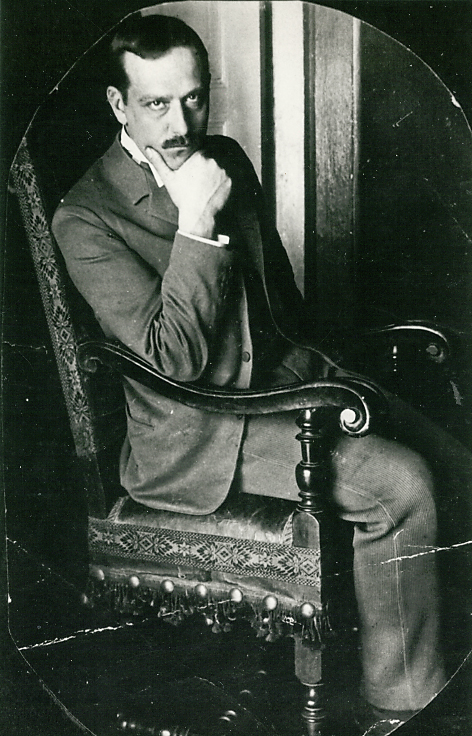
The period of World War I was a time of great transformation. Russia’s military defeat created new opportunities for national movements. In 1916, in territories occupied by German troops, Belarusian politicians first raised the issue of Belarusian statehood in the form of a federation with its closest neighbours, most hoping for an alliance with Lithuania. The ideological foundation of Belarusian federalism was the national idea. In the territories controlled by Russian troops, changes were facilitated by the outbreak of the revolution in February 1917, which quickly transformed Minsk into the political centre of the Belarusian movement. At that time, Skirmunt held an important position as plenipotentiary of the Special Council for Food in the Minsk Governorate.
The Krajowiec among Belarusians
In 1916, Skirmunt joined the Minsk branch of the Belarusian Society for Aid to War Victims – the only Belarusian organisation in Minsk at the time – and soon became its leader. Joining the Belarusian movement was his conscious choice, influenced by his earlier contacts with Belarusian activists, including the renowned Belarusian poet Maksym Bahdanovich. Another motive was the search for a political force capable of implementing the political agenda of the krajowcy and preserving the integrity of the lands of historical Lithuania. Skirmunt chose the Belarusian movement due to its characteristic national and religious tolerance, as well as the contacts between Belarusian politicians, Lithuanian activists, and the Lithuanian Polish elite.
The Russian Revolution enabled national activity; so, in late March 1917, Skirmunt initiated a congress of all Belarusian parties and organisations in Minsk. This resulted in the creation of a single coordinating centre – the Belarusian National Committee (BKN), which he headed. The BKN’s main political goal was to achieve Belarusian autonomy within the democratic Russian federation. At the same time, the BKN deliberately avoided the issue of defining Belarus’s borders, reflecting Skirmunt’s desire to frame the movement in national rather than territorial terms. However, the visit of the Belarusian delegation to Petrograd and its attempts to convey the idea of Belarusian autonomy to the leaders of the new Russia ended in failure.
The radicalisation of the Russian Revolution destroyed the unity of the Belarusian movement. During the BKN session on May 13–15, 1917, a serious clash erupted between the socialists and Skirmunt. BKN member Father Wincent Godlewski recalled that during the session he welcomed statements from landowners Edward Woyniłłowicz, Princess Maria Magdalena Radziwiłłowa, and Prince Hieronim Drucki-Lubecki regarding their desire to return “to the people from which they sprang”. In his speech, Hieronim Drucki-Lubecki admitted that he came from a Belarusian princely family. However, most BKN members were critical of the landed gentry. This was a political defeat for Skirmunt. Only he and Princess Radziwiłłowa, the committee’s main founder, remained on the Committee. Skirmunt then resigned as BKN chairman and remained a rank-and-file member.
The socialists decided to get rid of Skirmunt and in July 1917, in place of the BKN, established the socialist Central Council of Belarusian Organisations, which no longer had a seat for the former BKN leader. Skirmunt withdrew from Belarusian public activities for a time. In the second half of 1917, he collaborated with Polish organisations in the Minsk region, participated in the Moscow State Conference, and as a member of the Pre-Parliament (Provisional Council of the Russian Republic – editor’s note) witnessed the Bolshevik coup in Petrograd. After the Bolsheviks dispersed the All-Belarusian Congress in Minsk in December 1917, he headed the illegal Belarusian People’s Committee.
Skirmunt returned to public political activity in February 1918, when the German occupation zone expanded to encompass all of Belarus. He was one of the first to publicly advocate for Belarusian independence. He later founded the Minsk Belarusian Representation (MBR), which united Belarusians who did not adhere to socialist ideology. The MBR soon established contact with Germany. Hopes arose that, with German assistance, Belarus could be rebuilt. One of the MBR’s first actions was to send a delegation to the German command, where it presented the Memorandum on Belarus. Roman Skirmunt was a leading figure in the MBR, whose political program assumed the restoration of Belarusian statehood in the territories inhabited by Belarusians. This statehood was seen as being consolidated through an agreement with Lithuania and Latvia, thus ensuring access to the sea, and through an alliance with the “Great Central Power”, namely Germany. The importance of a just and historical state border with Ukraine was also emphasised. Agrarian reform was planned, which assumed increasing the holdings of small landowners and providing land to landless peasants. The Belarusian People’s Republic (BPR) supported the proclamation of independence of the Belarusian People’s Republic (BPR) on March 25, 1918, and its members joined the BPR Council in April. In May 1918, the BPR Council entrusted Roman Skirmunt with forming a coalition government, whose primary task was to secure German recognition of the BPR’s independence. Forming a government proved challenging due to opposition from Belarusian socialists.
Unlike the socialist trend in the Belarusian movement, whose program combined a national project with social radicalism and revolutionary slogans, often subordinating the former to the latter, the conservative-liberal circles linked the national idea to a program of gradual socio-economic and political reform.. After the victory of Bolshevism in Russia, representatives of the Belarusian socialist movement were the first to recognise that hopes of securing support for Belarusian self-determination from its eastern neighbours were illusory. Therefore, Roman Skirmunt and his supporters persistently sought to consolidate Belarusian national forces and find a reliable European partner.
A significant obstacle to Skirmunt’s work was the doctrinaire stance of Belarusian socialists and their distrust of the “Polish landlord”, which grew with the radicalisation of the Russian Revolution. The fall of Roman Skirmunt’s government (July 1918) was also due to Berlin’s position. In order to maintain good relations with the Bolshevik authorities in Russia, Berlin refused to recognise the independence of the BPR, although it occasionally signalled a willingness to do so. Nevertheless, even after this defeat, Skirmunt remained on the BPR Council and by late 1918 was one of its chief diplomats.
By the spring of the following year, Skirmunt was active in various associations of Lithuanian Poles. Their efforts were limited to preventing the partition of Belarus between Poland and Soviet Russia, incorporating Belarusian lands into the Second Polish Republic within its 1772 borders on the basis of a union or broad autonomy, and ensuring the implementation of land reform with minimal losses for landowners. At the same time, Belarusian public opinion continued to perceive him as an activist in the Belarusian movement. The Vilnius newspaper “Biełaruskaja Dumka” of May 5, 1919 (issue 4) informed its readers that “this week, the Belarusian nobleman Roman Skirmunt will arrive in Vilnius from Warsaw”.
The reasons for his departure from the Belarusian movement were his growing sympathy for the Bolsheviks and for the rebirth of the Polish state. Despite the dominance of National Democrat views among Polish elites, which resulted in the Treaty of Riga and the partition of Belarus, which Skirmunt considered a political crime, it was Poland that held the greatest hopes for normalising life in the region and eliminating the Bolshevik threat. However, in the Polish political arena, the owner of Porzecze remained a little-known figure.
The Interwar Period
The effects of the Treaty of Riga dashed Roman Skirmunt’s political ambitions, and his country was effectively reduced to the Polesie region. Skirmunt undertook the reconstruction of his destroyed estate in Porzecze and returned to political activity only after the May Coup d’état in 1926. He supported the changes at that time, hoping that Józef Piłsudski’s Sanation regime would correct the shortcomings of Polish policy towards the country’s eastern territories and national minorities. In 1930, he was elected to the Senate of the Second Polish Republic, but he quickly became disillusioned with the ruling camp’s policies and did not demonstrate significant parliamentary activity.
During the interwar period, Roman Skirmunt collaborated with the Vilnius magazine “Słowo” (editor Stanisław Cat-Mackiewicz), where he published memoirs of deceased natives and reflections on the published memoirs of Edward Woyniłłowicz and Hipolit Korwin-Milewski. He also spoke on issues crucial to the economy and the cultural development of Polesie. During this time, the concept of “Kraj” in his thinking narrowed to the Polesie region, which became his primary concern. The memoirs of the inhabitants of the village of Porzecze paint a picture of a “good lord” who came to help in critical situations and acted as a true protector of the local community. During fieldwork in Porzecze and nearby villages, I sometimes had a strange feeling of Roman Skirmunt’s presence in the lives of contemporary “Porzecze residents”.
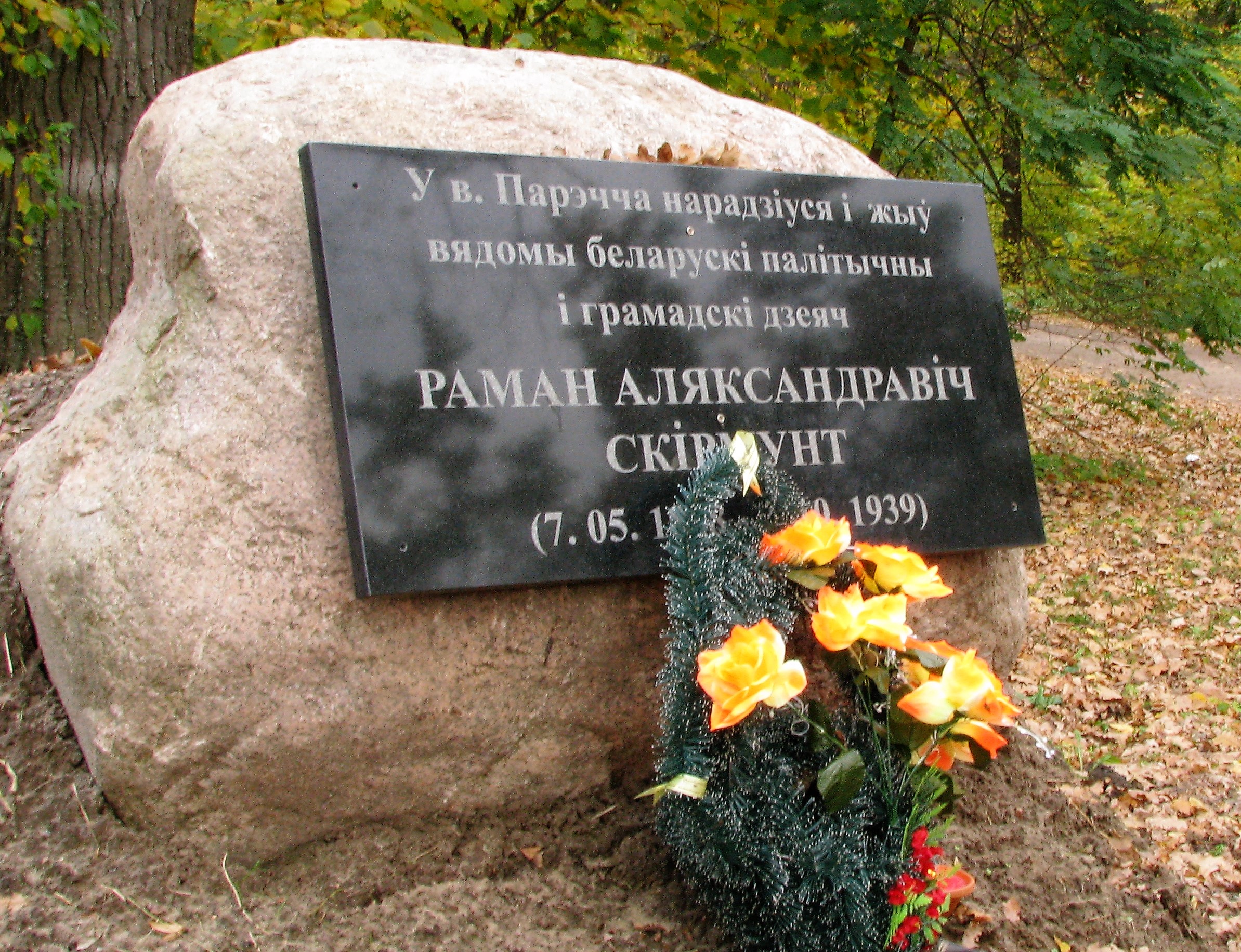
Plaque in the Porzecze park. 2014. Photo: A. Smalianczuk.
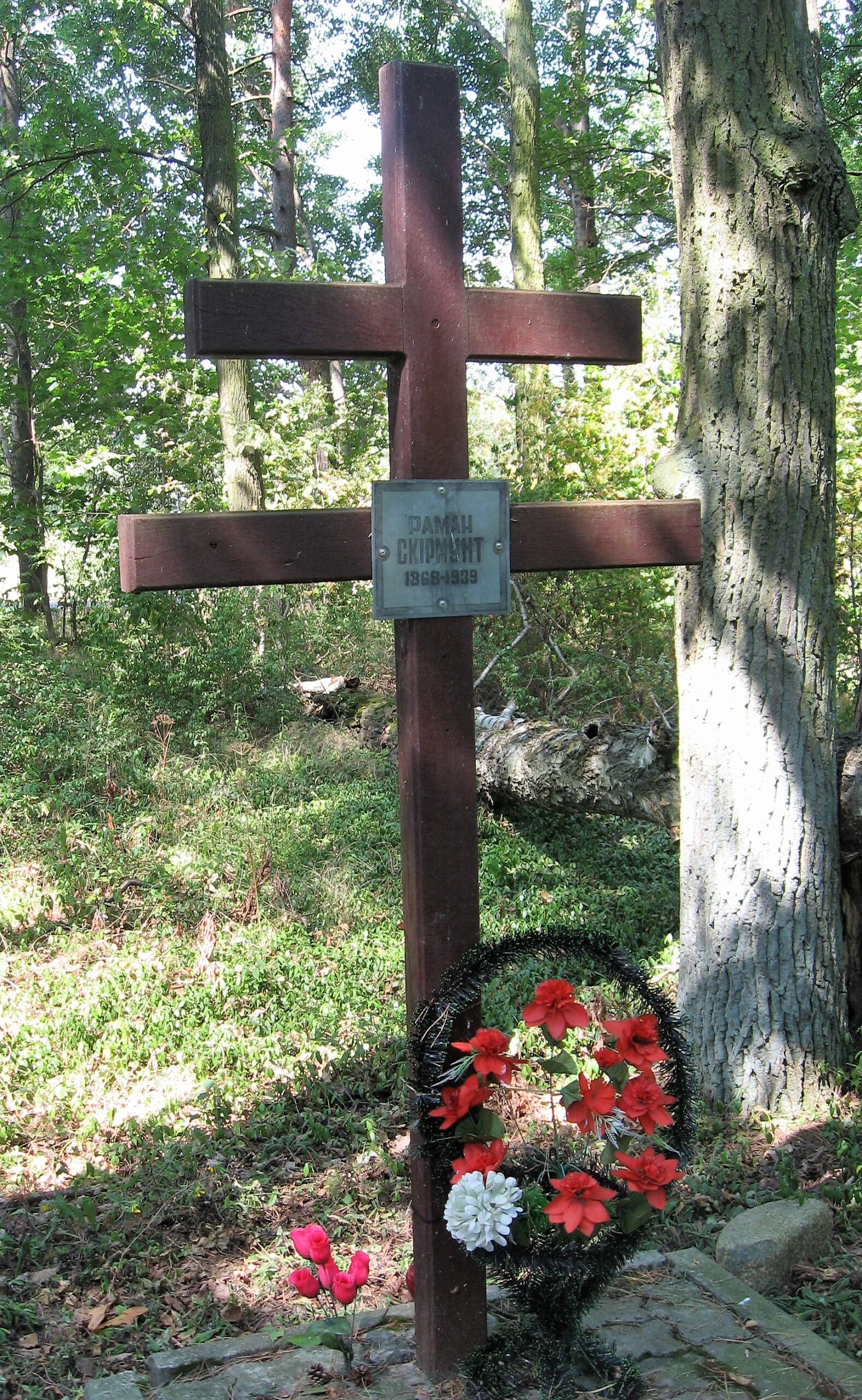
Roman Skirmunt’s life ended tragically. On October 7, 1939, he was shot in a forest near Porzecze. This crime was organised by NKVD officers, who found a culprit among the local peasant population. In the autumn of 1939, during the first Soviet occupation, so-called “people’s reckonings” with the “oppressors” were frequent. It can be assumed that Commissars Kholodov and Moskalov, who were in the village at the time, were aware of Skirmunt’s Belarusian political activities, which may have been a significant motive for his murder.
Skirmunt’s death became a symbol of the tragedy of the people of Western Belarus, annexed by the USSR. Propaganda slogans about the “liberation of Belarusians” from the rule of “Polish masters”, amplified in the autumn of 1939, actually signified the subordination of millions of people to the Stalinist system and its apparatus of repression, including the GULAG.
In the 1990s, a plaque commemorating the “Belarusian of Polish culture” – the native Roman Skirmunt – was unveiled in a park in Porzecze. A man whose political activity can be called the final act of Polish–Belarusian symbiosis is returning to historical memory.
Prof. Aleksander Smalanczuk
Translated from Polish by Katarzyna Remża
[1] Krajowcy – representatives/ evangelists of Krajowość Idea
Krajowość – a concept of supra-ethnic civic identity rooted in the historic lands of the former Grand Duchy of Lithuania.