

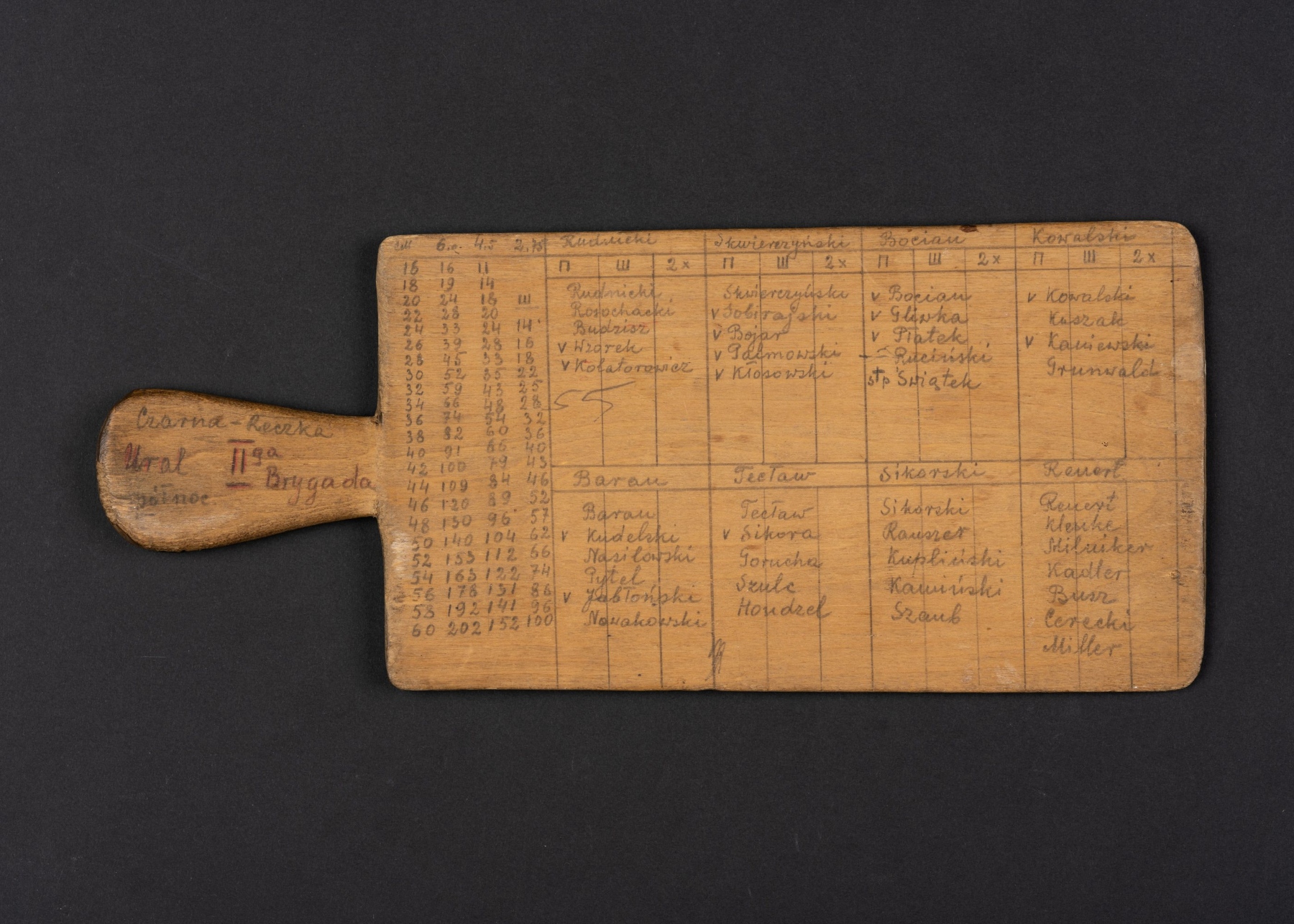
This small kitchen chopping board bears a remarkable message from the past: a record of Gulag prisoners working at the Czornaja Reczka (Black Stream) labour camp outpost in the vicinity of Verkhoturye, beyond the Ural Mountains. A few years ago, the board was donated to the Museum by Jolanta Woźniakowska, whose grandfather, Karol Frelek, brought it back from Sybir.
Karol Frelek was born in 1905 in Parysów, in the Garwolin district. He worked as a surveyor. He married Jadwiga Kosieradzka and purchased a farm in the village of Szydłowin, in the municipality of Suchożebry in the Masovia region. In 1938, their daughter Teresa was born.
In 1945, Karol Frelek was arrested and deported deep into Russia to Camp No. 231 in the Urals. At that time, the Soviets primarily arrested and deported members of the Polish independence underground to labour camps; however, whether this was the case here remains unknown. According to The Index of the Repressed, Karol Frelek was sent to a labour camp on 22 April 1945. Camp No. 231 consisted of two larger sub-camps [OŁP – Separate Camp Point]: Koszajski and Verkhoturye. These, in turn, were divided into smaller units known as camp outposts. Karol Frelek was assigned to the Czornaja Reczka outpost, subordinate to the Verkhoturye OŁP. Little is known about the Czornaja Reczka site itself, except that it was located approximately 45 kilometres north or north-east of Verkhoturye, where the OŁP administration was based.
After returning from Siberia, Karol Frelek worked at the municipal office in Garwolin. He died in 1959.
In the labour camp, Karol Frelek commanded the 2nd brigade, which worked in the forest felling trees. The inscriptions on the chopping board date from this period. On one side, next to an inscription on the handle reading: ‘Czarna Rzeczka, 2nd Brigade, Northern Urals’, along with sequences of numbers used to calculate work quotas, the names of the members of the 2nd work brigade at Czarna Rzeczka are listed.
They were divided into eight work groups, led by: Rudnicki, Skwierczyński, Bocian, Kowalski, Baran, Tecław, Sikorski and Renart. Both the group leaders and their members can be identified as detainees held in Labour Camp No. 231 in the Urals.
For example: Alfred Rudnicki was interned from 7 April 1946 to October 1947; Józef Skwierczyński from 22 April 1945 to 6 January 1946; Jan Bocian from 22 April 1945 to 27 July 1947; Franciszek Kowalski from 22 April 1945 to 15 February 1946 (alternatively: Jan Kowalski, 22 April 1945 to 27 July 1945; Józef Kowalski, 22 April 1945 to 15 February 1946; Piotr Kowalski, 22 April 1945 to 3 April 1946 [died]; or Zdzisław Kowalski, 22 April 1945 to 27 July 1945); Adam Baran from 19 April 1945 to 16 January 1946 (alternatively: Władysław Baran, 22 April 1945 to 23 September 1946); Antoni Sikorski from 1945 to 23 September 1946 (alternatively: Bogdan Sikorski, from 22 April 1945). Ignacy Świątek, listed in the 3rd work group and marked with a cross and the letters ‘sp’ (świętej pamięci, in memoriam), died on 20 July 1945.
The names of some brigade members are marked with tick symbols. Such markings appear next to 14 out of the 42 recorded names: Wzorek, Kolatorowicz, Sobirajski, Bojar, Palmowski, Kłosowski, Bocian, Gliwka, Płatek, Kowalski, Kaniewski, Kudelski, Jabłoński, Sikora. These individuals left the camp on 27 July 1945. Next to the name of Henryk Ruciński, horizontal lines are visible, suggesting that he may have died on the same day (?). Those whose names bear no markings left Camp No. 231 at a later date (in 1946) or are not listed in the published index. Notably, the members of the eighth work group are absent; judging by their names, this group appears to have consisted exclusively of German prisoners of war. This allows us to date the inscriptions on the board to the period between 22 April 1945 – shortly after Karol Frelek and most members of his brigade arrived at Camp No. 231 – and before the death of Ignacy Świątek on 20 July 1945. After 27 July 1945, the board ceased to serve a practical function, as nearly half of the brigade’s members had by then left the camp.
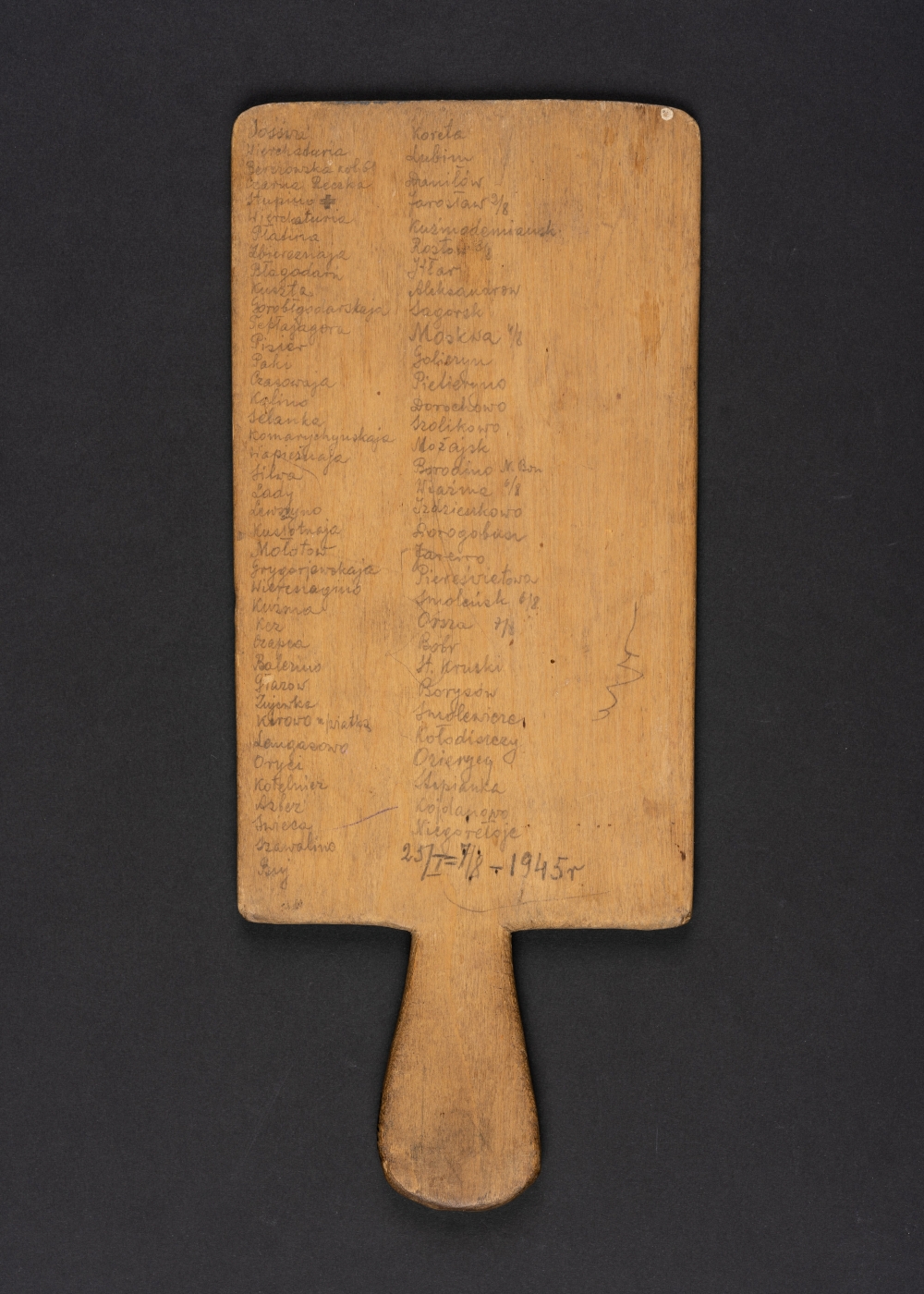
On the reverse side of the board, arranged in two columns, are the names of 72 localities. At the beginning are the names of sub-camps belonging to Camp No. 231. One of them – Stupino – is marked with a cross, as it housed a large camp infirmary. One of them – Stupino – is marked with a cross, as it housed a large camp infirmary. This is followed by the names of both major and minor railway stations, running from the Urals, through Moscow, and westwards as far as Kojdanowo (now Dzyarzhynsk) in the Minsk region of Belarus, and the station of Niegoreloye. The latter was the final Soviet station on the border between the Second Polish Republic and the Soviet Union. At this point, there also appears the inscription ‘25 I = 7/8 – 1945’. Fractions such as 2/8, 3/8, 4/8, and 6/8 are likewise recorded next to other place names. This appears to represent a reconstructed route of return from Labour Camp No. 231 to the pre-war Polish border – but can we be certain? Can anyone add further information about the individuals listed here? Every trace matters.
Please get in touch.
Translated from Polish by: Małgorzata Giełzakowska