

Maciej Wyrwa
Despite the passage of time, many families are still searching for information about the fate of their loved ones who were repressed by the Soviet Union. Despite years of searches carried out by, among others, the Polish Red Cross and the Institute of National Remembrance, numerous cases – their number probably reaching tens of thousands – have still not been definitively explained.
After the publication of the book Lost Victims of Katyn? List of persons missing in the north‑eastern voivodeships of the Second Polish Republic from 17 September 1939 to June 1940, I began to receive letters from people searching for information. The authors of these letters write, among other things: “I would like to submit a short biography of my great‑uncle, who was a victim of the Katyn crime in Belarus”; “I am searching for information about my grandfather’s brother. He probably died in the first days of the war. Perhaps he died in Katyn – that’s what his brother said”; “I am looking for information about my great‑grandfather. He died in Katyn, most likely in 1942”; or “My father is on the Belarusian Katyn list”. When someone “disappeared in the East” during the Second World War, the best‑known and socially rooted explanation remains the Katyn crime. In this way, a specific, although not always accurate, narrative fills the gap left by a lack of knowledge.
Let us therefore try to summarise what we know about the still unaccounted‑for victims on the “Belarusian Katyn list”.
What Do We Know?
From the “Katyn decision” issued by the Politburo[1] of the Central Committee of the All‑Union Communist Party on 5 March 1940, we know that the victims of the crime were not only prisoners of war from the three camps at Kozelsk, Starobelsk and Ostashkov, but also those arrested and held in prisons in the western oblasts of Ukraine and Belarus – that is, in the Polish territories annexed by the Soviet Union after 17 September 1939. The decision document laid down the procedure for the crime. The cases of these prisoners of war and detainees were to be examined under a special procedure by an “NKVD troika” composed of Vsevolod Merkulov, Bakhcho (Bogdan) Kobulov and Leonid Bashtakov: the detainees would not be summoned, charges would not be presented, and no indictment or formal decision to close the investigation would be issued. The death penalty – execution by shooting – was to be applied to all of them. It was planned to shoot 11,000 detainees considered to be “members of various counter‑revolutionary, espionage and diversionary organisations, former landowners, factory owners, former Polish officers, officials and fugitives”.
[1] Politburo – political bureau – the highest organ of the central committee in communist parties
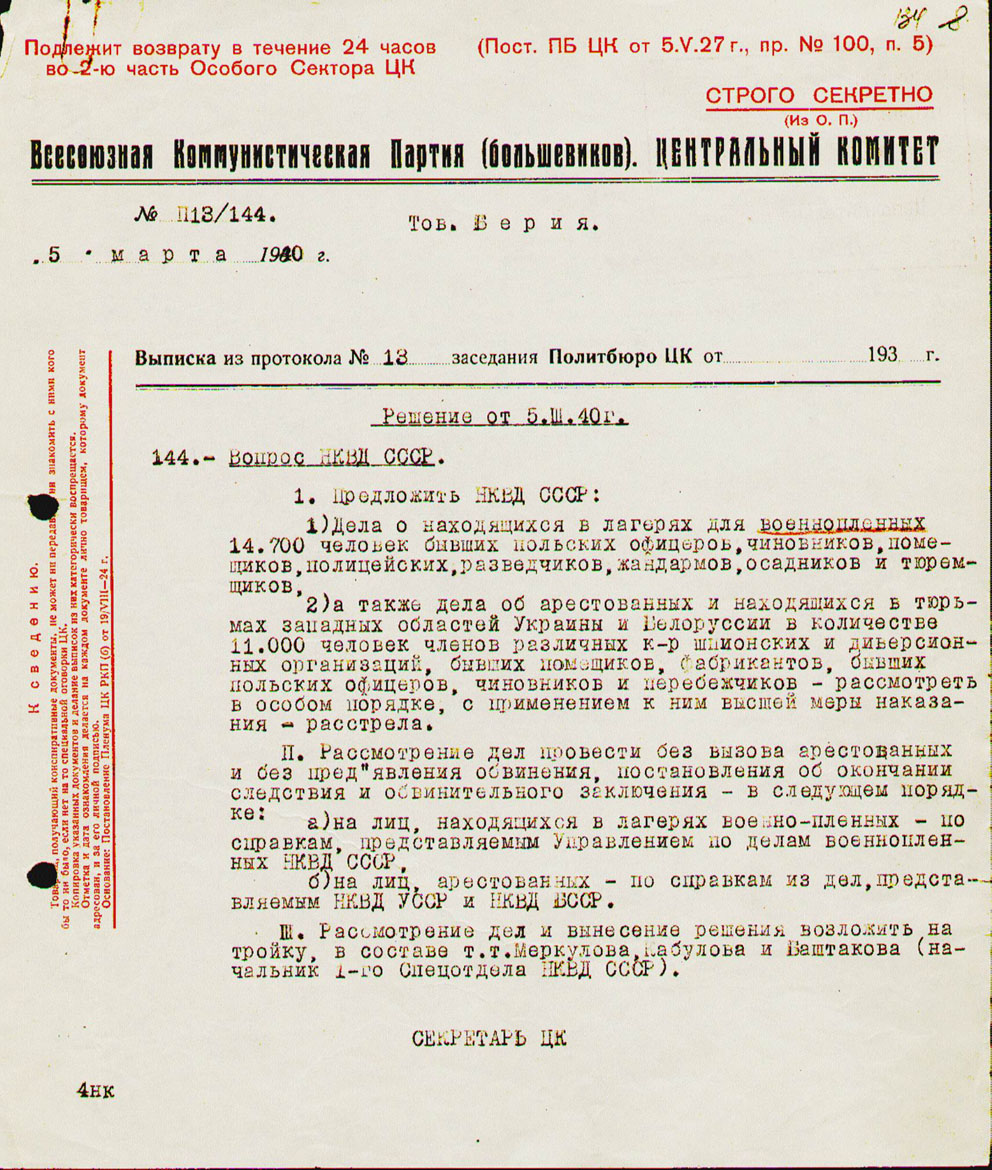
The note bears four handwritten signatures of members of the Politburo: Joseph Stalin, Kliment Voroshilov, Vyacheslav Molotov and Anastas Mikoyan, as well as annotations indicating votes “in favour” by Mikhail Kalinin and Lazar Kaganovich. The basis for this criminal decision was a memorandum prepared for Stalin by the People’s Commissar for Internal Affairs of the USSR, Lavrentiy Beria, in which we read that “all of them are hardened and unreformable enemies of Soviet authority”.
Such an operation could not have been carried out without prior preparations. It is worth recalling, however, that criminal actions on an even larger scale were carried out in 1937–1938, during the Great Terror. It is enough to mention that under the so‑called Polish Operation of the NKVD alone, at least 111,000 people were murdered, the overwhelming majority of whom were Poles living in the Soviet Union.
First of all, the appropriate number of railway wagons was secured. On 21 March 1940, Beria sent a letter to the People’s Commissar of Communications, Lazar Kaganovich, concerning the “execution of an urgent operational task”. In the case of prisoners from the territory of Belarus, they planned for 100 wagons of the Brest Railway, 23 wagons of the Białystok Railway, and 32 wagons of the Western Railway.
The next step was to secure transportation and supervision over the prisoners. On 22 March 1940, Beria issued secret order No. 00350: “The unloading of NKVD prisons of the western oblasts of the Ukrainian and Belarusian SSRs”. From this document it appears that from the NKVD prisons of the western oblasts of the Belarusian SSR, 3,000 detainees were to be transferred to the prison in Minsk, including 1,500 persons from the prison in Brest, 550 persons from the prison in Wilejka, 500 persons from the prison in Pińsk, and 450 persons from the prison in Baranowicze.
The transport of the detainees was to be handled by the head of the 2nd department of the Main Prison Administration of the NKVD of the USSR, State Security Captain Aleksandr Chechev, and by the People’s Commissar for Internal Affairs of the Belarusian SSR, Lavrentiy Tsanava. Responsibility for “ensuring strict discipline and guarding the detainees during reception and loading, as well as during the transport by train of the detainees” was entrusted to Tsanava, Chechev and the commander of the 15th NKVD Convoy Troops Brigade, Colonel Popov. The dictate presupposed that the entire operation would be completed within ten days.
Those destined for execution were most probably transported to the central prison in Minsk on Volodarsky Street (the former Sapieha castle) and to the internal NKVD prison, known as the “American prison” or the “round building”, located on Zacharievskaya Street (today Independence Avenue).
As in every mass NKVD operation, the crime was accompanied by extensive bureaucracy. For the prisoners, registration files and “information sheets” were filled out, which were then sent to the 1st Special (registration‑statistical) Department of the NKVD of the USSR. On their basis, dispatch lists were drawn up – namely, orders to execute, also called “death lists”. These were then examined and approved by the aforementioned “NKVD troika”. It is these dispatch lists that are today conventionally referred to as the “Belarusian Katyn list”.
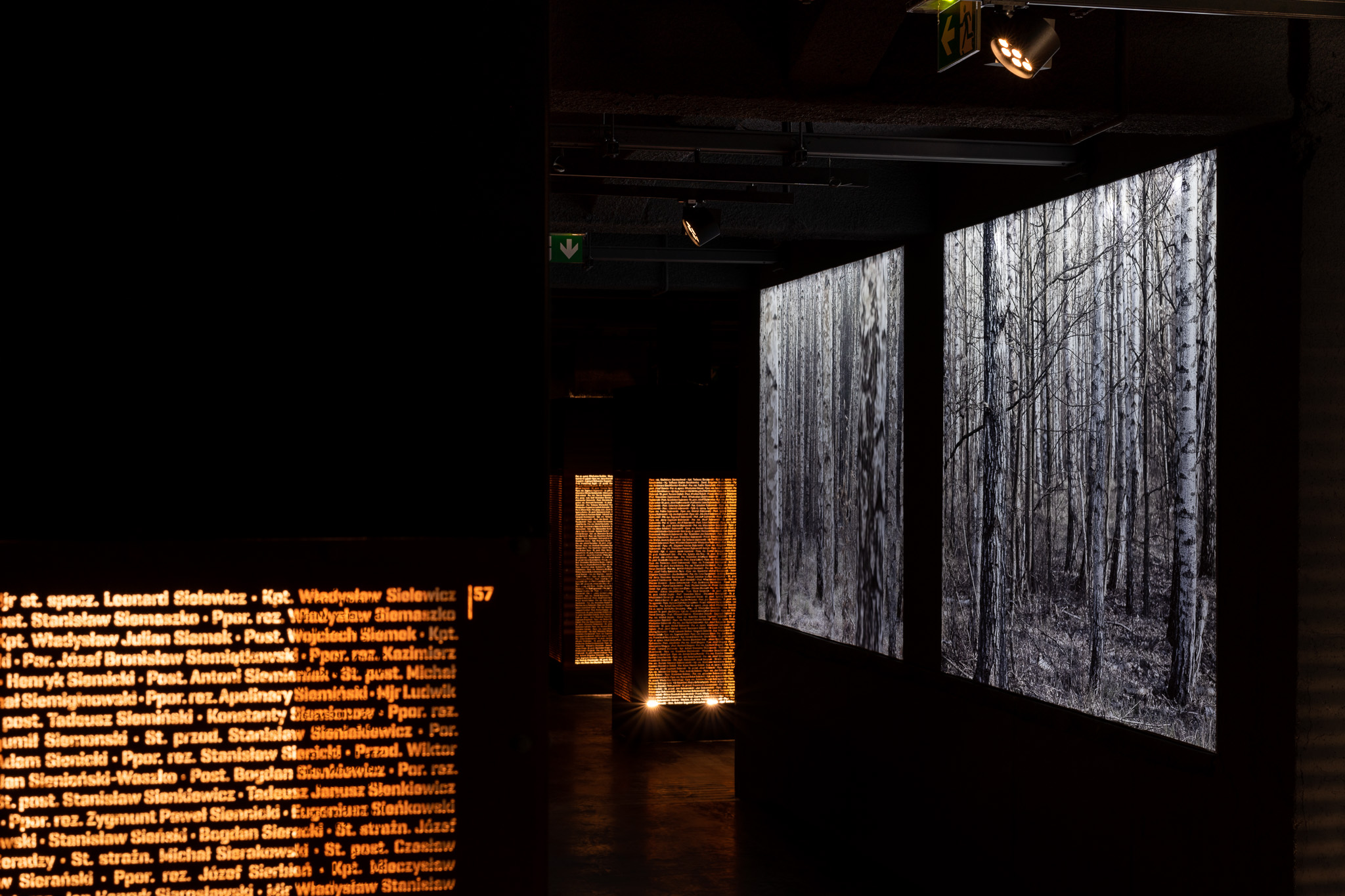
On the basis of documentation relating to the Katyn crime, Jędrzej Tucholski established that the dispatch lists of executed prisoners of war from the camps at Kozelsk, Starobelsk and Ostashkov, and of prisoners murdered in Ukraine, were numbered in a single continuous sequence. Gaps in the numbering indicate that nine lists contained the names of prisoners held in Belarus, sentenced to death between 22 April and 19 May 1940. These dates are confirmed by witnesses’ accounts. In his Notes from Exile, Konstanty Rdułtowski recalled: “At the end of April or the beginning of May, Kazio, Stefan Rdułtowski, Jan Mierzejewski and Mieczysław Kotarbiński were taken away. In their place, others were packed into the cells. In the meantime, they have still not been found.” Their fate, it is worth noting, remains unknown to this day.
The spring deportations of 1940 may be an important clue in determining whether a given person fell victim to the Katyn crime. The second wave – the so‑called April deportations – primarily concerned the families of persons repressed on the basis of the decision of 5 March 1940. On 2 March 1940, the Soviet authorities decided to deport for ten years to the Kazakh SSR, among others, members of the families of those arrested and of prisoners of war held in camps. Five days later, Lavrentiy Beria specified that family members were to be understood as wives, children and parents, as well as siblings, provided they lived together with the arrested person or prisoner of war. It is estimated that in April 1940 at least 61,000 Polish citizens were deported. To this day it is not known how many of them did not survive exile.
What Do We Not Know?
To this day we do not know where and in what manner the victims of the Katyn crime in Belarus were shot, nor where their bodies were hidden. Were the victims murdered in the cellars of the Minsk prison, or perhaps – according to one hypothesis – directly over previously prepared “death pits” in the forest complex at Kuropaty? The latter possibility is supported by witnesses’ accounts that in 1940–1941 they saw lorry transports entering the forest, from where shots were then heard.
The hypothesis that Kuropaty was a place of concealment of bodies is also supported by the results of partial exhumations carried out by the Belarusian side in 1988–1989. At that time, the remains of persons were discovered, many of which bore traces of shots to the back of the head – typical of the method used by the NKVD. The same method was used to kill other victims of the Katyn crime. Objects suggesting that persons from pre‑war Poland may have been among the victims were also found with the bodies, such as medallions with the Black Madonna of Częstochowa and Our Lady of Ostra Brama, a metal cup, and shoes and rubber boots made by Polish brands. A harrowing piece of evidence is a man’s comb found there with an inscription scratched in Polish: “The hard moments of a prisoner. Minsk 25.04.1940. The thought of you drives me mad. 26.04 I burst into tears – a hard day”. Did its owner fall victim to the Katyn crime?
Since 1937, Kuropaty had served as a secret burial ground, with at least 30,000 victims of Soviet crimes being buried there. Much indicates that the bodies of Poles murdered during the Great Terror and as part of the Katyn crime may lie there side by side.
Was Kuropaty the only place where the bodies were hidden? The Belarusian researcher Ihar Kuzniacou has indicated a dozen or so probable sites in the Minsk area where victims of Soviet repression were buried – including Drozdy, Komarówka, and the grounds of today’s Minsk‑1 airport. Without comprehensive archaeological work, we will never know for sure.
We also do not know the final number of victims of the Katyn crime in Belarus. From a memorandum containing a proposal to destroy the registration files of the murdered from the Chairman of the Committee for State Security (KGB) of the USSR, Aleksandr Shelepin, to the Chairman of the Council of Ministers of the USSR, Nikita Khrushchev, dated 3 March 1959, we learn that within the framework of the Katyn crime 14,552 prisoners of war were shot – whose bodies lie in the Polish cemeteries at Katyn, Miednoye and Kharkiv‑Pyatykhatky – as well as 7,305 persons held in prisons in so‑called Western Belarus and Western Ukraine. The list of those murdered in the territory of the Ukrainian SSR, the so‑called Ukrainian Katyn list, containing 3,435 names, was handed over to the Polish authorities on 5 May 1994 by the Deputy Head of the Security Service of Ukraine, General Andriy Khomych. If the number of executed prisoners given in Shelepin’s memorandum (7,305) is correct, then the analogous “Belarusian Katyn list” should contain 3,870 names. It remains a mystery how the discrepancy in the number of victims arose. Let me recall: the “Katyn decision” of 5 March 1940 speaks of 11,000 detainees, while Shelepin writes of 7,305 persons.
We know almost all the names of the executed prisoners of war from Kozelsk, Starobelsk and Ostashkov, as well as the names of the detainees murdered in Kyiv, Kharkiv and Kherson. We still do not, however, know the names of those murdered in Minsk.
It may be assumed that the names on the so‑called Belarusian Katyn list – analogously to the discovered and declassified “Ukrainian Katyn list” – were first and foremost representatives of the elites of the Second Polish Republic. Among them were officers (including reservists), policemen and other uniformed service personnel, officials, as well as members of the intelligentsia, but also teachers, doctors, lawyers, engineers, clergy, landowners, merchants, entrepreneurs, and social and political activists. They were mostly of Polish nationality, but also Belarusian, Jewish, Ukrainian, and members of other minorities living in pre‑war Poland, judged by the Soviet authorities to be potentially hostile elements. The vast majority of the victims were probably men, although among those murdered there may also have been women, primarily members of the intelligentsia.
To sum up, the so‑called Belarusian Katyn list may include persons who were arrested by the Soviet authorities after 17 September 1939 and were held in prisons in the annexed north‑eastern voivodeships of the Second Polish Republic. These people were then, from March 1940, transported to prisons in Minsk or were already imprisoned there. An important indication is also the moment when contact with the arrested person was lost, falling between April and June 1940. Additional indirect clues may be their membership of the broadly understood elites of the Second Republic and the deportation of their relatives to the Kazakh SSR in April 1940.
One essential question still remains: Why, despite so many years having passed since the crime was committed, do we still know so little about it and its victims?

Unfortunately, the answer is quite simple: the authorities of Russia and Belarus are not interested in revealing the whole truth about the Katyn crime. In Belarus, the criminal investigation concerning NKVD executions carried out in 1939–1941 in Kuropaty was discontinued as early as 1995. In turn, the Russian Main Military Prosecutor’s Office, in conducting its investigation into the Katyn crime, did not address the issue of the detainees at all. The investigation was discontinued in 2004. This decision, as well as some of the evidence gathered during the investigation, were classified.
To this day, despite efforts, the Polish side has not been granted access to archival records that could help determine the identities of the victims, the circumstances of the crime, as well as its perpetrators. The murdered have also not been afforded a dignified burial. Instead, in contemporary Russia, the Soviet responsibility for the crime is increasingly being questioned, and in Belarus the very fact that murders were committed on its territory is denied. As Alyaksandr Lukashenka stated: “Not a single Pole was shot on the territory of Belarus.”
Maciej Wyrwa – Doctor of History, graduate in East European Studies at Adam Mickiewicz University in Poznań. Head of the Research and Scholarship Programs of the Mieroszewski Centre.
Translated from Polish: Katarzyna Remża (Sybir Memorial Museum)