


The attempted crossing of the Soviet–German border in October 1939 marked the beginning of the end for Father Fabian Abrantowicz. He would never again escape from Soviet custody. When tortured, he would confess to alleged numerous crimes against the Soviet authorities – only none of which were true.
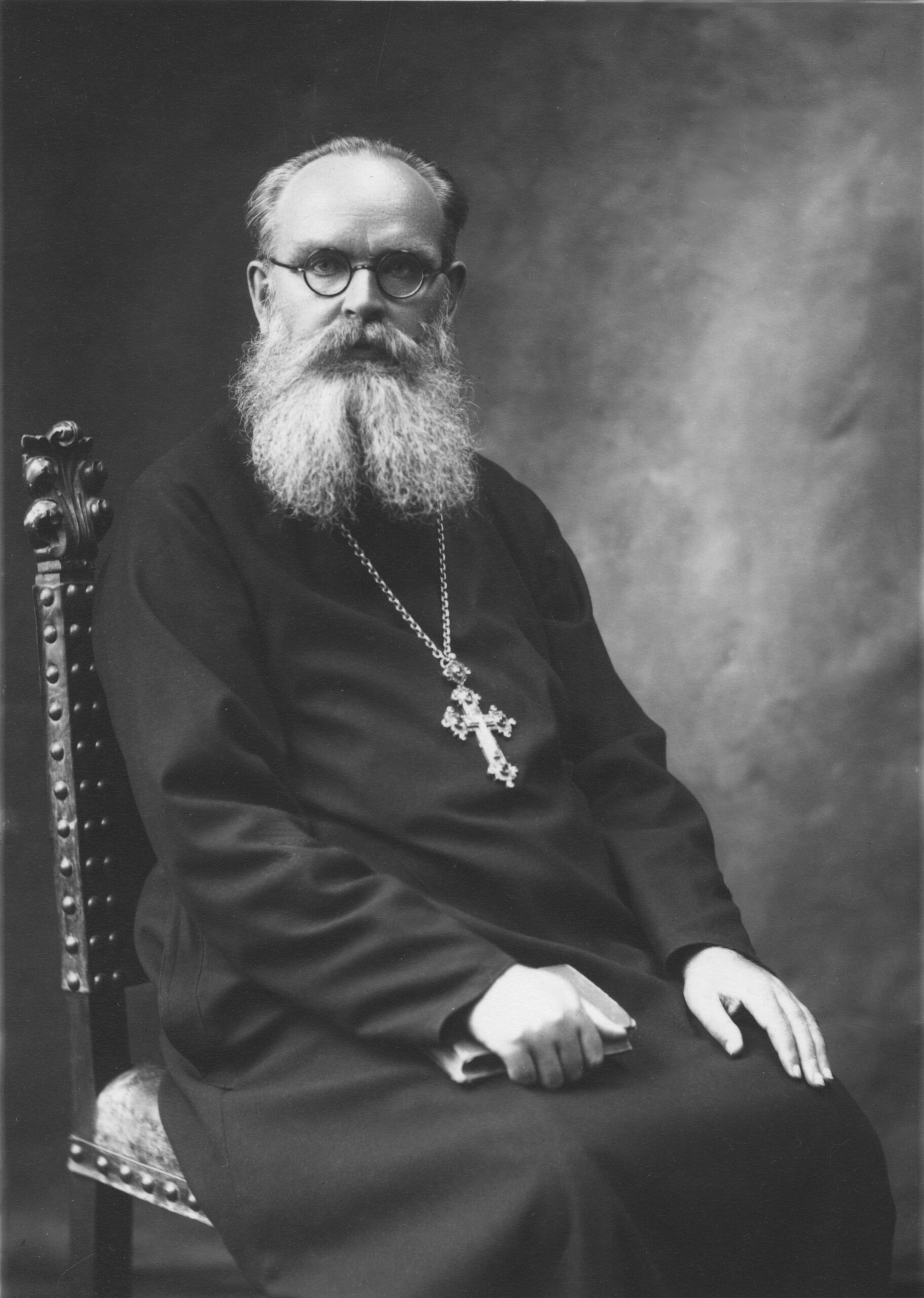
Throughout his life, Father Abrantowicz, a Belarusian by origin, remained uninvolved in politics. From an early age, however, he recognized his vocation to serve God. He was born on 14 September 1884 in Vereshkovshchina near Novogrudok and attended school in that town. At the age of sixteen, after completing his education, he entered the theological seminary in Saint Petersburg. He later continued his studies at the Ecclesiastical Academy, also in Saint Petersburg. In 1908, he was ordained a priest. Two years later, having completed his studies and earned a master’s degree in theology, he taught for some time at a gymnasium affiliated with the Church of St Catherine, as well as at the Imperial School of Law. He subsequently left for Louvain in Belgium, where he obtained a doctorate in philosophy from the Catholic University. Upon returning to Saint Petersburg, he became a lecturer at the seminary in 1914 and also served as a pastor.
The October Revolution forced Father Abrantowicz to leave Saint Petersburg. In 1918, the Bolsheviks closed the seminary there. He then moved to Minsk, where Bishop Zygmunt Łoziński sought to establish a new institution and appointed Abrantowicz as its rector. He energetically undertook the task of organizing the school. However, Minsk also became unsafe two years later, when Bolshevik forces approached, and the seminary had to be evacuated. Father Abrantowicz returned to Novogrudok, his native region, where he engaged in pastoral work. When a lower seminary was opened there in 1922, he resumed his duties as a lecturer.
In 1926, Father Fabian Abrantowicz joined the Marian Fathers (Congregation of Marian Fathers of the Immaculate Conception of the Most Blessed Virgin Mary). This decision was likely influenced by his acquaintance with Father Jerzy Matulewicz, a lecturer at the Saint Petersburg Ecclesiastical Academy during Abrantowicz’s studies and later Bishop of Vilnius (1918–1925). Bishop Matulewicz had also revitalized the Marian Order, which had previously been gradually suppressed by the Tsarist authorities; he himself had taken religious vows in 1909. Following his example, Abrantowicz took his vows in 1927. The following year, he was appointed by Pope Pius XI as Apostolic Administrator for Catholics of the Byzantine-Slavonic rite in China. In 1929, he departed for Harbin.
The beginnings of his mission were difficult. Father Abrantowicz entered an unfamiliar environment that regarded him with suspicion. Only a handful of people attended services, and there were insufficient funds for any significant activity. Progress in overcoming these barriers was slow. He established an orphanage for Orthodox boys, later transformed into a secondary school that eventually developed into an ecumenical institution. He also showed concern for educational centers run by religious sisters. By the mid-1930s, a house of the Marian Fathers had been opened in Harbin.
Father Abrantowicz worked there for the next ten years, during which he also visited Europe several times. In the spring of 1939, he again traveled to Rome, and in August he arrived in Poland. After visiting several Marian monasteries in Poland and Latvia, he went to see his family in Novogrudok. He was with his relatives when the Second World War broke out. He intended to return to Rome via Lviv. He reached the city and even met with Metropolitan Andrey Sheptytsky. However, his journey to Rome never materialized: while attempting to cross the border near Rava-Ruska, he was detained by German forces and handed over to Soviet border guards. He was imprisoned in Lviv and charged with illegal border crossing, membership of a Catholic religious order, and active involvement in anti-Soviet activities.
Over the following months, he was interrogated repeatedly, often for many hours at a time. In an effort to force him to sign fabricated confessions, the Soviet authorities resorted to torture. As a result, Father Abrantowicz signed all the statements attributed to him, including admissions of espionage on behalf of Japan and the Vatican, as well as conducting activities directed against the Soviet state.
In January 1941, he was transferred to Butyrka Prison in Moscow. Only after several months was he formally charged, yet the investigation continued. In September 1942, a special NKVD tribunal sentenced him to ten years in a labour camp, specifying Karaganda as the place of imprisonment.
Father Abrantowicz never reached the camp. He remained imprisoned in Moscow until the end of his life, though the reasons for this remain unclear. While in prison, he wrote a study on the history of Catholicism in Russia. He died on 2 January 1946.
In 2021, the Vatican Congregation for the Causes of Saints initiated the canonization process.
(ap)