


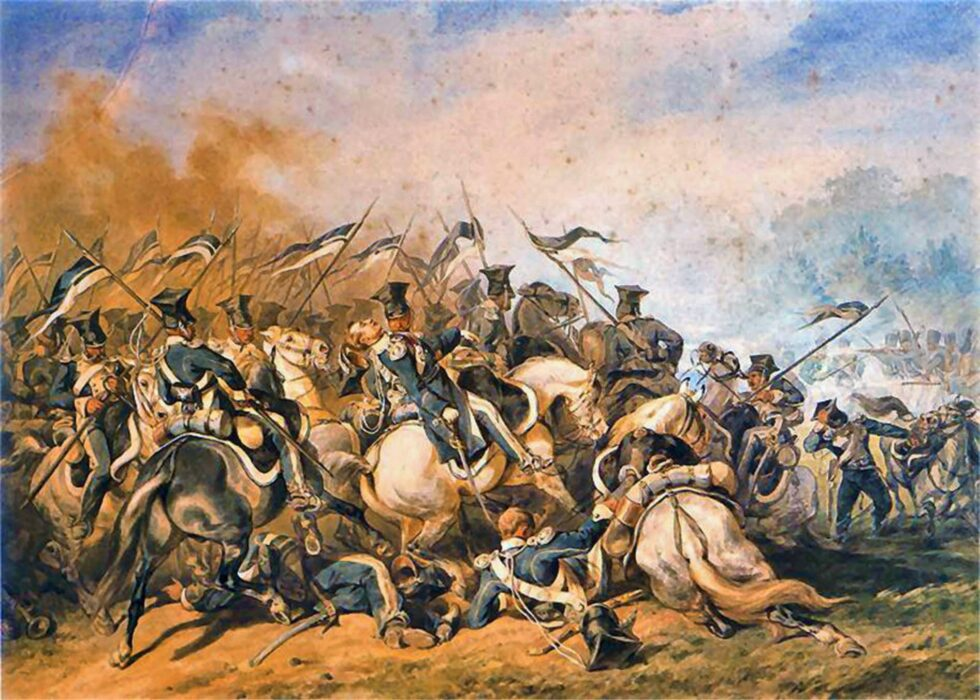
The Battle of Ostrołęka is the second biggest clash of the November Uprising, and at the same time is the battle which changed the faith of this national uprising. Everything occurred on the 26th of May 1831, almost half a year after the famous November Night.
A Road to Battle
Over a month had passed since the Battle of Iganie (the 10th of April 1831). It was a break in hostilities. Ignacy Prądzyński was a Polish commander who wanted to continue the fighting and use the initiative to destroy the Russian forces. This nearly thirty-nine-year-old general became known as a determined supporter of offensive maneuvers against tsarist troops. However, his previous efforts had been met with the refusal of the Commander-in-Chief, General Jan Skrzynecki. Until that moment…
The operational plan prepared by General Wojciech Chrzanowski assumed the destruction of the Russian guard stationed between Łomża and Ostrołęka, which consisted of 30,000 soldiers and 80 cannons. Polish troops numbering more than 50,000, were formed into three columns. Moreover, 19,000 soldiers were appointed to probe the main Russian forces stationed near Siedlce under the command of Field Marshal Ivan Dibich. Their presence was intended to convince the Russian commander that the main forces of Congress Poland were standing in his way and to prevent him from providing any support to the Guard.
Meanwhile, the Polish columns marched against the guards on the 15th of May and three days later engaged them in battle. The Russians began to retreat and General Skrzynecki’s actions turned out to be most helpful here. He commanded a halt to the pursuit of the guards until May the 20th, allowing them to escape towards Białystok. In the meantime, Field Marshal Dibich’s troops were alerted and decided to cut off the Poles from Warsaw. In this situation Skrzynecki decided that the pursuit, which had already reached Tykocin, should be stopped. Together with his soldiers, he marched towards Ostrołęka to cross the western bank of the Narew River.
The indecisive or lost battle?
On the morning of the 26th of May, as Polish soldiers crossed the river near Ostrołęka, they were attacked by Ivan Dibich’s soldiers. The sudden appearance of the Russians and other mistakes committed by the commanding General Skrzynecki, might have led to the total defeat of the Polish army. Salvation came from the daring chargé of the light horse artillery battery under the command of General Józef Bem, who prevented the Russians from making further attacks with grapeshot fire. Due to those actions Polish troops were able to retreat towards Warsaw. By the evening the battle was over.
As a result of the clashes, the Polish army lost 6,000 soldiers, of which 2,000 were killed (among them were 2 generals – Henryk Kamieński and Ludwik Kicki). The loss of buildings in Ostrołęka must also be noted, destroyed by fires that blazed all day. However the losses incurred by the Russians were not insignificant – about 5700 people.
The Battle of Ostrołęka, although not so much lost as indecisive, was a crucial moment in the uprising. From that moment it was the Russian army that “dealt the cards” on the war map. Strategically this battle was a failure of Congress Poland’s army.