

Sergiusz Leonczyk
After the end of the Polish–Bolshevik War, on 18 March 1921, a peace treaty between Poland and Russia and Ukraine was signed in Riga. Among its provisions were clauses concerning the repatriation of the Polish population from Russia, Ukraine and Belarus to the newly independent Polish state. Officially, this repatriation lasted from 1921 until June 1924; however, the final waves of repatriates were still arriving in Poland as late as 1925. Unfortunately, not everyone was afforded the opportunity to make use of their right to return to their historical homeland.

Not everyone was able to leave
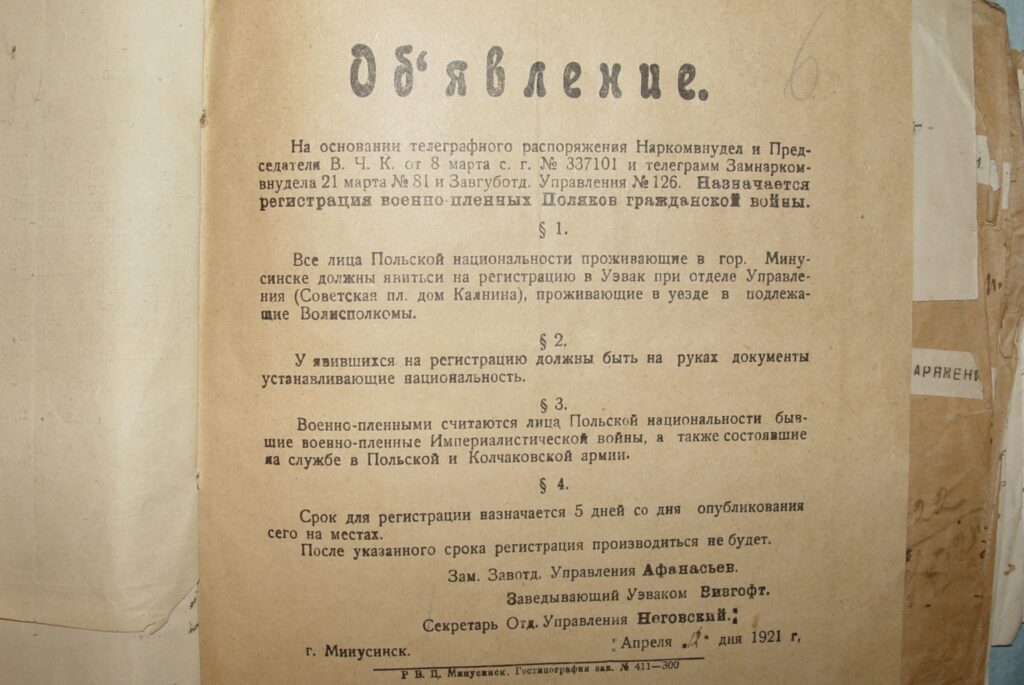
For some Poles, information regarding repatriation simply failed to reach them. In the main, this concerned inhabitants of Polish villages located far away from major centres, as evidenced by accounts passed down by their present-day descendants. Some Poles did not take advantage of repatriation due to illness affecting a family member or simply because of a reluctance to leave (this particularly applied to mixed marriages). There were also cases in which the Bolshevik authorities refused to grant permission for departure. This is illustrated, for example, by a regulation of the Administrative Department of the Yenisei Provincial Executive Committee of 26 March 1921, under which all local Poles were required to register for repatriation, yet one clause stated that “[…] those registered have the right to depart only with individual permission of the Administrative Department of the Yenisei Provincial Executive Committee”. In the case of repatriation to Poland, Latvia, Estonia and Lithuania, the local authorities argued that “the simultaneous departure of skilled workers is undesirable, as under conditions of an acute labour shortage the development of industry in Siberia will be hampered”.
Those who remained voluntarily in Siberia were mostly those Poles employed in good jobs, secure positions, and an ideological (critical—editor’s note) attitude towards life in “bourgeois” Poland. This was especially true of former political exiles from the turn of the nineteenth and twentieth centuries (activists of socialist and related movements—editor’s note). The authorities also carried out ideological agitation among Poles, which often served to effectively discourage them from leaving. Polish peasants frequently came to the realization that they had voluntarily left their homeland, that in Siberia they owned land and had built houses, and that in Poland there was no one waiting for their return.
What awaited those Poles who remained in Siberia? Did they have opportunities to preserve their native language and Polish traditions?
“Korenization”, or how to turn Poles into communists
With the introduction of the New Economic Policy (NEP) in Soviet Russia in the spring of 1921, major changes occurred in the functioning of state authorities, both at the centre and in the periphery. The new economic policy coincided with liberalism in matters pertaining to nationality. Proclaimed in the 1920s, the policy of so-called korenization was intended to draw national minorities into the sphere of socio-political activity and thus “nationalise” the state, party and social apparatus by introducing their native languages as official ones.
The campaign against illiteracy contributed to the establishment of national schools. In implementing native-language education programmes, national minorities living in Siberia were divided into “indigenous local” and “western” groups. The latter included Poles, Latvians, Lithuanians, Germans, Finns, Ukrainians and Belarusians.
A 1924 report of the Polish National Bureau of the People’s Commissariat for Education (Narkompros) stated that the majority of the Polish population in Siberia resided in villages, as—unlike Poles living in Siberian cities—they had in many cases not taken advantage of repatriation opportunities. Emphasis was placed on the fact of them being less well prepared for life in the new socialist reality, with priests and church institutions constituting the main obstacle. Local authorities were advised to pay particular attention to establishing national schools in villages inhabited by Poles.
Polish schools in Siberia

The largest number of Polish schools, both primary and secondary, were located in Tomsk and the Tomsk Governorate. In the Tomsk archival records, the name of Maria Czajkowska, a teacher of the Polish language, appears several times. She was to represent Poles from the Tomsk Governorate at the First All-Russian Congress of Polish Educational Workers in Moscow, held from 29 December 1923 to 1 January 1924, with the participation of several dozen delegates—teachers and Polish community activists. Besides her, representatives from Novonikolayevsk and Yekaterinburg were also to represent Siberia. However, Czajkowska was unable to make the journey to Moscow, as she was working deep within the governorate. She taught in several Polish schools opened in Połozowo, Białystok, Malinówka, Akimo-Aninskoye, Voskresyenskoye, Borkowskoye and the village of Wilenka. In total, during the 1923/24 school year, 504 pupils in these schools were educated in Polish. At that time, according to statistical data, 11,234 Poles were living in the Tomsk Governorate. In addition to rural schools, literacy centres, libraries, so-called “reading rooms”, and special mobile Polish propaganda theatres were established.
“The cuckoo is calling”
At the beginning of the 1920s, Polish education in Siberia received the support of Polish consulates. This assistance consisted primarily in supplying schools with the necessary literature and textbook material. The Soviet authorities, however, took a dim view of such aid, despite the pressing needs. The nationality department authorities in Krasnoyarsk envisioned a solution to the shortage of teaching staff by way of inviting a “communist teacher” from Poland. In spite of these efforts, in 1927 none of the teachers in Polish primary schools in the Tomsk district were university graduates. There was a shortage of textbooks and Polish-language literature. In the school in the village of Białystok in 1925, the total sum of books in Polish to be found in the Polish library, amounted to 96. These included textbooks and Polish translations of works by Lenin and Dzerzhinsky, while there was a noticeable lack of nineteenth-century Polish literature. Interesting memoirs have survived concerning Polish language instruction in the village of Despotzinovka in the Omsk Oblast. According to local residents, the teacher from Poland who worked there, in addition to teaching Polish, taught children Polish folk songs in the evenings, such as “The Cuckoo is calling”.
According to the 1926 census, 782,300 Poles remained in the USSR, including 204,000 in the territory of the Russian Federation.
Where are the famous Antuszki and Sianożatki?

In 1927, celebrations marking the tenth anniversary of Soviet rule were organised in cities of Western Siberia. These events included so-called fairs, to which representatives of various nationalities from Siberian villages were invited. Poles also participated in large numbers, and reports which have been preserved document the distinctiveness of Polish rural society in Western Siberia. They displayed primarily handicrafts—horse-drawn vehicles, tarantasses, cooperage and embroidery, embroidered tablecloths and shirts—as well as Polish dishes and beer. Performers in Polish folk costumes danced on stage, also singing Polish songs. These accounts testify to the active nature of Polish community life in Western Siberia at that time.
On the other hand, an interesting observation regarding the decline of Polishness in Siberia during these years is to be found in the writings of Wacław Sieroszewski, who wrote in 1928 that only minor traces of Polish identity remained among the Siberian peasants:
“The famous villages—Antuszki, Sianożatki, Terteż in the Orenburg Governorate; Polish settlements in the Tobolsk Governorate in the Ishim and Tatarsk districts; and those in the Omsk, Tomsk and Yenisei governorates—have vanished without a trace in the Russian sea. Apart from the świtka, the four-cornered cap, and better cultivation of the land, their Polishness has not been retained.”
In general, it is difficult to speak of good relations between the Polish government and the Soviet Polish diaspora. One can, however, point to the first clear deterioration of these relations with regard to the participation of diaspora delegates in the First Congress of Poles from Abroad, held in Warsaw from 14 to 21 July 1929. Polish diaspora delegates were allocated only 14 seats, provoking outrage on their part. The organising committee of the Congress unquestionably feared that delegates from Soviet Russia would engage in intense propaganda during the Congress and that their decisions would be dictated by the Communist Party.
It is unbecoming to slander one’s homeland
Earlier, at the beginning of July 1929, competing congresses of Polish organisations were organised by the Soviets in Soviet Ukraine, Belarus and Russia. Among the Polish delegates from Russia were various representatives from Leningrad, Novosibirsk, Tomsk, Omsk, and many other cities and villages. Additionally, Polish consulates in the USSR twice declined to issue entry visas to delegates travelling to the Congress, which triggered multiple protests among Poles in Russia.
In Leningrad and many other Russian cities, Polish organisations—at the behest of the authorities—held mass rallies. In the village of Białystok, during a meeting held on the occasion of the May Day holiday, a resolution was read out stating: “On the refusal to admit our delegates to the Warsaw Congress, where issues of war and agitation against the USSR will be discussed.” The participants declared this decision “shameful and demonstrating ignorance on the part of the English puppy—lordly Poland”. Such a position was opposed by the teacher of the Polish school, P. Symanowicz, who proceeded to state: “Comrades, we cannot accept this in the slightest, as by doing so we then go against our own Homeland—Poland. It is unbecoming to slander it in such a fashion. I express my opposition.” The authorities reacted swiftly, labelling him as a counter-revolutionary and relieving him of his post.
A tragic turning point
At the beginning of the 1930s, a tragic turning point was reached, as education in the Soviet Union came to be unified. From 1935 onwards, the Russian language became compulsory in all schools. The relatively liberal nationality policy was implemented only until the end of the 1920s. Accelerated industrialisation, and especially forced collectivisation (1929–1934), claimed its toll of many victims among Siberian Poles.
As a result of the establishment of collective farms, small villages and hamlets—regarded by the authorities as remnants of private, capitalist ownership—were liquidated. Polish hamlets were particularly numerous in the Omsk Oblast and the Tomsk district. In 1929, the resettlement of the Poles began, forcing them out of these hamlets into larger Russian villages, and at the same time their land was transferred to the newly created collective farms.
In a report dated 15 February 1930, the deputy representative of the OGPU in the Siberian Region informed Moscow that tendencies towards emigration were visible among Poles in Siberia. Poles increasingly inquired about the possibility of emigrating to Poland, as the majority could not bring themselves to agree to work in the newly established national collective farms. In the summer of 1930, a group of peasants from the vicinity of Novosibirsk travelled to the Polish legation in Moscow requesting the return to Poland of residents of several villages. However, the helpless diplomats were only able to offer them limited financial assistance.
A Pole: a kulak, an exploiter…
Documents preserved in the archives in Minusinsk confirm that pressure was exerted by Soviet authorities on the wealthier Polish peasants. By way of illustration, in 1933 it was documented about Albert Wojciechowski, a resident of the village of Stroganovka in the Minusinsk district of the East Siberian Territory (which in 1926 still comprised 113 Polish households, inhabited by 573 Poles): “Pole, kulak, 50 years old. Deprived of electoral rights as an exploiter. He owned a leather goods workshop employing 20 workers. Deprived of electoral rights in 1930 by the Stroganovka village council.”
In the village of Polski Wysiełok in the Minusinsk district, the first Polish collective farm was established in 1931 under the name “Collective Labour”, being later changed to “Progress”, and finally renamed as “Stalin’s Way”. In 1933, the authorities of the West Siberian Territory reported that collective farms had already been established everywhere. There were, however, exceptions. Residents of the village of Białystok were forced to establish a collective farm, but it was only created in 1935 following the arrest of seven villagers by the OGPU. The collective farm was given the Polish name “Red Banner”.
The aggression of “Polish fascism”
Contact between Poles—Soviet citizens—and the Polish consulate proved to be dangerous for them: individuals seeking assistance from Polish diplomatic missions were invariably treated by the OGPU–NKVD as spies.
A particular intensification of repression against citizens of Polish nationality began in January 1934, after the signing of the Polish–German non-aggression pact. In the USSR, a hysterical press campaign was revived, similar to that which occurred in the period of the Polish–Soviet War. Newspapers, radio, theatre, cinema and even fiction sought to convince the population of the growing military threat from Poland and the inevitable aggression of “Polish fascism” against the “homeland of the world proletariat”. As a result, being Polish in the Soviet Union in the second half of the 1930s was equated with second-class citizenship. In Siberia, persecution was initiated against those who had fought in the 5th Siberian Polish Rifle Division. Repression primarily affected peasants and their already adult children. A serious blow dealt to the Poles was the persecution of the Roman Catholic clergy and the Catholic faithful.
The struggle against religion
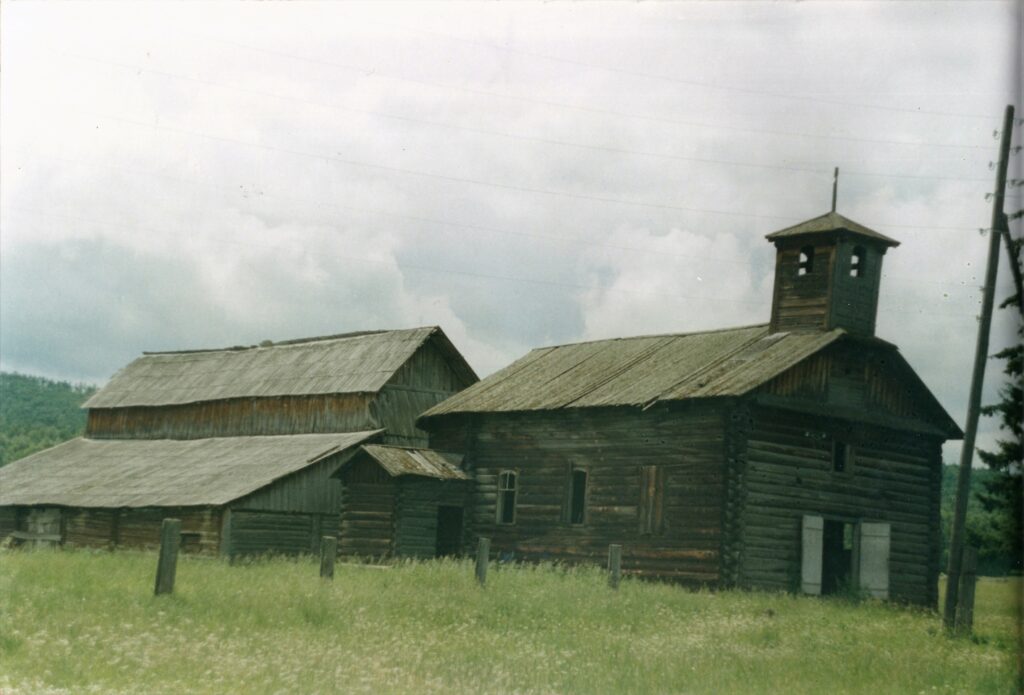
The struggle against religion began as early as 1918, initiated by the decree “On the Separation of Church and State” issued on 23 January. Its practical effect was the mass closure of churches and persecution of clergy and the religious faithful. Under Article 65 of the 1918 Constitution of the RSFSR, all priests were to be deprived of political rights, including the right to vote. The teaching of religion was prohibited not only in schools, but also in a domestic setting where parents would have wished to raise their children in a religious spirit.
The village of Białystok provides a perfect illustration of the changing priorities under the new власти. Tsarist religious policy to a limited extent, allowed Catholicism to be practiced, at the very least without posing a threat to life, and permitted the formation of certain national, religious and cultural organisations. The Bolshevik authorities, by contrast, pursued a policy of uncompromising struggle against religion, against both the Orthodox and Catholic Churches. An uncompromising example of this was the execution in the Tomsk Governorate in January 1921 of two priests—Orthodox Bielawski and Catholic Grabowski—in order to prevent the influence of “agitation among the benighted masses against workers’ and peasants’ power”. Furthermore, the priest’s house in Białystok was converted into a school in order to fulfill the cultural and educational needs of Poles. Despite the existing problems, churches in Białystok and other Polish villages in Siberia remained open until the early 1930s, with the last church wedding taking place in Białystok in February 1929, while in 1934 church bells were forcibly removed.

Shoot the priests
In 1931, Fr Julian Groński, administrator of the Apostolic Vicariate of Western Siberia, was accused of counter-revolutionary activity and imprisoned in a labour camp. He was succeeded by Fr Hieronim Cerpento, who was subjected to repeated imprisonment over the course of his ministry. On 24 June 1936, the Military Tribunal of the Siberian Military District in Krasnoyarsk sentenced him to ten years’ imprisonment. The indictment stated that he had been behind the organization of counter-revolutionary groups at the church and had actively conducted espionage work for Polish intelligence. After the launch of the campaign against the alleged Polish Military Organisation (POW), Fr Cerpento was subsequently accused of belonging to this organisation. In January 1938, he was sentenced to death by firing squad for his alleged links with the Polish General Staff and the Vatican, and for the conducting of counter-revolutionary insurgent activity over many years in Polish colonies in Siberia. Along with Fr Cerpento, a group of parishioners in Krasnoyarsk were also arrested and sentenced to death. The sentence was carried out on 18 January 1938.
Among the victims of the “nationality purges” could also be included Polish community activists, teachers of the Polish language and Polish communists, as evidenced by the numerous archival records preserved in Krasnoyarsk.
Mass repression

The mass repressions carried out as part of the so-called Polish Operation of the NKVD put an end to the brief period of revival of Polish community life in Siberia within the framework of the Soviet experiment between 1918 and 1935. As the scholar of this period, Mikołaj Iwanow, rightly observed: the new authorities, as well as Polish communists within the Soviet state, opted for a rather cautious and perceptive method of neutralising Poles’ internal loyalty to the Second Polish Republic. Instead of seeking to persecute everything that was Polish, they chose instead to reinforce Polishness universally—but on a different plane of consciousness. This plan failed however, both in Soviet Ukraine, where the so-called Marchlewszczyzna was created, and in Soviet Belarus, where the so-called Dzierżyńszczyzna emerged, as well as in Russia and Siberia. The response of the authorities was mass repression.
Sergiusz Leończyk is a professor at the University of Siedlce.
Subheadings supplied by the editors.
Translated by Sylwia Szarejko.