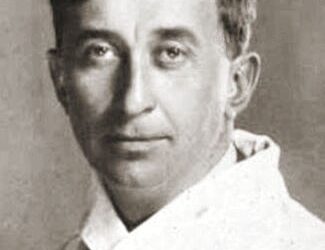

On 28 June 1914 in Sarajevo, in Bosnia (then part of the Austrian-Hungarian Empire), the assassination of Austrian heir to the throne, Archduke Franz Ferdinand, and his wife Sophie was successfully carried out. The attack was organised by the Serbian nationalist terrorist group the “Black Hand,” and the assassin who fired the fatal shots was Gavrilo Princip.
“Remember Me When the Night Fades…” – Tomasz Zan: Romantic, Exile, Naturalist
Tomasz Zan, co-founder of the Vilnius Philomath Society, is most often associated with his role as the spiritual leader of the prisoners imprisoned in “Konrad’s cell” from Part III of Mickiewicz’s “Forefathers’ Eve.” However, he was also a poet, a naturalist, and a
Kazimierz Zieleniewski — An Exile Who Succeeded
At only eighteen years of age, while still a student, Kazimierz Zieleniewski was exiled to Siberia during the January Uprising. Though he was supposed to spend the rest of his life there, he refused to be broken. On the contrary: he achieved great financial success, and his house in Tomsk became a focal point of Polish patriotic and cultural life.
Litwá – ródna ziamièlka! (O Lithuania, my native land…) – about Vincent „Vincuk” Dunin-Marcinkiewicz
Who was he really? A Pole? A Belarusian? An admirer of the simple Belarusian people and rural life or a khlopoman? Vincent “Vincuk” Dunin-Marcinkiewicz was probably a bit of each, which characterised many representatives of the borderland intelligentsia in the mid-19th century.
24.03.1794 Start of the Kościuszko Uprising
The year 1794 marked the decline of the Polish-Lithuanian Commonwealth. The state was already heavily reduced territorially after two partitions and equally greatly dependent on neighbouring states, above all Russia. Tsarist troops were stationed in the country, banks collapsed and prices rose. It seemed that the final decay of the state was only a matter of time. It was obvious that patriotic circles were not going to watch this calmly.
A Restless Spirit – Apollo Korzeniowski
While in exile, he returned to literary pursuits, writing among other things, the play No Rescue (Bez ratunku) and the essay An Enquiry into Shakespeare’s Dramatic Art (Studia nad dramatycznością w utworach Szekspira). He also translated foreign literature into Polish, including the works of Shakespeare, Victor Hugo, and Charles Dickens.
In the summer of 1863, due to Evelina’s deteriorating health, the Korzeniowskis obtained permission from the authorities to relocate to Chernihiv. Within only two years, Evelina was to pass away from tuberculosis. In the wake of her death, Apollo’s health also took a rapid turn for the worse — he, too, was suffering from tuberculosis with additional weakening brought on by heart disease. Although increasingly frail, he continued to write. In the spring of 1866, he made the difficult decision to send his son to live with his brother-in-law, Tadeusz Bobrowski.
In December 1867, Apollo finally received permission to leave Russia. He went first to Lviv, eventually settling in Kraków with his son in the spring of 1869. There, already incredibly weakened and afflicted, he yet again recommenced his activities, establishing contact with the newly founded periodical Kraj, also hoping to continue his writing. He was still hopeful that he could overcome his illness — alas, it was not to be. He died on May 23, 1869, and was buried in the Rakowicki Cemetery.
His son, Konrad, was subsequently taken into the care of his grandmother, Teofila Bobrowska, with his uncle Tadeusz later taking up the responsibility. In 1873, the teenage boy returned to Kraków. He had already, for several years been an honorary citizen of the city — a title that had been granted to him in recognition of his father’s merits.
15.01.1582. The truce of Yam-Zapolsky
For many years, Ivan IV, known as Ivan the Terrible, who headed the Russian Empire, had been eagerly eyeing Inflants, a territory mainly divided between Poland, Lithuania and Sweden. Their task was to conquer these territories entirely for the benefit of Russia. It can be said therefore, that the beginnings of “Russian” Siberia were also the beginnings of “Polish” Sybir.
Sergiusz Piasecki — Adventurer, Smuggler, Spy, Executioner, Writer, Émigré
A singular talent of Polish literature with a swashbuckling past: a defiant and unyielding anti-communist, intelligence agent of the Second Polish Republic in the Eastern Borderlands, smuggler, fearless AK soldier. Sergiusz Piasecki received a pardon from his prison sentence owing to his literary exploits.
16 .11.1918 Independence message
The 11th of November is National Independence Day in Poland. We celebrate it to commemorate the events of 1918, when the Regency Council in office in Warsaw handed over sovereignty over the reborn Polish Army to Józef Piłsudski. This this came about was due to several factors. First and foremost, it was down to the fact that Piłsudski had arrived in the Polish capital the previous day, having previously been released from the Magdeburg fortress, having been held there since August 1917.
Helping the Youngest — Maria and Kazimierz Wodziccy
Had it not been for the initiative of Maria Wodzicka, the help of her husband Kazimierz – Consul General of the Republic of Poland in Wellington – and the wife of New Zealand Prime Minister Janet Fraser, a group of more than 700 Polish orphans and half-orphans evacuated from Siberia would probably have wandered around the world for a long time yet. But thanks to these good people, the children have found their new home in the antipodes.