


A Serb and an Austrian in Bosnia – the complicated beginnings of war
On 28 June 1914 in Sarajevo, in Bosnia (then part of the Austrian-Hungarian Empire), the assassination of Austrian heir to the throne, Archduke Franz Ferdinand, and his wife Sophie was successfully carried out. The attack was organised by the Serbian nationalist terrorist group the “Black Hand,” and the assassin who fired the fatal shots was Gavrilo Princip.
This event sparked a chain of developments that ultimately led to the outbreak of the First World War, also known as the Great War. And as much as the initial days and weeks after the Sarajevo assassination proved to be relatively calm, only a month later events began to move at lightning speed.
The Ultimatum
In response to the assassination and to claims that it had been inspired by the Serbian government, Austria issued an ultimatum to Belgrade on 23 July. By acceding to all of its demands Serbia would have greatly limited its own sovereignty. It did nevertheless, agree to the majority of them. The sole exception regarded the condition that would have permitted Austrian officials to conduct their own investigation on Serbian territory. Despite pressure from the Russian legation, Belgrade remained firm, unwilling to reverse its decision. Austria, considering this to be a casus belli, declared war on Serbia on 28 July. This event — the beginning of what was only anticipated to be a small, local conflict — became the first falling “domino” setting off a war on a scale unlike anything humanity had ever experienced.
Russia enters the stage
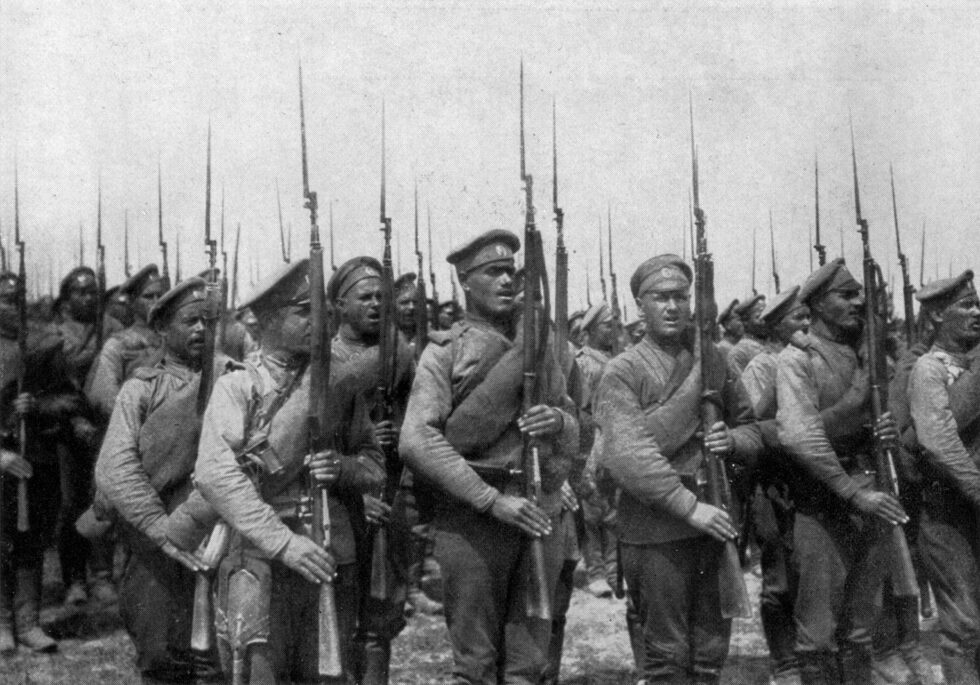
Russia had on 24 July, several days before Austria-Hungary declared war on Serbia, already announced its readiness to defend Serbia if attacked by Vienna. They quickly moved to fulfill this promise, by declaring a partial mobilisation on 29 July. The most important decision however, arrived a day later — on 30 July 1914, when the Russian Empire proclaimed a general mobilisation. From that point onwards, the subsequent “dominoes” started to fall at ever increasing speed.
On 31 July, Germany threatened Russia with a declaration of war if mobilisation was not halted — something which St Petersburg had not the slightest intention of heeding. By way of support for the Tsar, France announced its own mobilisation on 1 August. That very same day, Germany declared war on Russia, and two days later — on France.
The next stage was Britain’s entry into the war. In response to Germany’s invasion of Belgium on 3 August, London issued an ultimatum to Berlin. The next day (4 August), Britain declared war on Germany.
In the midst of all this, Austria-Hungary had gone “missing” for a brief period, only to return however on 5 August with a declaration of war on Russia. Yet in turn, on 10 and 12 August, France and Britain respectively declared war on Austria-Hungary.
A deep-rooted “domino effect”
The whole sequence of war declarations was not, of course, a coincidence or the result of the temporary whims of the leaders. It stemmed above all from the existence of two opposing political–military blocs in Europe, which bound the major powers together. One — the Triple Alliance — was the pact linking Germany, Austria-Hungary, and Italy (at the outset at least), while the other — the Triple Entente — united Russia, France, and Britain. Bound by obligations to assist their allies, these states declared war on one country after another. None of them seemed to be aware that rather than lasting a few weeks, the conflict would in fact drag on for five long years.