


Jerzy Rohoziński
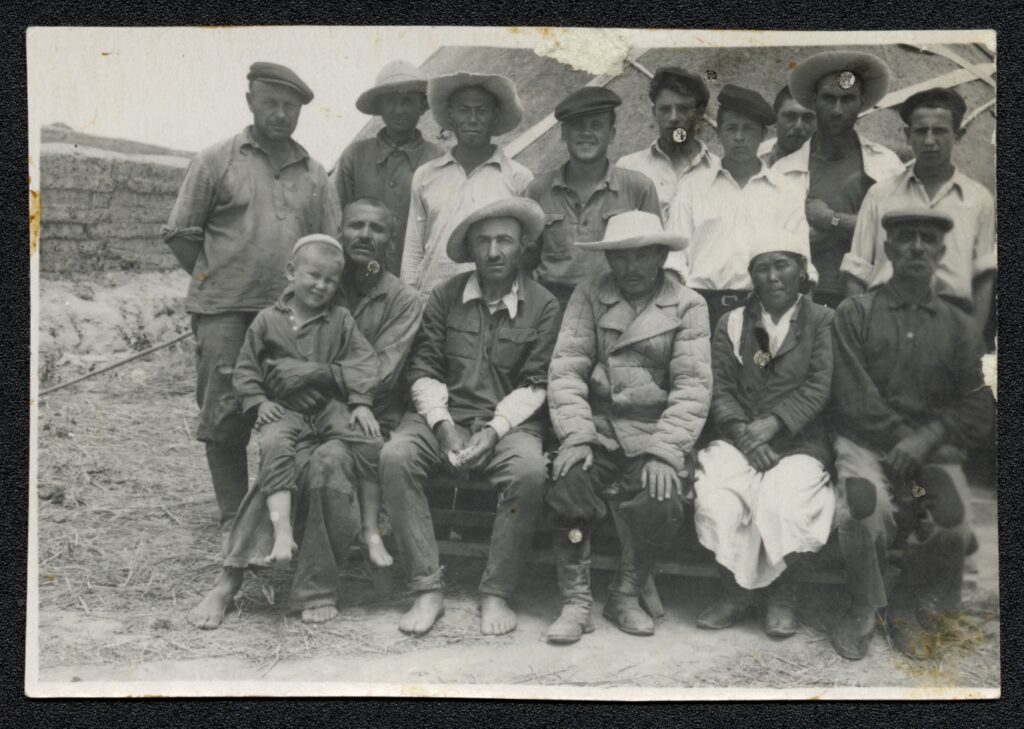
Yes – this particular story does have a happy ending. On 19 June 2019, thanks to the efforts of the Pilecki Institute in Warsaw, Tassybai Abdikarimov from the Maktaaral District – an elderly man in a tyubeteika, his beautifully weathered face etched with deep lines – became the first citizen of Kazakhstan to receive the Virtus et Fraternitas medal from the President of the Republic of Poland, in recognition of his assistance to Poles during the war and under totalitarian regimes.
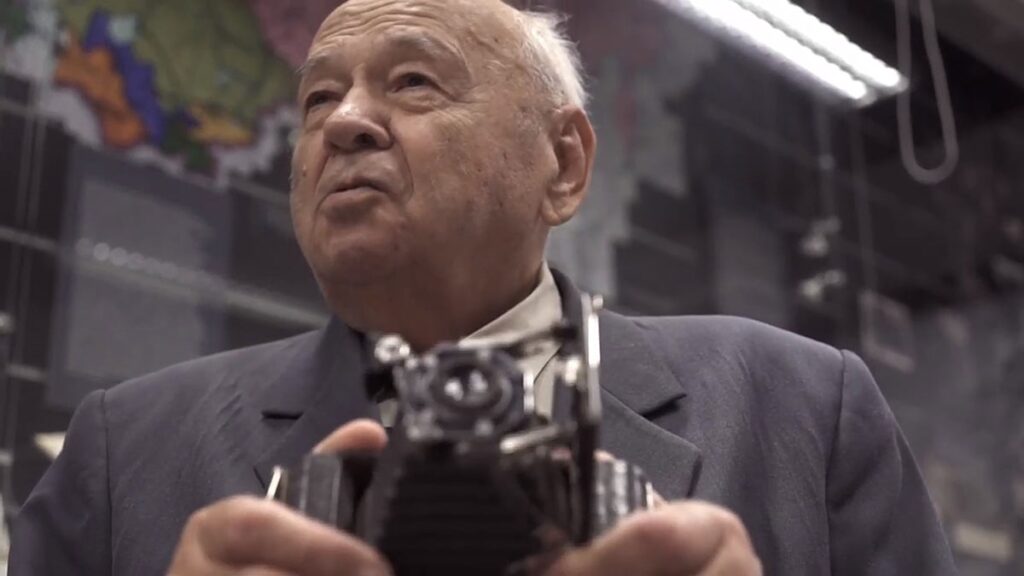
The events unfolded following the end of the war. On the night of 18 April 1952, the Soviet authorities deported more than five thousand ethnic Poles from the Byelorussian SSR to southern Kazakhstan, condemning them to forced labor on the cotton fields of the Pakhta-Aral state farm. They were sent to the Hungry Steppe, which the Soviet regime was crisscrossing with irrigation canals to support cotton cultivation. This was to be the last mass deportation of the Polish population from the former Eastern Borderlands. Officially, it was described as the resettlement of “kulak families.” Among those deported was the Jabłoński family from the Grodno region. Accompanying them was twenty-year-old Walenty, who was at that time a medical student. Hidden among his belongings was a camera he had bought at a Grodno market. Performing near miracles while developing film at night, he documented key moments of their exile. It was he whom the young Tassybai would later help during a bout of illness, delivering food to him.
“…their house once stood there”
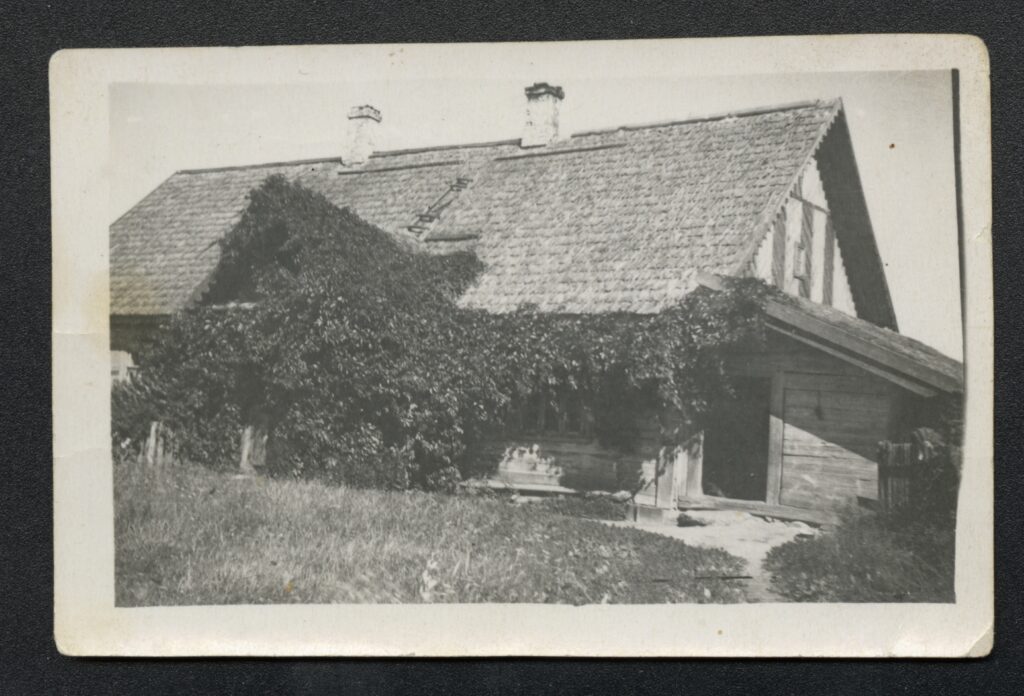
Kozłowicze, Grodno Region in Belarus—the Jabłoński family’s home village. All around, fields of wheat and potatoes; some twenty farmsteads. Empty, quiet, peaceful. “Willows once grew there – the Jabłońskis had planted them,” says Grzegorz Obuchowicz, pointing into the distance. He is the village’s oldest resident and the head of the local parish committee. “They were later cut down because they got in the way of the collective farm. The Jabłońskis had twenty-eight hectares here; they farmed very well. They kept both cows and pigs. And their house stood right there.” And then? “And then what? Everything was taken over by the kolkhozes. There came the dekulakization; people were deported. In 1949 and 1950 they started imposing heavy taxes – three or four times a year – and then they just kept adding more and more. If someone was unable to pay, they were deported. I think that if someone declared they were giving everything up and joining the kolkhoz, then they were no longer required to pay the tax. After the war, positions in the authorities were handed out to front-line soldiers, partisans – they were always assigned some post. There was a man here in Kozłowicze, Horbaczewski. He had an old cowshed, and there was a rifle in there. Whether he hid it or not – no one knows. But he was sentenced to fifteen years.”
From the road one can see, on a small rise, a wooden church shaped like a cube, roofed with sheet metal and topped with two four-sided towers. We go inside. Four pillars, three wooden altars, stained-glass windows, and three paintings hanging on the walls – the Black Madonna of Częstochowa, the Sacred Heart of Jesus, Christ the King of the Universe, and Saint Andrew Bobola. Between them hangs a banner reading “Intercede for us, the exiles,” and a statue of Mary. “The settlers from Rokitno used to pray to this statue – it’s nearby, not far from here. But when they were deported in 1940, it was brought to our church,” Mr. Grzegorz explains. “It used to stand in a roadside shrine, and the settlers held May devotions there.” Then he adds, “Walenty Jabłoński served here as an altar boy.”
Once, this was a gentry hamlet. In 1921 the population numbered 175: 145 Catholics and 30 Orthodox Christians. At that time, the parish church of the Assumption of the Blessed Virgin Mary and Saint Andrew Bobola stood here, dating from the first half of the nineteenth century. In the 1850s it was renovated by a local landowner, Countess Aleksandra Świeczyna née Bisping. After the January Uprising, it was taken over by the Orthodox Church and converted into an Orthodox church. It was returned to the Catholics in 1920. During both the Soviet and German occupations, the local rectory provided shelter to the Nazareth Sisters from Grodno, who secretly taught religion to the children.
Secret Order No. 00246
There would be no place for this world in Soviet Belarus. From the very first days after the so-called “liberation,” the local Council of Ministers was eager to act: to get rid of the Poles, to get rid of the kulaks. As early as March 1949, in a letter sent to Malenkov, they attempted to persuade the then Deputy Prime Minister by invoking the “anti-Soviet activities of the kulaks, closely linked to the counter-revolutionary nationalist underground,” warning that “kulak elements are committing acts of terror.” The Kremlin, however, remained silent, as everywhere the security services were overwhelmed with work.
The green light for deportations only came in September 1951. The operation itself began in the spring of 1952. “In April of the current year, kulaks and their families who display hostility toward collective farms are to be resettled from the Grodno, Molodechno, Brest, Baranovichi, Pinsk, and Polotsk regions of the Byelorussian SSR to districts of the Kazakh SSR,” reads the strictly confidential Order No. 00246 of the USSR Ministry of Internal Affairs. In total, 1,375 families – 6,064 people – living in the Brest, Grodno, Molodechno, and Minsk regions were officially marked for deportation. Ultimately, fewer than six thousand people were deported. Some families managed to hide; there were errors in the lists, which were sometimes hastily amended; bribes also played their part. Those deported – at least in theory – were permitted to take with them valuables, household items, and food supplies. Their fixed property was transferred to the collective farms.
“And so the Jabłońskis were deported,” the elderly Obuchowicz continues his story. “And what happened to their house afterward?” – “It was moved to Hrynievka, the neighboring village where Orthodox people live, and rebuilt as a primary school.” Were there any conflicts with the Orthodox community? “No, we lived well together here.” – And were they deported too? – “No, not the Orthodox. But in the 1970s people started leaving there for Grodno and other cities, and the school was closed.” – Did they help those who had been deported? – “Of course. They shared whatever they could – sending pork, sending flour.” – And did people ever return from deportation? – “It happened, but you had to sign a document declaring that you would have no claim to the lost property. My wife’s family returned – elderly people, no children – and they came back, but everything had been taken from them. Their house had been dismantled, sold off somewhere. Only the pigsty remained, so they built a little stove inside it and lived out their old age there. Otherwise – anyone who could, left for Poland…”
Who was deported from here? The Pyrski, Obuchowicz, and Lisowski families.
… these names recur in the stories. Who else? The names of the deported appear in the registry of those subjected to repression between 1928 and 1953. That registry is kept at the National Archives of the Republic of Belarus. But of course, no one is going to let me in there…
Four Files, Four Families, Four Dramas
Since research in Belarus proved impossible, the search was forced to continue in Kazakhstan. I travel to Shymkent, the former capital of the South Kazakhstan Region. My first stop is the local Museum of the Victims of Political Repression. No, I do not walk in off the street – I had a prior appointment and, a ‘recommendation’, so to speak. The museum was established in 2001, operates under the municipal authorities, features a modern architectural form, and delivers a reasonably coherent exhibition. Inside, the focus is primarily on the Great Terror of 1937–1938, the repression of members of the Kazakh autonomist movement Alash Orda, and the Suzak uprising against collectivization – a largely regional profile, though the nationwide context is also apparent. The information panels are exclusively in Kazakh, with many visits made by school groups. The guide – a young woman – explains to me that “Stalin knew nothing about the famine and the repressions,” that everything happened “behind his back.” Well then. I leave the museum, and directly opposite the entrance, in the park across the street, stands a monument to the “Great Patriotic War”…
The director – as directors tend to do – complains about underfunding and staff shortages, about how much more could be done if only… “you understand, of course.” Still, she hands me four folders copied from the former KGB archives. I pore over the documents, frowning; the director observes me and seems to suddenly notice something familiar in my features. I must have steppe roots – Turkic, perhaps even a bit Mongolian. I do. Cossack, on my father’s side.
Four files of people deported in 1952 to the South Kazakhstan Region from Soviet Belarus, the Grodno and Molodechno regions. Four kulak families: three Polish, one Lithuanian (were there more?). Four files, four names, four families, four dramas.
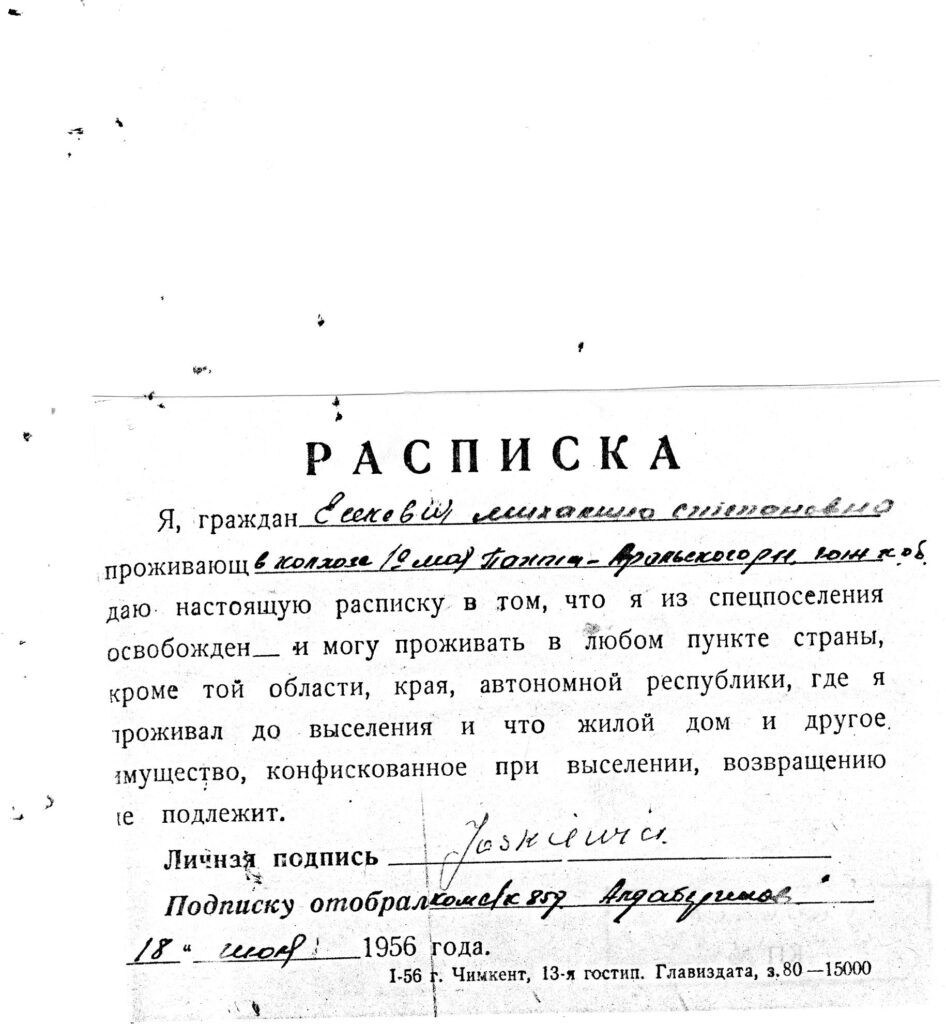
Michał Joskiewicz (b. 1874) with his family – wife Michalina, daughter Zuzanna; a kulak household: 15 hectares of land, two horses, three cows, fifteen sheep and goats, one hired hand and three seasonal workers. In June 1956, the father was classified as a second-degree invalid on the basis of a decision by the district health commission.
Adolf Ankianiec (a Lithuanian, b. 1888) with his family, malogramotny (semi-literate); a kulak household: 19 hectares of land, one horse, one cow, sixteen sheep and goats, employing permanent and seasonal hired laborers. His son Antoni (b. 1926) was released from deportation in 1953, as he did not work on the family farm and, moreover, had gotten married to Natalia Povareva, a member of the Communist Party since August 1946, a twice-decorated disabled veteran of the “Great Patriotic War.” Antoni Berdzik (b. 1891) with his family: wife, four sons, and three daughters, malogramotny; a kulak household: 15 hectares of land, two horses, four cows, five sheep and goats, seasonal workers. Oh yes – on 19 May 1949, Berdzik was sentenced to ten years’ imprisonment under Article 93b of the Criminal Code of the Byelorussian SSR (essentially arbitrary; no point delving into its substance) and five years’ deprivation of rights (as if he had ever had any?). Yet on 30 April 1953, pursuant to the decree of the Presidium of the Supreme Soviet of the USSR of 27 March 1953, he was granted an early release from his sentence and deported to the Pakhta-Aral District (present-day Maktaaral), where his family was already living. Yes, yes – amnesty, family reunification – Lavrentiy Pavlovich Beria was a generous man. After his time in prison, he lived there no more than a month. Finally, Maria Szłykowicz (b. 1927) with her family: two daughters and two sons; a kulak household: 8.8 hectares of land, 14 hectares of garden, 2.2 hectares of meadow, two horses, four cows, eight sheep and goats.
Soulless papers, soulless people…
The files are almost identical. The same documents, questionnaires, forms. One looks at them and thinks: dull, emotionless paperwork. However, one must not think in this way. Before winding up in a convict’s file and subsequently an archive, they held their own dramatic histories. First off, someone was arrested, ordered to pack quickly; NKVD officers shouted that any attempt to flee would, with no warning, be met with gunfire, and then they were hauled off to the regional Office of State Security. There, a colonel, major, or lieutenant colonel would sit, asking questions, smoking cigarettes, tapping on a typewriter. Name, surname, date of birth, nationality, marital status… After two or three hours, the first personal questionnaire was ready to be signed. On the train, another NKVD officer would present a second form, this one shorter. It stated that, pursuant to the decree of the Presidium of the Supreme Soviet of the USSR of 26 November 1948, the citizen in question was being sent to compulsory special settlement with no right to return to their previous place of residence. Upon arrival, at the special commandant’s office, the person would sign yet another statement acknowledging familiarity with the decree of the Council of People’s Commissars of the USSR of 28 January 1945 “On the Legal Status of Special Settlers.” And then there was one more slip of paper – a raspiska – stating that escape from the special settlement was punishable by twenty years of penal labor. In the signatures under “I have been informed,” one can see where hands had clearly trembled the most… Before returning from exile, everyone had to sign a final declaration: “I may reside anywhere in the country except the region in which I lived prior to deportation; the house and property confiscated during deportation are not subject to restitution.”
Compensation for Toil and Sweat
“…are not subject to restitution” – of course. And yet, in the State Archive of the South Kazakhstan Region, a considerable surprise awaits me. The archive is squeezed between buildings of the police and the Ministry of Internal Affairs – a legacy of Soviet times, when archives were subordinate to the MVD, the guardian of those secrets hidden within documents. For documents, ex definition, concealed secrets. But I have the proper authorization, and the boxes of chocolates presented with a deep bow to the director send a clear signal that I am a respectable person. Everyone here is exceedingly kind. It is December; outside there is a biting frost – for the south of the country. The archive is underheated; staff work in sweaters and quilted jackets. But I am given the luxurious treatment – the ladies bring an extra heater into the reading room.
I examine correspondence of the local administration from the 1950s. And what do I see? In March 1958, the chairman of the South Kazakhstan Regional Executive Committee, Comrade Uspanov, received an urgent letter from the Ministry of Foreign Affairs of the Kazakh SSR:
“The Ministry has written repeatedly since April 1957 regarding the transfer of funds owed to Polish citizens for days worked on collective farms in the Ilyichev and Kirov districts of the South Kazakhstan Region. Of the sixteen Polish citizens entitled to payment for their labor, the Ilyichev branch of Gosbank has transferred funds to the account of the Polish Embassy in Moscow for only seven persons (…). Despite numerous written and telegraphic reminders, the Ilyichev and Kirov district executive committees have stubbornly remained silent, having failed to carry out an important task of a government body – the USSR’s Ministry of Foreign Affairs. For a year now, correspondence has been ongoing between the MFA of the Kazakh SSR and the Ilyichev and Kirov district executive committees concerning the transfer of funds owed by collective farms to Polish citizens who departed in 1956, yet to this day the Ilyichev District has failed to wire funds owed to the following citizens: R. Obuchowicz, J. Siedlecki, H. Jurewicz, S. Miktajfus, L.A. Kuczyński, H.A. Kuczyński, Bogucki, Macewicz, Pietkiewicz, and R. Machniewicz, and in the Kirov District – to citizens Kazakowski and Kondrat. According to information received from the Consular Department of the USSR MFA, the Embassy of the Polish People’s Republic in Moscow persistently demands settlement and transfer of funds to the aforementioned Polish repatriates. Given the political significance of this matter, the MFA of the Kazakh SSR requests that the South Kazakhstan Regional Executive Committee take appropriate measures to expedite the transfer of funds to the above-mentioned account of the Embassy of the PPR at Vneshtorgbank in Moscow. The leadership of the USSR MFA proposes that full settlement and transfer be completed by 15 April of this year. Please inform us of the measures taken so that a report may be submitted to the USSR MFA.” A handwritten note on the document states that settlements were completed in the remaining nine cases.
As for the Ilyichev District Executive Committee, an inspection by the Main Administration for Resettlers had already found in 1953 that it displayed a “callous and bureaucratic attitude toward settlers.” Pensions, disability benefits, and allowances were withheld for six to twelve months even from “120 families of fallen soldiers, invalids of the Great Patriotic War and industrial workers, single mothers, and large families.” Well, that truly was a “callous and bureaucratic attitude”… The only question is whether someone along the way did not simply pocket that money. We are quick to pin the blame solely on district officials here. And yet Ksenia Bidzinashvili, a Georgian woman deported to these regions (for at one point people from practically every corner of the planet found themselves here), recalls: “There were so-called brigadiers. They were Kazakhs; they supervised us. Every five days they gave us something like payment for our work, so we would have the means to live, to buy food and drink.” So a brigadier, a collective farm chairman, an accountant, or the proverbial postman could easily pocket someone’s pension or wages. Except that our compatriots were likely not interested in “something like payment,” but in fair compensation for backbreaking labor. In truth, what they wanted was recompense for ruined health and years of their lives taken away from them.
Payment for labor in cash was, incidentally, a novelty. It appeared for the first time specifically in 1957, in the cotton collective and state farms of the Uzbek SSR. Collective farmers earned less than those in state farms. And those who did receive wages could not get over how poorly their pay matched the supposedly spectacular profits of the farms, as trumpeted in statistics, reports, ceremonial speeches, and press paeans. Socialist managers of the cotton sector slashed wages wherever they could to meet plan targets. Perhaps similar reforms were on the minds of Kazakh comrades at the time? Perhaps it was precisely this “monetization of wages” that brought those compensations to the surface for our compatriots from Belarus?
Walenty Received Nothing
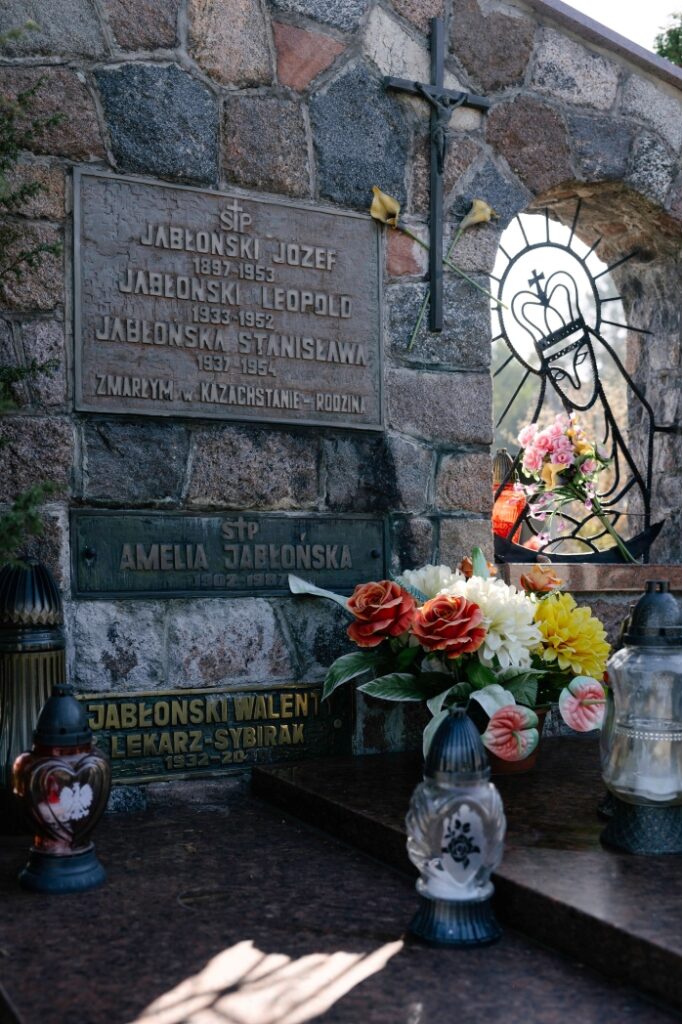
The grave of the Jabłoński family at the parish cemetery in Bialystok. Photo by Jan Szewczyk / Sybir Memorial Museum.
Hard to say. I am curious how it all unfolded – how it actually worked. That “persistence” of our embassy in Moscow… that is, our embassy – though in reality the embassy of People’s Poland. So I comb through consular reports and classified cables from the repatriation period in the archives of the Ministry of Foreign Affairs. I search, sniff around: how was it with those compensations, who got what, and how? But there is nothing. Yes, there is plenty of general tension – negotiating the agreement with the Soviets, logistics. “The embassy is receiving an increasing number of telegrams and letters from Poles in remote localities requesting telegraphic transfers of money to cover travel expenses to the country,” diplomats reported to headquarters in May 1956. The final version of the agreement would include a provision that “the costs of travel and transportation of luggage are borne by the repatriates. The Soviet side bears only the costs of transport for persons imprisoned or relocated in places of compulsory settlement.” The Soviets also refused to allow Polish diplomats to undertake “independent field trips.” The agreement did not regulate “the issue of compensation for persons repressed and subsequently rehabilitated.” The Polish side further maintained that “those eligible for repatriation, that is – Poles, former Polish citizens, are several times more numerous than indicated by the Soviet side,” estimating their number at 500,000 and with the intention to accept 60,000–100,000 persons annually. The Soviets obstructed and slowed down the process, and in September 1958 the embassy recorded “instances of restrictions on the acceptance of repatriation applications” by the Soviet side, along with a decline in the number of repatriates despite an increase in the number of applicants. At one point, a very blunt assessment surfaces: “the course of talks was difficult; their position was very rigid.”
So how, for heaven’s sake, did it work out with those compensations – if it even worked out at all? And why only for some, and not for others? For instance in the case of Walenty Jabłoński, nothing ever came his way.
Jerzy Rohoziński, PhD – historian and cultural anthropologist, assistant professor at the Center for the Study of Totalitarianisms (Pilecki Institute). His research focuses on the social and religious history of imperial Russia and the USSR. Author of, among other works: „Święci, biczownicy i czerwoni chanowie. Przemiany religijności muzułmańskiej w radzieckim i poradzieckim Azerbejdżanie”; „Bawełna, samowary i Sartowie. Muzułmańskie okrainy carskiej Rosji 1795–1916”; „Gruzja. Początki państw”; „Narodziny globalnego dżihadu”; „Najpiękniejszy klejnot w carskiej koronie. Gruzja pod panowaniem rosyjskim 1801–1917”; „Pionierzy w stepie? Kazachstańscy Polacy jako element sowieckiego projektu modernizacyjnego”. Recipient of the Gold Badge of Merit of the Association of Siberian Deportees.
Translated by Sylwia Szarejko.