

Ewa Nowicka-Rusek
The need to preserve identity and a sense of belonging to a distinct ethnic or cultural group is universal. The contemporary world of the Western cultural sphere is founded on national identity, and those ethno-cultural communities that seek to secure a dignified place within it must do so by attaining the status of a nation. Such aspirations can now be observed on every continent.
Small – sometimes very small – peoples inhabiting the vast expanse of Siberia strive, with varying degrees of success, to survive both as culturally distinct communities and as bearers of distinct ethnic identities. Among the groups I encountered during many years of field research in Siberia, a particularly important role is played by the Buryats – a relatively numerous Mongolic-speaking population (altogether around one million) that lives across an immense territory stretching from the shores of Lake Baikal to the vast steppes of northern Mongolia. The Buryats have managed to preserve, revive, and reconstruct many elements of their tradition, while simultaneously building a modern, ambitious, well-educated, and creative society. I will attempt to outline several key mechanisms that underpin this impressive process of constructing a modern Buryat identity. These may be summarised as rediscovered, invented, and constructed tradition.
Rediscovered, Invented, and Constructed Tradition
Undoubtedly, every culture undergoes change over the course of a community’s existence: it loses certain elements, reinterprets others, and further develops still others according to new patterns – often drawn from external traditions with which it has come into contact. Moreover, the conscious and purposeful actions of the growing number of emerging intellectual elites play an ever-larger role in the revival and development of traditional cultures among what we refer to here as “small nations”. It is these elites who create a national culture that synthesises the diversity of regional traditions. These groups deliberately draw upon historical knowledge of fading – or already vanished – cultural elements characterised by regional specificity. They bring back cultural content rooted in the past, reshaping it into modern forms that are intelligible and acceptable to contemporary audiences. They also undertake efforts to preserve their communities’ endangered ethnic language and to deepen knowledge of its history. In this way, the Buryat language and historical awareness of the group’s past become the foundation for the continuity of this ethnic community and for individual Buryat identity. A particularly important criterion of Buryat identity is familiarity with – and reverence for – selected reconstructed elements of traditional culture, which assume the role of symbolic markers of identity for the entire group.
In recent decades, as the effectiveness of the intergenerational transmission of ethnic culture has declined, the importance of highly attractive and widely engaging new forms of cultural communication has increased. These include festivals, performances, and public cultural events that foster a sense of national community. This sense is reinforced through the use of the national language during such events, while various elements of organised activity contribute to the construction of a distinctly Buryat vision of history. I will now present two such ethnic festivals: the Yord Games among the Western Buryats in 2000, and the Night of the Yokhor events that were held in the capital of the Republic of Buryatia in 2012 and 2013. Both were organised to a significant extent around the Buryat circle dance and form the basis of my field observations.
The Yord Games of 2000

In July 2000, among the Western Buryats – who have preserved archaic shamanistic elements of Buryat culture rooted in clan-based social structures – a cultural festival was held near the western shore of Lake Baikal. It was named the Yord Games, after Mount Yord. The organisers of this revived cultural event were convinced that the Yord Games represented a faithful reconstruction of a former socially significant collective Buryat sacred celebration of a shamanistic character. Most of the events mentioned in historical sources were incorporated into the contemporary programme, whose central element was a reconstructed shamanistic celebration based on these historical accounts.
At sunrise on Mount Yord on a July morning, the Yord Games began with prayers performed by local shamans, who invoked blessings for the festival. They lit a ritual fire and carried around mountain khadags – long ceremonial cloths (up to 30 metres in length) bearing sacred Buryat inscriptions.
The culmination of the Yord Games is the yokhor, a collective circle dance performed around Mount Yord. People gather spontaneously, and gradually a regular circular formation emerges. Participants hold hands, though maintaining discipline proves difficult; from time to time, the circle breaks as individuals release their neighbours’ hands – either because the circle becomes too crowded or because some participants leave, losing their sense of the ritual’s importance and sacred character.
The contemporary performance of the dance differs considerably from its fading traditional model. The Buryat ethnographer Matvei N. Khangalov, whose writings are frequently cited by the festival’s organisers, described the circle dance in 1908 – linking it to the symbolism of a communal drive hunt – as follows: “The national dance khararkha (a collective circle dance) consists of three parts: first, the dancers form a circle, hold hands, move slowly in the direction of the sun, and sing traditional “long songs”. In the second stage, the dancers move closer together, waving their interlocked hands up and down; the song becomes less drawn out and louder. In the third stage, the dancers stand very close to one another, with elbows bent at right angles, and all jump up together. They continue dancing in this way until exhaustion”.
In 2000, this sequence was followed less strictly. In earlier times, the centre of the circle was occupied by the tobshi (the head of a clan or a shaman) along with his assistants, known as gazarshi. According to Buryat scholars, the dance should be initiated by elderly men and women, just as clan leaders or shamans would begin a communal hunt. The shouts and the tightening of the circle have been likened to the dynamics of such a hunt. Traditionally, the dance lasted for approximately six to seven days, requiring at least 700 participants to encircle the mountain. If attendance reached two or three thousand people, the rituals lasted even longer and the yokhor was performed around the hills both day and night.

In addition to the dance, the 2000 Games featured traditional Buryat competitions for singers and reciters of sacred texts, including excerpts from the Buryat epic Geser. At the same time, visitors could witness spectacular traditional Buryat sporting contests: archery, wrestling (including three-man bouts), and horse racing – set against the picturesque landscape of the western shore of Lake Baikal. A beauty contest known as Dangina was also introduced in an expanded form. Young women presented a distinctively Buryat conception of female beauty, attractiveness, and grace. This encompassed not only physical appearance but also attire and behaviour in culturally significant situations. It included, for example, the ability to greet and welcome guests properly and to introduce oneself in terms of family and clan affiliation.
These carefully observed forms, while demonstrating continuity with tradition, also convey meanings of unity today – bringing together clan-based communities into a single Buryat nation. The consciously designed programme of the Yord Games incorporates all the fundamental cultural elements that are described as characteristic of the Buryats as a nation. Together, they form a cultural canon composed of markers of Buryat identity, which appear in varying proportions across all Buryat cultural festivals.
The first Yord Games are said to have taken place around a hundred years ago, although precise historical evidence is lacking. This represents a classic example of an “invented tradition”. The contemporary Yord Games are undoubtedly a creative reworking of selected older – or supposedly older – customs. According to oral accounts, the Games were once held regularly once a year in spring, or twice a year – in spring and autumn. Following their revival in 2000, they were intended to be held every four years, although in practice they have taken place rather irregularly.

In 2010, the festival was organised on a much smaller scale, partly due to disputes among shamans over the appropriate date (specifically, the correct lunar phase). In 2013, the Yord Games were held with greater splendour.
Increasingly, the Yord Games are presented not only as a Buryat event but as an interethnic gathering, uniting the peoples of Central Asia – particularly the indigenous peoples of Siberia.
The Night of the Yokhor, Ulan-Ude, 2012
Another festival – this time explicitly referring in its name to the Buryat collective dance – is the Night of the Yokhor. Its location underscores the pan-Buryat character of the event. On 13–14 July 2012, the fifth, jubilee edition of this two-day festival took place at the central stadium in Ulan-Ude as part of the national programme “Buryatia – A Land of Impressions”, run by the Ministry of Culture of the Republic of Buryatia. The programme itself reflects the broader direction of the authorities’ ethnic policy.
A striking feature of the Night of the Yokhor is its exceptional orderliness and organisation, and the legally enforced ban on alcohol consumption in any form – something exceptionally rare in the Russian Federation for events of this kind. Although the ban is imposed from above (by the authorities of the Republic of Buryatia), participants emphasise that observing it is a matter of national pride. The behaviour of those attending the festival reflects a kind of spontaneous psychological and social self-selection. One can observe groups of friends who have arranged to meet, as well as individuals greeting acquaintances encountered by chance. The atmosphere is joyful and friendly; following Michael Herzfeld, one might describe it as an instance of cultural intimacy.
A central role during the Night of the Yokhor is played by Buryatia’s leading national theatre, Baikal. Performances on stage showcase not only the yokhor itself but also a wide range of Buryat artistic expression – works created and performed by artists from various regions of ethnic Buryatia. Promotional materials and descriptions of the festival consistently highlight the most distinguished Buryat performers appearing on stage. Festival participants are not merely passive spectators – they are also expected to dance the yokhor themselves. A significant portion of the programme is devoted to teaching the dance: specific steps, arm movements, and body posture at particular moments, as well as collective movement in a circle. On stage, the organisers, orchestra, and dance ensemble demonstrate the steps and coordinated movements of hands and bodies. Some participants, including small children, wear traditional Buryat costumes.
A poster advertising the 2012 festival (scheduled for 12–13 July) suggested that women should wear flat shoes and assured potential participants that the dance was easy to learn. This implies that some Buryats may not be familiar with the details of performing the yokhor or may not fully grasp the meaning of dancing in a circle. Throughout the capital of the Republic of Buryatia, invitations encouraged participation in the shared celebration of dance: “The yokhor should be understood as a dance, a living activity, a hobby, and a distinctive form of recreation – it is entering our everyday lives. From the depths of centuries, the yokhor carries a magical power of attraction. Once you learn this dance, you will never forget its rhythmic movement”.

Games in 2010. Photo by Wojciech Połeć
The festival is a vibrant event, drawing attention primarily through its rich ethnic colour. This time, singers arrived not only from within the Republic (i.e., within the Russian Federation) but also from Inner Mongolia in China and from Mongolia itself, where a sizeable Buryat population has lived since the 1920s – having fled Russia after the Revolution in fear of collectivisation policies.
Most of those gathered on the stadium’s artificial turf actively participate in the dance. Performers themselves join the circles, instructing dancers at close range and demonstrating proper steps and movements described by earlier ethnographers. This illustrates how scholarly knowledge is being utilised consciously, and how deliberate action contributes to shaping a new form of tradition. Some participants are already familiar with the steps, while others make mistakes but learn from them with enthusiasm. The atmosphere is one of eagerness and commitment: actual mastery of the steps becomes less important than a willingness to learn and the shared experience of expressing cultural distinctiveness together. At the end of the festival, the hosts lead triumphant chants from the stage, echoed by participants with raised hands. A call rings out: “Buryats, forward!” – taken up by all.
An interesting element of learning the yokhor is the presentation of the steps, rhythms, melodies, and tempos associated with particular tribal and territorial groups. In 2012, dances included the yokhor of the Zakamna Buryats (from the western region near Lake Khubsugul), the Ekhirits (living mainly west of Lake Baikal, in the Ust-Orda Buryat Okrug and partly on the eastern shore), the Barguzin Buryats (inhabiting primarily the north-eastern shores of Lake Baikal and the Barguzin River basin), as well as the eastern – Khori – Buryats (from the Kizhinga district of the Republic of Buryatia). All versions of the dance are relatively easy to replicate, yet their rhythm and movement dynamics differ significantly between groups. The fast and energetic Ekhirit yokhor is followed by the bouncing, springing Barguzin style; next comes the fastest version – the running-step yokhor of the Zakamensk Buryats – followed by the slow, calm, almost phlegmatic dance of the Khori Buryats, accompanied by a long song.
On stage, two presenters (a man and a woman) dressed in national costumes alternately use Buryat and Russian to introduce each dance, naming its territorial and tribal origins and describing its specific steps. Participants engage with equal enthusiasm and energy in each successive variation of the dance. The fact that all participants perform the yokhor in the styles of different clan and tribal groups reflects a profound transformation in the social meaning of the dance among the Buryats, as well as the emergence of a new unifying significance attached to its performance. While clan and tribal divisions still manifest themselves in everyday life – for instance, in the ways people introduce themselves – they no longer constitute the sole, or even the primary, basis of identity. One may be an Ekhirit, belong to a particular clan of the Khori tribe, but above all, one is Buryat.
The Night of the Yokhor, Ulan-Ude, 2013
In July 2013, the two-day Night of the Yokhor festival was held once again, proving even more engaging than its previous edition. A representative of the Baikal Theatre opened the event in Russian, stating, “You all know that the yokhor is an important national dance – it is part of our culture”. In 2013, there was a much stronger emphasis on fostering a supra-tribal Buryat patriotism, as well as on supporting a broader pan-Mongol community. This marked a significant shift in the scope of the promoted sense of belonging. The pan-Buryat community emerged as the primary frame of reference, yet it was now explicitly situated within a wider pan-Mongol context. The second day of the festival clearly evolved towards the form of a gathering of all Mongolic-speaking peoples. The concept of a broader ethnic Mongolia promoted at the festival encompassed Khalkha Mongolia, Inner Mongolia, Buryatia, Kalmykia, and parts of Tuva, where, although the language is Turkic, Buddhism predominates, alongside the use of Old Mongolian script and an economic structure similar to that of the Buryats. These shared cultural features link Tuva with the Buryats. The musical repertoire was highly diverse: alongside widely popular songs from several decades ago, one could hear traditional folk songs, often arranged in a distinctly modern style. The musical production was largely contemporary, yet performers consistently incorporated elements of folk tradition, blending them into genres such as ethno-rock, ethno-disco, and ethno-rap.

Whereas in 2012 the announcements were delivered in both Buryat and Russian, in 2013 the vast majority were presented in rich, expressive Buryat by the elder artist Gunzen-Norbo Gunzynov from Kizhinga, often with great humour. This gave the festival a distinctive brilliance for Buryat-speaking audiences. Those fluent in the language emphasised the subtlety of the humour and the presenter’s exceptional linguistic competence. At times, he addressed the audience in Russian, gently joking about young Buryats who greeted one another in that language: “Oh, the first Buryat who speaks Russian – well done!” followed shortly by: “Oh, a second one speaking Russian – but we’ve agreed we’ll switch to Buryat later, right?” In this subtle and humorous way, the experienced performer made visible the fact that some people of Buryat origin did not know the Buryat language.
The host announced that the entire ethnic Buryatia had gathered: “The Khamag Mongol project is unique – one history, one destiny, one passionate heart. Let us welcome our distinguished guests from Tuva, Kalmykia, Inner Mongolia, Mongolia, and our Republic”. Subsequent performances included, among others, a traditional song about the altargana – “a plant whose roots run so deep that it survives the harshest conditions: frost, drought, and the absence of sunlight – just as the Buryat people endure”. This modest steppe plant has become a symbol of the Buryat nation. A representative of the visiting performers from Tuva declared: “There are five of us, but we are worth fifty”.
The Baikal Theatre ensemble performed a Kalmykia dance, singing a Kalmyk song about longing for Buryat brothers. The Soyots – a very small Turkic minority within the Republic of Buryatia – also sang in Buryat: “Before the hunt, let us dance”. Many songs evoked themes of distance from one’s homeland – whether due to war or hunting. In both the spoken introductions and the lyrics, one frequently hears that all Mongols – that is, speakers of Mongolic languages – share “one liver” (the equivalent of the heart in European traditions), symbolising a deep sense of unity.

One of the more popular long songs was summarised by a Buryat interpreter as follows: “A young boy rides to his mother’s home – she lives far away; she is probably making tea now and waiting for me. Now I return as a grown man, on my way to my mother”. The song was met with great applause. Songs about tea prepared by one’s mother are especially popular and are sung at virtually all weddings. Other songs celebrate a beautiful, graceful young woman or a shepherd proud of his fine livestock: “If my animals are in good condition, then I, the shepherd, am happy. And all Mongols will be happy”. Many songs are devoted to the mother, “to whom one can never repay her goodness – my heart and my liver are with you”. Recurring motifs include the homeland, the mother, journeys, and close friends who are far away but always worth visiting.
The Night of the Yokhor festival aims to strengthen Mongolic-speaking peoples. Speeches and chants emphasise the value of regional diversity, the need to develop mutual connections, to draw on history, and to build links between generations. On stage, performers joke about different local or tribal accents in Buryat pronunciation, yet all of this unfolds within an atmosphere of familial warmth. Participants express appreciation for the gathering: “How wonderful that we have come together from so many places, meeting in this solar circle filled with such extraordinary energy”. These final words are spoken in Russian, and the young audience responds with enthusiasm. Traditional costumes from various Buryat groups are displayed; the most beautiful, we are told, were commissioned from the Shenekheen Buryats living in China.
There is clear evidence of a conscious effort to reconcile the shamanic traditions of the Western (Cis-Baikalian) Buryats with the Lamaist traditions of the Eastern Buryats. During the opening, strong drumbeats in the shamanic yokhor style accompany the recitation of a poem about Lake Baikal – described as a great vessel from which all may drink and share. Girls dressed in white with blue sashes perform dances whose colours also evoke Baikal. Traditional long songs of the Eastern Buryats about the homeland, the steppe landscape, and childhood are also performed. Elements of Khori line dances (ner’en) are incorporated into the contemporary yokhor.
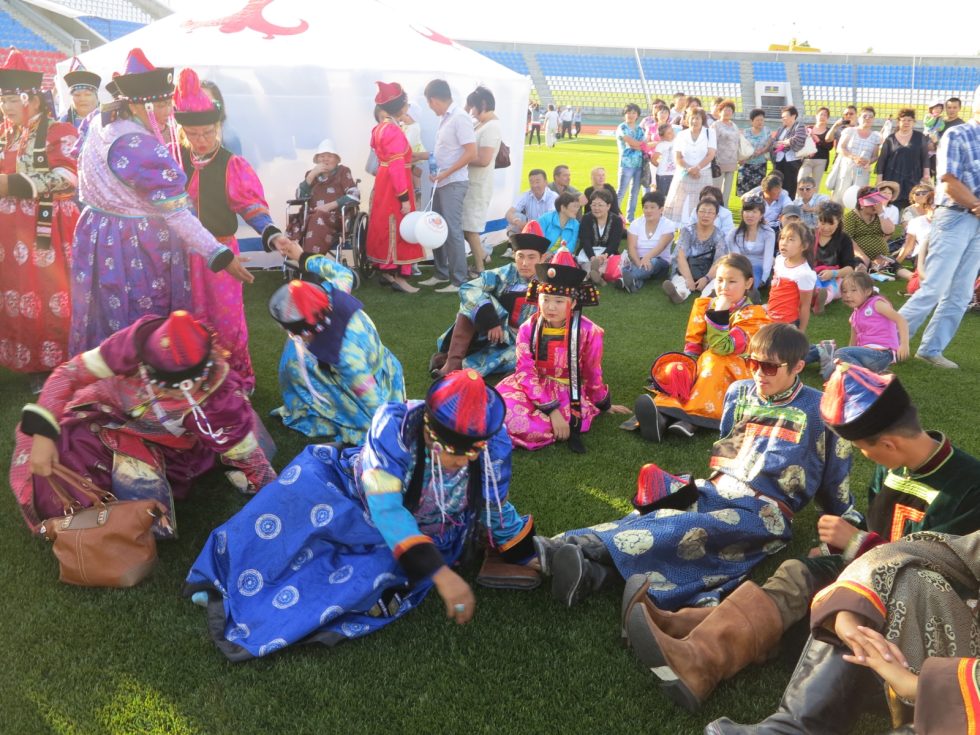
The regional and tribal diversity of Buryat folklore is presented as a source of richness within the national Buryat culture. From the stage, one repeatedly hears the message: “Let us not turn away from one another because we are different. Let us build something shared out of this diversity”. Representatives of all generations appear on stage, and young – even very young – performers sing ancient songs. At the end of the second day of the 2013 festival, the host announced “Now we are about to witness the largest yokhor in the world”, while a song encouraged everyone to dance together “on this land”. A great commotion rose across the stadium. A Buryat doctoral student commented that “They want everyone to come and understand that we are one nation, one life. The idea is to unite in this yokhor here and now”. He added that there was also an ambition to surpass the Yakuts’ Guinness World Record for the largest ohuokhai dance. Indeed, successive circles begin to form, eventually filling the entire stadium. The collective dance was spontaneous, vibrant, and enthusiastic, and the atmosphere was one of unrestrained joy.
Nation-Building
In the construction of ethnic self-identification, Buryat identity comes to the fore. The development of a shared pan-Buryat identity – of community and even unity – is strongly supported by the policies and activities of the intellectual elites of ethnic Buryatia. On the first day of the festival in 2012, more than a thousand people gathered in the stadium at the height of the celebrations. In 2013, attendance rose to around five thousand at peak moments, particularly on the second day, when renowned song and dance performers drew larger crowds.
The second day of the Night of the Yokhor in 2013 was even more ceremonial. A powerful tendency emerged toward seeking a broader pan-Mongol cultural and symbolic community – toward identifying what unites various Mongolic-speaking peoples. The ethnic composition of participants was strikingly homogeneous in both 2012 and 2013: non-Buryats were rarely seen and seemed more like foreign tourists than local Russians. In 2013, they constituted less than 10 percent of festival participants, including journalists – both local and international – and
a small number of foreign visitors. Among the Buryat participants, all generations were represented, with the notable exception of the oldest.
In 2012, traditional dress was worn more often by adults than by young people. A year later, however, traditional costumes were predominantly worn by the younger generation, which clearly formed the majority of participants. In essence, what defines tradition is not the chronological age of a cultural element, but the conscious choice to preserve it and the fascination it inspires.
The idea of using the collective circle dance as a means of shaping national identity can also be found among other small peoples or ethnic groups of Siberia. The similarity of the yokhor to the Yakut osuokhai and the Dolgan heiro is particularly noteworthy. The manner in which this dance is performed and its embedding in broader conceptions of social life serve, in effect, to integrate the small peoples of Siberia – bringing together, for example, the culturally distant, archaic, shamanistic Western Buryats of the Baikal region and the Lamaist Eastern Buryats into a single nation.

Today, there is a broad consensus regarding the role of the circle dance. Researchers regard it as an activity that fosters the maintenance not only of clan-based community but, even more importantly, of ethnic or national – specifically Buryat – unity. Collective dancing, which involves close physical proximity – participants stand in a circle, hold hands, and perform the same movements with their legs, interlocked arms, and entire bodies – creates a sense of togetherness and, ultimately, solidarity.
Professor Ewa Nowicka-Rusek is a cultural anthropologist, lecturer at Collegium Civitas, and author of, among others, the textbook Świat człowieka – Świat kultury (Warsaw, 2006). She has conducted field research in Europe, Siberia, Mongolia, and China, and has also studied the Polish community of the Siberian village of Vershina.
Translated by Sylwia Szarejko