

September or August?
If one speaks of the outbreak of the Second World War, generally September 1939 comes to mind. Particular focus is placed on 1 and 17 September —dates signifying the German and Soviet aggression against Poland. Yet nobody can be certain how events would have unfolded had it not been for events that took place in Moscow during the night of 23–24 August 1939. It was at that time that key decisions were made, decisions whose direct consequence was the two invasions of the Republic of Poland. Therefore it would not be erroneous to state that, in reality, the war actually began in August…
From Hatred to Friendship
The interwar period was a time of constant shifting in relations between Moscow and Berlin. Until 1917, Russia and Germany had stood on opposite sides of the barricade in the First World War. Their mutual hostility was therefore natural and would endure for a number of years more. With the signing of the Treaty of Rapallo in 1922, a new chapter was ushered in. It led to a strengthening of relations and heralded far-reaching cooperation in the months that followed, which related also to military collaboration. This friendship survived until 1933, when Adolf Hitler — a fervent enemy of communism — ascended to power in Germany. Hence forth, the Soviets and Germans stood as the greatest ideological and political adversaries in Europe, indeed in the whole world. Even so, Stalin’s and Hitler’s territorial ambitions ultimately forced the resumption of cooperation along the Berlin–Moscow axis. One of the key motivating factors for both sides being their shared hatred of Poland.
The Brown–Red Embrace
In March 1939, Joseph Stalin delivered the so-called “Chestnut Speech,” in which he openly declared the Soviet Union’s willingness to cooperate with any country in the world. This was a clear signal in Germany’s direction. From that moment on, diplomatic efforts on both sides concentrated on bridging the divide between the two estranged countries. It did not escape Europe’s attention that a potential alliance between them would pose a mortal danger. The British and French viewed the Soviets as the only credible political and military force with the resources to halt German expansionism. Therefore they entered into talks with Moscow. However, the Allies were not in a position to offer Stalin what he desired most of all: a westward shift of the Soviet borders. Standing in his way here were, above all, Poland and Romania. Hence the why the Soviets were far more inclined towards cooperation with the Third Reich. The first visible sign of this rapprochement came with the signing of the Soviet-German trade agreement on 19 August 1939. For further developments, the wait would not be a long one…
“Zdravstvuyte (hello), Herr Ribbentrop!”
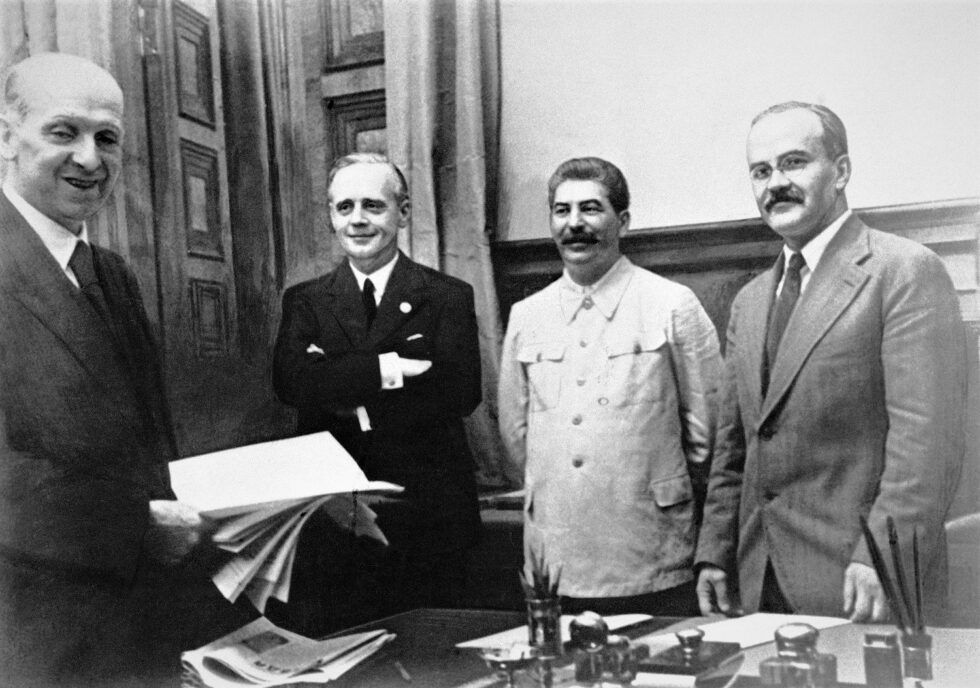
On 23 August, onboard an aircraft that landed at a Moscow airport was the German Foreign Minister, Joachim von Ribbentrop. In his honour — and to highlight the supposedly healthy German–Soviet relations — the airport was decorated out with Third Reich flags. The problem, however, was that such flags were nowhere to be found in Moscow, due to the previously hostile nature of relations with Berlin. Eventually they were located in a theatre, but due to having been used as props in propaganda plays, the swastikas on them… were apparently upside down.
That did not however appear to deter either side from their actions. Ribbentrop was taken to the Kremlin, where he was to meet with Joseph Stalin and Vyacheslav Molotov, the People’s Commissar for Foreign Affairs of the Soviet Union. Although the talks lasted the entire evening, they delivered the desired results. In the late night hours, with clocks in Moscow showing it was already well past midnight, Ribbentrop and Molotov — acting on behalf of Hitler and Stalin — added their signatures to the German–Soviet Non-Aggression Pact.
Shock? That’s an understatement
At that moment, it was clear that a historic breakthrough had occurred. Two states previously filled with hatred for each other, had managed to shake hands. Europe and the wider world were both shocked and terrified. However, it was not the non-aggression pact per se that was the source of the growing unease, but the secret protocol attached to it, in which Germany and the Soviet Union had agreed upon the division Poland and Eastern Europe into two spheres of influence:
- The Republic of Poland was to be partitioned along the Narew–Vistula–San line,
- Latvia, Estonia, and Finland were to fall into Soviet hands, while Lithuania was left to Germany,
- The Soviets expressed their interest in Romanian Bessarabia, with the German side declaring complete désintéressement with regard to this issue.
In this situation, war was only a matter of time. The initial date for the German invasion was set for 26 August 1939, but it was eventually postponed to 1 September.
But was it really “secret”?
The secret protocol to the Ribbentrop–Molotov Pact was “secret” only in name. In the hours and days that followed, the American, French, and British authorities came to learn of its existence. None of them however, passed on this information to the Polish side, believing that — being in a state of unawareness regarding the inevitability of the defeat hanging over them — the Poles would resist the Germans all the more fiercely. The details of the protocol were also known to Italy, Estonia, and Latvia. Information of this nature did in fact reach Poland on the eve of the war, but press reports of the time bore little resemblance to reality. On 30 August 1939, Kurier Poznański reported on 13 secret points of the German–Soviet pact, pertaining to colonial issues, the Far East, and “external-political and foreign matters.” Meanwhile, the following day’s Kurier Białostocki published an article in which it was stated that “the drawing up of a non-aggression pact between Germany and the U.S.S.R. is, in essence, a matter of indifference where Polish policy is concerned. After all, we too are signatories of a non-aggression pact with Russia, and for certain reasons Russia’s strict neutrality only serves to strengthen Poland’s position in the international arena.”
Polish society was essentially in the dark when it came to what would truly unfold in the coming days and weeks..